


.
This article is part of a series — At 250, Who Will America Be? — reporting on threats to American democracy as we approach the nation’s Semiquincentennial, on July 4, 2026.
∼ ∼ ∼
For decades following the mass firing of thousands of union air-traffic controllers by President Reagan, in the early 1980s, the American labor movement found itself in a near-death spiral that was greatly accelerated by internal union corruption. As a consequence, American workers saw their collective bargaining power diminished — or, as Donald Devine, Reagan’s head of personnel management, put it, “Businessmen would come up to me and say, ‘You know, when your guy, Reagan, stood firm with those guys, I started getting tougher with my unions, too; I realized I was giving away the store.’”
Then came dozens of prosecutions targeting the nation’s largest legacy unions. The United Auto Workers and the Teamsters were nailed for self-dealing that betrayed their rank and file on a breathtaking scale, even as management and Wall Street pressed their growing advantage thanks to Reagan’s direct attack on the union movement.
Historically, it was unions like the UAW, under the leadership of Walter Reuther from 1946 to 1970, that made the connection between their support of the Rev. Dr. Martin Luther King Jr.’s work on social justice and the broader labor movement agenda. Similarly, when the nation’s power structure continued to support the war in Vietnam, it was unions such as the UAW, the News Guild, and the Transportation Workers Union that backed the anti-war Senator George McGovern over President Richard Nixon.
Union density, which is widely credited with creating the largest middle class in world history, declined from about one in three households, in the 1950s, to slightly over 10% today. When the percentage of unionized public sector workers is removed from that calculation, just 6% of the private sector workforce is unionized today, down from 17% in 1983.
It was a squeeze play that decimated the American worker: The elected power structure stood by and collected millions in contributions from labor and corporations simultaneously. And as it turned out, a diminished labor movement not only meant lower wages, it also helped derail the broader social progress unions had long championed — as we’ve seen most recently with the Dodd decision’s wholesale rollback of reproductive rights.
It should come as no surprise that, at the same time, corporations successfully shifted their tax burden onto individuals.
AN EPIC WEALTH TRANSFER
According to a RAND Corporation analysis, over the past several decades the nation’s top 1% was able to extract almost $50 trillion in wealth from the bottom 90% of the nation’s households. Today, Fortune reports, the average CEO with a publicly traded corporation makes 272 times the median salary of their employees, meaning it would take five lifetimes to make what the boss makes in a single year.
Just this past Labor Day, Senator Bernie Sanders (I-VT) observed that the loss of labor’s leverage over capital had had profound consequences for the nation: “despite huge increases in worker productivity and an explosion in technology, the average American worker is making over $45 a week less today than he or she did 50 years ago after adjusting for inflation.”
Sanders, who chairs the Senate Committee on Health, Education, Labor, and Pensions, estimates that 60% of Americans struggle — often with two incomes in a household — to make ends meet, because their wages have failed to keep up with the cost of living. “Tens of millions of Americans are struggling to put food on their table and pay their rent, while the wealthiest people in this country are doing better than they ever have in the history of America” with “more wealth inequality than at any time since the Gilded Age,” Sanders said in November at a recent Senate hearing entitled “Standing Up Against Corporate Greed: How Unions are Improving the Lives of Working Families.” That hearing featured UAW president Shawn Fain, general president of the International Brotherhood of Teamsters Sean O’Brien, and Sara Nelson, international president of the Association of Flight Attendants-CWA.
“To all the auto workers out there working without the benefits of a union, now it’s your turn,” Fain said in a union video pitching for auto workers to sign up for union representation. “The money is there. The time is right. You don’t have to worry about how you’re going to pay your rent or feed your family while the company makes billions. A better life is out there.”
While campaigning for president in 2019, Sanders noted, “The wealthiest three families now own more wealth than the bottom half of the country,” referring, according to the Poynter Institute’s fact-checkers, to “Bill Gates of Microsoft with $89 billion, Jeff Bezos of Amazon with $81.5 billion and Warren Buffett of Berkshire Hathaway with $78 billion. Their total wealth of $248.5 billion was higher than the wealth of the bottom 160 million Americans, at $245 billion.” Considering that Elon Musk is worth in the neighborhood of a quarter-trillion dollars these days, that list might have to be adjusted, but the concept of wildly uneven wealth distribution in the U.S. remains the same.
This year, in the aftermath of Covid, when thousands and thousands of essential workers died after workplace exposure to the disease, 450,000 union members were willing to resort to a strike, a 900% increase from just two years before. Automakers, actors, writers, nurses, and a long list of other workers were fed up enough that they walked off their jobs by the tens of thousands. Meanwhile, the National Labor Relations Board reported last year receiving over 2,500 applications for workplace union representation, a 53% increase over the previous year.
NURSES HIT THE BRICKS
Close to 80,000 union healthcare workers employed by Kaiser Permanente in several states won a 21% pay increase over four years following a three-day strike in October, the largest such action in U.S. history. The tentative deal includes restrictions on outsourcing and measures to promote staff retention, a key concern of the coalition of unions led by the Service Employees International Union (SEIU). “Millions of Americans are safer today because tens of thousands of dedicated healthcare workers fought for and won the critical resources they need and that patients need,” Caroline Lucas, executive director of the Coalition of Kaiser Permanente Unions, said in a statement. “This historic agreement will set a higher standard for the healthcare industry nationwide.”
The October 4 to October 7 strike by the Coalition of Kaiser Permanente Unions was organized by eight unions, including members of SEIU and the Office and Professional Employees International Union (OPIEU) in California, Colorado, Maryland, Oregon, Virginia, Washington, and Washington, D.C. Addressing problems of understaffing and increasing wages were key demands. Dave Regan, president of the SEIU-United Healthcare Workers West, which represents most of the workers covered by the tentative deal, said it set an important precedent because it will cover several states where Kaiser Permanente has facilities. “We’ve never achieved a contract settlement that had equivalent, annual pay increases for people no matter what part of the country they’re in,” Regan told Chief Healthcare Executive, an industry journal. “Given the pandemic, given the state of the economy and the inflation, this was something that was enormously important to us, and we’re really proud to report that we achieved unified, consistent pay raises.”
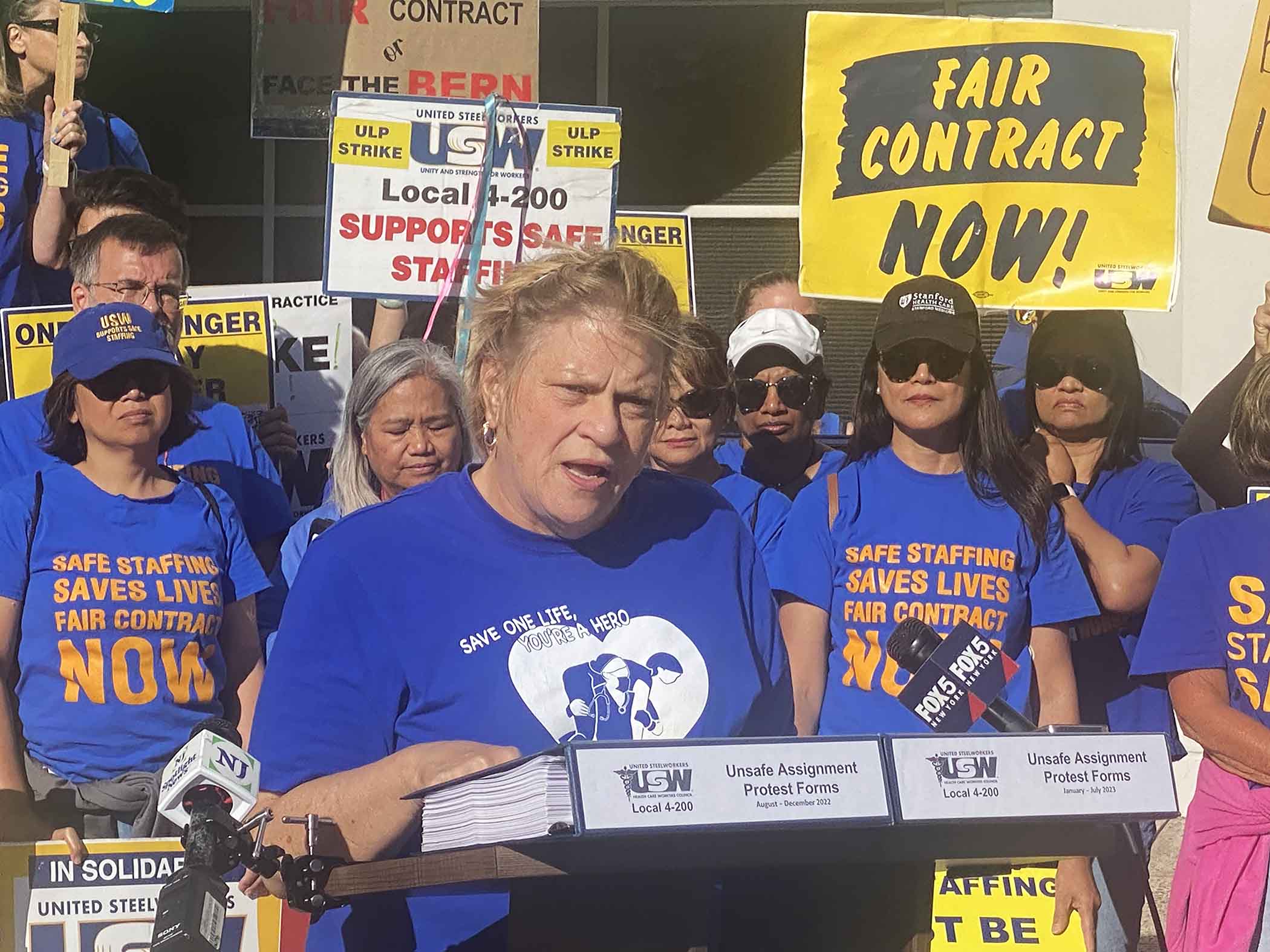
In New Jersey, 1,700 nurses with the United Steelworkers Nurses Local 4-200 went on strike in August for safer staffing at Robert Wood Johnson University Hospital, in New Brunswick, New Jersey. Over the past four months, the parent nonprofit, RWJ Barnabas Health, has spent well over $120 million dollars on busting the strike, bringing in strikebreaking nurses and spending a fortune on public relations in an effort to undermine the nurses’ credibility with the community.
Can grassroots engagement convince marginalized voters that they possess unrealized power when acting collectively in their own self-interest at the voting booth?
In December, the USW Nurses Local 4-200 prevailed, winning a contract ensuring that when management comes up short with staffing, there will be a monetary penalty in the form of premium pay for the nurses who are working. Management is also required to hire dozens of additional nurses.
Throughout the four-month ordeal, the union nurses linked safe staffing to better patient outcomes, a result that peer-reviewed research confirmed after California adopted a state law mandating patient-to-nurse ratios. Now, Local 4-200 will continue the fight in Trenton, with a broad coalition of other unions, all pressing for a healthcare system that puts people ahead of profits.
Labor, after years of being on the defensive, is on the march, with 67% of Americans supporting the movement in 2023, according to Gallup — a turnaround from the 59% of Americans who supported Reagan’s firing of air traffic controllers in 1981. As it turns out, acting in our collective interests is contagious, and success breeds success.
TEAMSTER AND UAW REBIRTHS LINKED
For years, largely below the media’s radar, grass-roots reform movements within the Teamsters and UAW worked to reclaim their unions. Those efforts culminated in the direct election by the rank and file of reformers: Sean O’Brien, in 2021, to lead the Teamsters, and Shawn Fain as UAW president, earlier this year. Fain’s election came only after the conviction of a long list of UAW officials, after a sprawling corruption probe netted over a dozen top union officials, including former UAW president Gary Jones.
According to the U.S. Department of Justice, Fiat Chrysler [FCA US LLC], then one of the Big Three automakers, spread $3.5 million around to get the UAW leadership to sell out the membership, from 2009 through 2016. “Instead of negotiating in good faith, FCA corrupted the collective bargaining process and the UAW members’ rights to fair representation,” the DOJ stated in a press release in 2021.

“I am running because I am sick of the complacency of our top leaders,” Fain announced during a candidates’ forum last year, blasting the UAW leadership for viewing “the [auto] companies as our partners rather than our adversaries” and for feathering their own nests with “wage increases, early retirement bonuses, and pensions,” even as the rank and file failed to be made whole after major concessions made during the Great Recession of the late 2000s.
Two years ago, O’Brien’s election as Teamster president was sparked by a rank and file revolt, after the prior union administration, under James Hoffa Jr., imposed a national UPS contract that the majority of members had rejected, using the technicality that less than two-thirds of the union had voted in the ratification election.
This year, leading into negotiations with UPS, the Teamsters deployed practice pickets — defined by the activist site Labor Notes as “a way to show the company, the public, and your co-workers that you are ready to stick together and win the contract you deserve” — across the country, while O’Brien and his negotiating team didn’t flinch, making clear to management that UPS’s 340,000 Teamsters would walk out as the deadline approached.
The union emerged with a landmark deal, giving all full- and part-time UPS Teamsters $2.75 more per hour in 2023 and a total $7.50 per hour increase over the length of the contract. Wage gains for part-time workers were double the amount achieved in previous UPS deals with current part-time workers, who will receive a 48% average total wage increase over the next five years. The wage increase schedule for full-timers “kept UPS Teamsters the highest paid delivery drivers in the nation, improving their average top rate to $49 per hour,” according to the union.
Ray Jensen is the assistant director of UAW Region 9, which includes New York, New Jersey, and Pennsylvania. He was hired on as an autoworker back in 1999 and is a second-generation member of the union. He believes the Teamsters and UAW rebirths are interconnected.
“There had been a movement in the Teamsters for quite a while called TDU — Teamsters for a Democratic Union — they basically laid down a blueprint for the UAWD [United All Workers for Democracy], which is a militant group of autoworkers — a group that backed Shawn Fain and all the candidates that ran on his slate and won,” Jensen said during an interview with this reporter on WBAI. “We just listened to the membership and they said they were tired of the concessions from company-friendly unionism, and you saw what happened. There’s been a revival, not only in the UAW, but for the entire labor movement in the country.”
THE GREAT RESTORATION
In the throes of the Great Recession of 2008, it was major UAW concessions and a multibillion-dollar taxpayer bailout that were credited with saving America’s Big Three automakers. When Jensen first started as an employee, 24 years ago, after just a 90-day probationary period, a worker was hired and could expect to get up to the top wage rate in three years.
“In the course of time and with all the corruption” the workforce was divided into different tiers with inferior pay scales, where it could take as long as eight years “to achieve full rate,” recalled Jensen in that interview. “You had tiers upon tiers and we’re all fighting amongst ourselves instead of fighting with the only true enemy we have, which is the company.” In the years since the government bailout and union concessions, the Big Three automakers reported record profits and eye-popping multimillion-dollar CEO pay packages.
“In the 1930s in the New Deal era, you saw a huge increase in voter registration and participation by working-class people, some of whom were brought to that through their activity with a union organizing strikes.”
“Workers got caught on the losing end of a ‘one-sided class war,’” Fain said recently, while testifying at a Senate hearing just a few weeks after his union won a seven-week strike that secured his members a landmark deal, ending the tier system and providing for major wage gains and benefit restorations.
“We won things in this contract that our industry hasn’t seen in 15 years or more,” Fain testified. “We won victories that will instantly — overnight — change the lives of thousands of families across this country. Over time, it will transform communities, adding thousands of jobs and massively boosting the purchasing power of working-class families. “
Fain continued: “Never in our history have we negotiated the reopening of a plant. That all changed with this contract. Belvidere Assembly, in Illinois, was written off for dead when they laid off the remaining 1,300 workers. We not only got the company to reopen the assembly plant, but we also negotiated for a new battery plant. Both of these plants will add thousands of jobs to save the Belvidere community. That’s what a union can achieve.”
Even before UAW members ratified the contract, non-union automakers Toyota and Honda moved to match some of the wage gains secured by the union for their members.

In November, Fain announced an ambitious union-organizing drive aimed at the 150,000 workers employed by the 13 non-union automakers. “To all the auto workers out there working without the benefits of a union, now it’s your turn,” Fain said in a union video pitching for auto workers to sign up for union representation. “The money is there. The time is right. You don’t have to worry about how you’re going to pay your rent or feed your family while the company makes billions. A better life is out there.”
Ironically, the UAW had gone into the latest negotiations pushing for a four-day workweek, something the air traffic controllers, before they were fired by Reagan, had proposed. Meanwhile, Italian automaker Lamborghini and its unions reached a landmark deal that establishes a four-day workweek that will permit workers to “work less and work better.”
FORWARD MOTION
On December 1, the UAW announced that it was joining a growing number of labor organizations in calling for a ceasefire in Israel and Palestine. The same day, 1199 SEIU, the nation’s largest healthcare union, with 450,000 members, issued a similar call for a ceasefire.
“From opposing fascism in WWII to mobilizing against apartheid South Africa and the CONTRA war, the UAW has consistently stood for justice across the globe,” Region 9A director Brandon Mancilla stated. “That is why I am proud that the UAW International is today officially calling for a ceasefire in Israel and Palestine.”
In addition, UAW’s executive board voted “to form a Divestment and Just Transition working group to study the history of Israel and Palestine, the union’s economic ties to the conflict, and to explore how to achieve a just transition for US workers from war to peace,” according to the union statement.
A TEMPLATE FOR THE NATION?
Could the UAW and Teamsters revivals, along with the nurses’ new militancy, offer a model for how to reclaim democracy nationally? Can grassroots engagement convince marginalized voters that they possess unrealized power when acting collectively in their own self-interest at the voting booth?
Noted labor historian Joshua Freeman, a professor emeritus at Queens College at the City University of New York, thinks it might. He tells the Voice he believes the scale of the Teamsters and UAW revivals might offer a template for a broader democratic revival of the country through grassroots engagement: “We don’t have that many massive organizations that have complicated democratic systems. Unions are an example of that. Most of our churches don’t run that way. Boy Scouts don’t run that way. [Unions] are an arena in which people develop ideas and skills that are relevant in an electoral democracy too. And of course we have the history of people who got active in the labor movement going to work in the electoral arena. So, there could be some spillover. It can only be positive. It can’t be negative.”
Freeman believes that an upsurge in labor organizing can translate into a broader voter mobilization, as was seen recently in Ohio when the Ohio State AFL-CIO played a leading role in helping pro-choice forces win ballot questions on reproductive freedom.
“There’s a long history of that. You saw that in the 1930s in the New Deal era, where you saw a huge increase in voter registration and participation by working-class people, some of whom were brought to that through their activity with a union organizing strikes,” Freeman explains. “In general, you can create a new atmosphere — a democratic atmosphere — where you can have a new sense of some control over your life. That is certainly something that has happened in the past, and can be happening again.”
In the U.S. there are 85 million low-wage and low-wealth potential voters, roughly one-third of the electorate. And the reality, according to a report by Columbia University researcher Robert Paul Hartley, is that most struggling households are not even participating in our democracy. Hartley found that only 46% of voters with household incomes less than twice the federal poverty rate cast a ballot in 2016, as compared to a 68% turnout rate for voters who had a household income more than twice the poverty line.
In 1962, Martin Luther King spoke to the National Maritime Union about civil rights issues in the South, a speech that eerily echoes our national circumstance 23 years into the 21st century: “Our nation is facing severe trials in these turbulent days because one region of our country still holds itself above law, as if it were cut adrift from constitutional obligations, and insurrection and mutiny against the government is still possible. They not only abuse persons, but they debase the democratic traditions of the nation in their defiant resort to anarchy and storm troop rule.”
And then King offered a crucial insight: “Against this force, which has the power of states at its command, Negroes have searched for effective weapons. We believe we have found them. Emulating the labor movement, we in the South have embraced mass actions — boycotts, sit-ins and, more recently, a widespread utilization of the ballot,” adding, “The secret ballot is our secret weapon.” ❖
Bob Hennelly is an award-winning print and broadcast journalist who covers labor and politics for Salon, Work-Bites, City & State, and InsiderNJ. He hosts the Stuck Nation Radio Labor Hour on Pacifica’s WBAI, 99.5 FM, and is the New York City Hall reporter for WBGO, 88.3 FM, NPR’s jazz station, in Newark, New Jersey.