






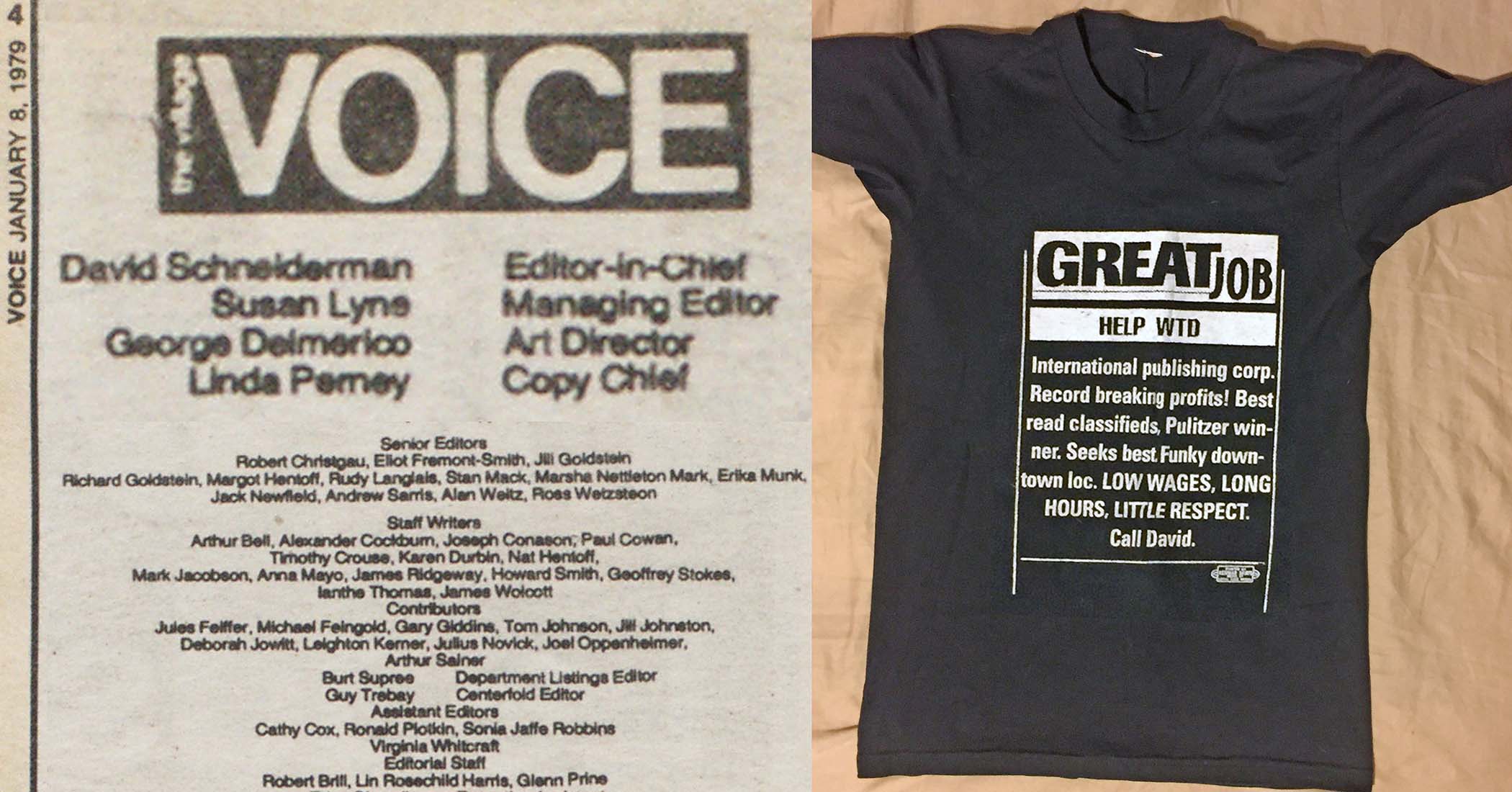
The first time David Schneiderman appeared as “Editor-in-Chief” on a Village Voice masthead was in the January 8, 1979 issue. In the next issue, a massive investigative piece by Wayne Barrett on a 30-something real estate developer named Donald Trump was featured on the front page. According to Tricia Romano’s fabulously informative oral history of the Voice, The Freaks Came Out to Write, Schneiderman had to turn the piece around in a hurry:
When I got to the Voice, my very first day, [reporter Jack] Newfield says to me, “There’s this guy, Wayne Barrett, you got to meet. He’s a freelance reporter. He’s really good. He’s got a big article on Donald Trump.” … Parts of it were pretty dense. But it went into all of Trump’s deals. This is a guy who would use tax breaks and other government things to build stuff and make a lot of money off of the taxpayer. He was screwing New York. Sounds familiar, right?
Not a bad curtain-raiser. Schneiderman later hired Barrett as a staff writer, and if David’s editorial instincts were generally on the nose, he was also, in later years as publisher, a fair dealer in how he treated the Voice’s always cantankerous staff.
I know this because I faced off with Schneiderman during contract negotiations throughout the 1990s and 2000s. Fortunately, David had already been softened up by the principled tenacity of such shop stewards as classified ad taker turned fashion writer Lynn Yaeger and arts editor/food writer Jeff Weinstein. One year that duo was instrumental in getting management (and some reluctant union members) to agree to a reverse percentage raise, i.e., the lower-paid workers got a bigger boost in their paychecks than the better-compensated marquee name writers and editors; another year, the pair spearheaded the fight for a clause that would lead to family-style insurance for “spousal equivalents,” so that gay members of the staff could cover their partners. This was a first in a major labor contract. Schneiderman took it in stride, telling Romano years later, “That’s why we called [Lynn] Norma Rae because she would sit across the table from us during negotiation and shoot daggers through her eyes at the management.”
One off-the-books negotiation with Schneiderman concerned letting Voice employees clean their own offices when the workers of the outside housekeeping staff went on strike. We didn’t want any scabs in the building, so two other Voice union reps accompanied me to David’s office. He agreed that if we would make sure the trash was taken out and the place didn’t get too ramshackle, he would be fine with our doing our own cleaning. I had brought along a garbage bag and took care of David’s trash that evening, to which I remember him saying, “Baker, you’ve found your calling.” The offices at 36 Cooper Square did start getting a bit disheveled, with some employees not as diligent about emptying their trash as others, but the strike was settled long before the cubicles reached the SOP rattiness of the old offices at 842 Broadway.
This was just another example of Schneiderman’s general equanimity, and since he’d been hired away from The New York Times by Rupert Murdoch (who bought the Voice in 1977), he needed it — coming from the Gray Lady, Schneiderman was suspect in the unruly precincts below 14th Street. But he understood how to maintain a wall between the business and editorial realms, and in the Voice’s 2005 50th-anniversary issue he told reporter Jarrett Murphy, “I think everyone looked at Rupert Murdoch as Russia, and we were Poland, and the question was when would he invade.” Schneiderman proved adept at fending off Murdoch, who once demanded that David fire a reporter who kept reporting on Murdoch’s perfidies. Schneiderman refused, and the press baron eventually gave up and sold the paper in 1985 for a handsome profit, having earlier told Schneiderman that he “could not understand how a bunch of communists could manage a paper so well.” Schneiderman stayed on under the new owner and, listed on the masthead variously as Publisher, President, or CEO, guided the paper through some of its best years, including winning two Pulitzer Prizes, one in 1996 for Jules Feiffer’s political cartooning and another in 2000 for Mark Schoofs’ coverage of AIDS in Africa. Earlier, as Editor-in-Chief, he had already overseen the Pulitzer that Teresa Carpenter garnered in 1981 for her wrenching feature about Dorothy Stratten, “Death of a Playmate.”
Over seven decades, many a mensch has passed through the Voice’s portals. David is a solid part of that pantheon. ❖
David Schneiderman
April 14, 1947 – January 17, 2025