






∼ ∼ ∼ This article is part of a series—At 250, Who Will America Be?—reporting on threats to American democracy as we approach the nation’s Semiquincentennial, on July 4, 2026. ∼ ∼ ∼
A day after the recent presidential election, in an effort coordinated across at least 30 states, racist texts began popping up on phones belonging to people of color. The anonymous messages, many of them sent to students in middle school, high school, and college (and in some instances, using their names), told the recipients that they’d been “selected to pick cotton at the nearest plantation” and that “our executive slave catchers will pick you up in a brown van” on a specified date. Other messages, targeting LGBTQ individuals, made similar summons to “re-education camps.”
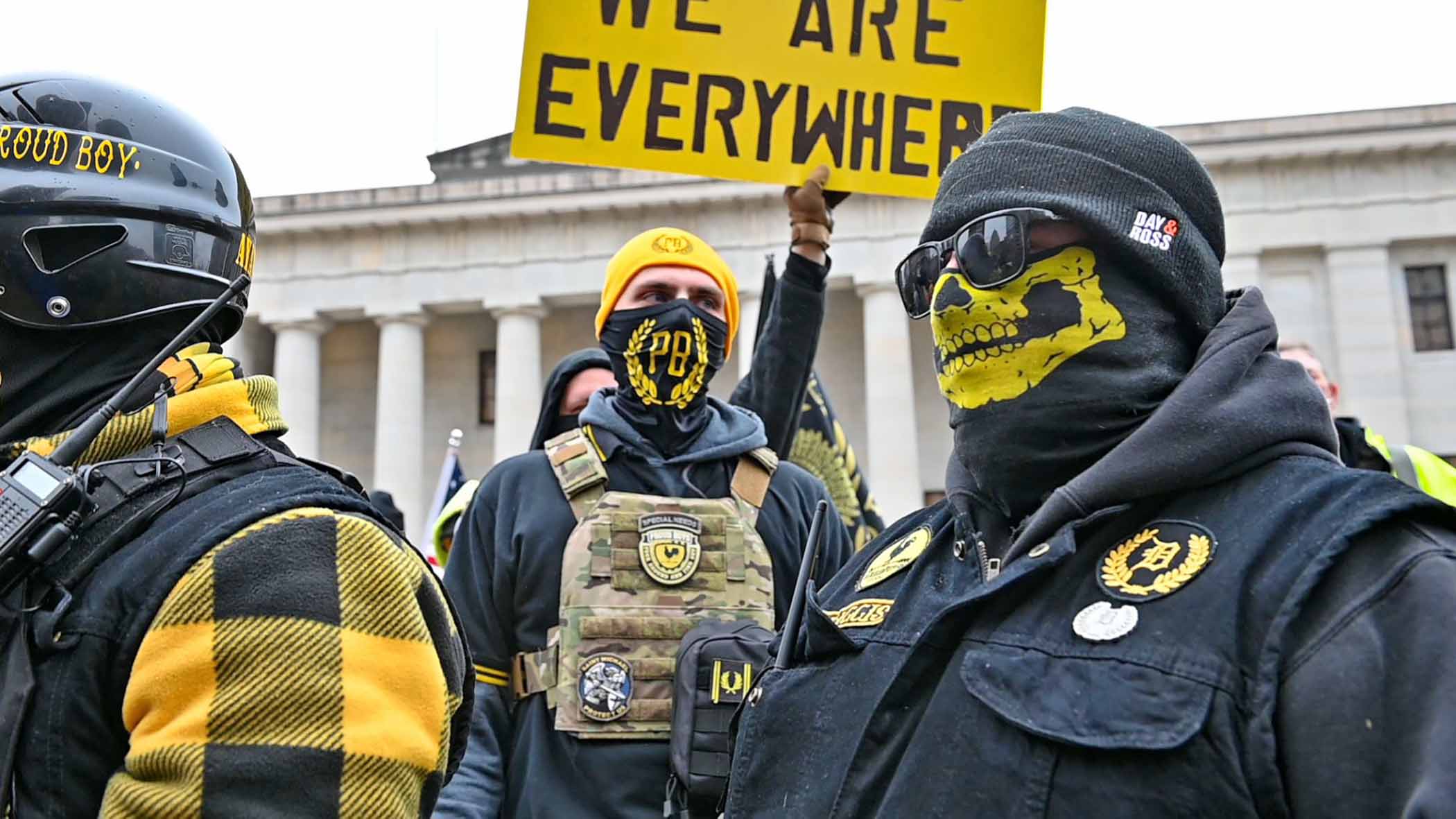
Around the same time, other extremists took to the streets. In Howell, Michigan — a small city that’s seen its fair share of racist incidents over the years — a group waving Nazi flags that included a swastika-centered Stars and Stripes demonstrated outside a performance of “The Diary of Anne Frank,” shouting “Heil Hitler, Heil Trump!” Residents of Waterloo, Iowa, discovered flyers on their lawns that bore a mimicked insignia of the Waffen-SS, the “Totenkopf,” and encouraged them to join the Aryan Freedom Network. In Columbus, Ohio, a group of armed men calling themselves the Hate Club marched through a high-visibility area of cafes and galleries wearing skull masks and waving flags emblazoned with red swastikas, chanting “America! For the White Man!”
Many who encountered these acts were rightly shocked and frightened, but no one should have been surprised that Trump’s victory re-energized the extremists of white Christian nationalism: The president-elect’s campaign’s encouragement of such racist dogma was pretty much nonstop. Trump continually bragged about his plans for clearing out immigrants (“On day one, I will launch the largest deportation program in American history”), conjuring images of German boxcars. He repeated his fantasy that the border crossings were “an invasion,” declaring, at one rally, “We will not be occupied, we will not be conquered.”
And Trump tossed out his tastiest Nazi treat when, in an interview, he talked about immigrants “poisoning the blood of our country,” an idea lifted right out of Mein Kampf. Hitler used the phrase “poisons the blood,” or something close to it (depending on the translation), several times. In the 1939 English edition, translated by James Murphy, you’ll find this: “whenever Aryans have mingled their blood with that of an inferior race the result has been the downfall of the people who were the standard-bearers of a higher culture,” leading to “[The Jew] poisons the blood of others but preserves his own blood unadulterated.”
These beliefs are not relegated to the fringe. Maybe more dangerous in the long run is the mainstreaming of white nationalism into the hallowed halls of democracy.
Denounced for making the reference by various commentators, including former New Jersey governor Chris Christie, writer Jason Stanley (How Fascism Works) and the Washington Post’s Aaron Blake, Trump denied ever having read Mein Kampf (his usual strategy of phony ignorance when confronted with an unsavory association), then repeated the phrase several more times at other events, like a crazed Dr. Strangelove unable to prevent his right arm from jerking up into a Hitler salute.
The potential involvement of extremists in the Trump administration’s domestic plans should be ringing alarm bells at this point. Fascist regimes, particularly in their early stages, often encourage brutal paramilitary gangs to intimidate opponents or to carry out acts of institutionalized hate by proxy. Under Trump, real possibilities could include extremist assistance with immigrant round-ups, with battling protesters, or even with the vengeance Trump has vowed to take against his critics, notably Liz Cheney and Jack Smith. Recall that the brutal attack on Nancy Pelosi’s husband, intended for Pelosi herself, was made by a man, David DePape, who believed in the conspiracies (particularly, the “stolen election”) embraced by far-right extremists.
No group in the U.S. has yet assumed the power of history’s two most infamous goon organizations — Hitler’s Brownshirts (the Sturmabteilung) and Mussolini’s Blackshirts (the Squadristi) — but, according to the Southern Poverty Law Center (SPLC), “In 2023, there were 165 active white nationalist groups across the United States — the highest number the SPLC has ever recorded.”
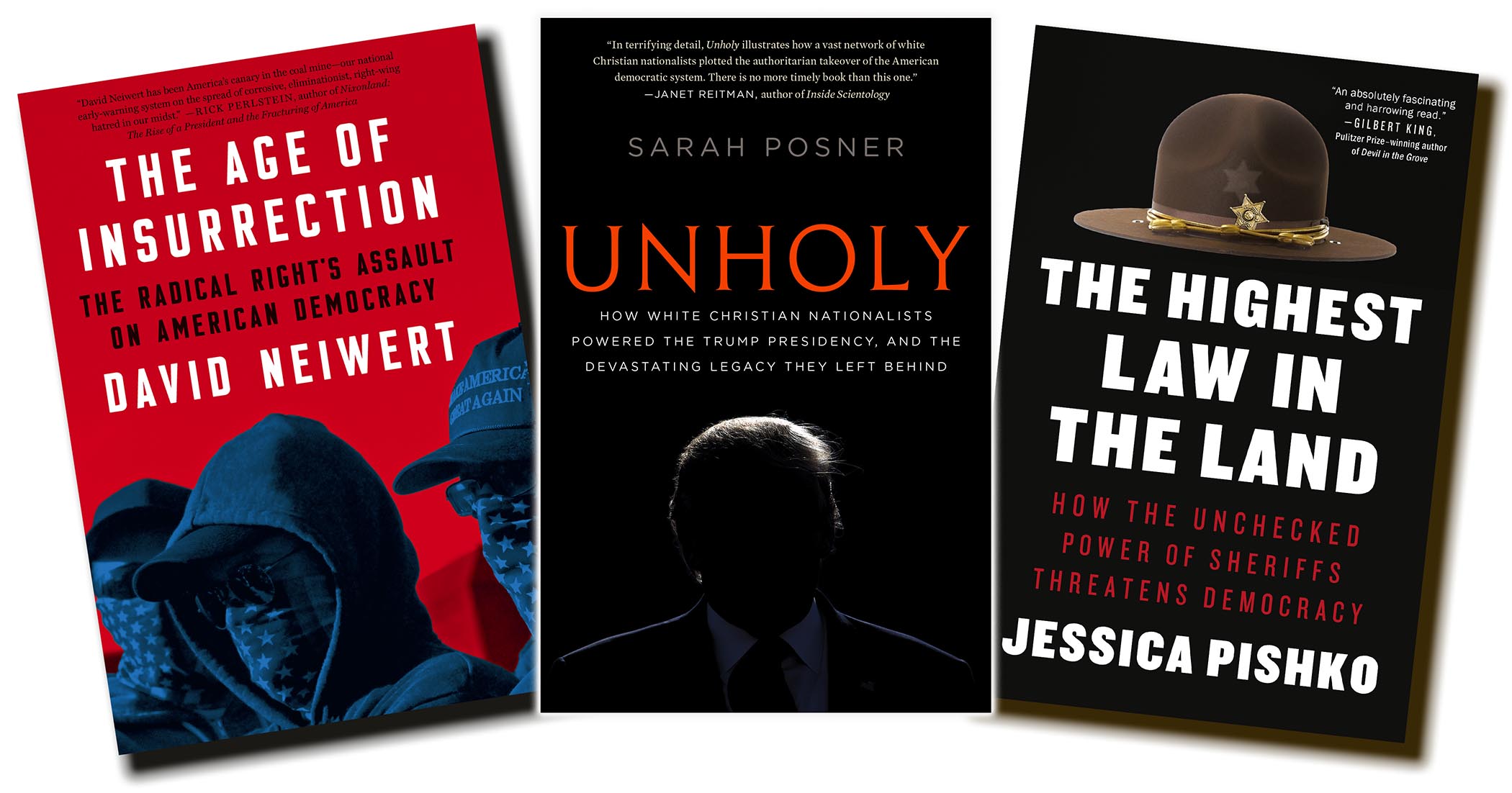
In The Age of Insurrection: The Radical Right’s Assault on American Democracy, David Neiwert (a former correspondent for the SPLC) offers a dire prediction: “Rather than breaking the fever of right-wing extremism, January 6 became a starting point for a new age in American politics: an age in which insurrection is celebrated, seditionists are defended as ‘patriots,’ and the politics of menace and violence are woven into our everyday discourse and interactions.” In his book, Neiwert investigates recent acts of far-right extremism — some associated with the anti-government “Patriot” movement but most with white nationalism — to explain the delusional but fully embraced conspiracy theories that lie beneath the fanaticism.
On May 14, 2022, for example, 18-year-old Payton Gendron was responding to warnings about “replacement theory” (according to his manifesto) when he used an assault rifle to murder 10 people in Buffalo, 8 of whom were Black. This theory — based on the books of a French anti-multiculturalist intellectual who lives in a castle (Renaud Camus, no relation to Albert the humanist) — claims that Western society, as Neiwert writes, “is being flooded with brown-skinned minorities as part of a long-running plot to replace white people — a plot overseen by Jewish ‘globalists.’”
The solution to this plot, the extremists believe, is “accelerationism” — another idea that originated in French philosophy (see Gilles Deleuze and Félix Guattari) and one that advocates, in the American right-wing version, the destruction of liberal democracy through acts of violence.
Neiwert covers the development of these notions, and others, through the first Trump term and across various groups — such as the Proud Boys, Boogaloo Bois, the Oath Keepers, and the 1st Amendment Praetorian — and demonstrates how it all culminated, with perverse logic, in the deadly January 6 attack on the Capitol, a frenzied communion of conspiracy-based ideologies and vicious urges.
“The majority of white evangelicals are all in with Trump.”
But these beliefs are not relegated to the fringe. Maybe more dangerous in the long run is the mainstreaming of white nationalism into the hallowed halls of democracy, and into the wider zeitgeist. Neiwert reminds us that “this kind of radicalization has been openly encouraged by Republican officeholders including Congress members like Arizona’s Paul Gosar and Georgia’s Marjorie Taylor Greene, and a broad array of right-wing pundits.…” Confirming the effectiveness of that message, the results of a 2022 SPLC poll of 1,500 Americans, Neiwert notes, “were disturbing: nearly 70 percent of Republicans believed in the Great Replacement theory.…”
The extremism of the Republican party might be a more recent phenomenon, enabled by a leader who constantly promotes himself with vile sensationalistic lies, but the roots of GOP racism run deep, going back, as Sarah Posner sees it, to the New Right of the 1970s. Posner’s sharp and superbly researched book Unholy: How White Christian Nationalists Powered the Trump Presidency, and the Devastating Legacy They Left Behind, upends the origin story of evangelical rage, tracing it back not to the 1973 legalization of abortion by Roe v. Wade but to a 1971 federal court decision that prevented the IRS from granting tax exemptions to segregated private schools. Evangelical leaders saw the policy as an attack on Christian schools in the South — another attempt to disrupt their comfortable all-white status quo. Their opposition, infused with continuing anger over court-ordered busing for public schools, became (Posner writes) “fevered and apocalyptic.” Champions of segregation soon started “demonizing the government’s supposedly heavy hand and, in the process, creating an enduring movement centered on the shibboleth that the federal government is the enemy of Christians’ religious freedom.…”
That theme was echoed by the white supremacist columnist Sam Francis — “the intellectual godfather of the alt-right,” as Posner calls him — in a 1982 polemic in the essay collection The New Right Papers, in which Francis emphasizes the New Right’s message of “perceived injustices, unrelieved exploitation by anonymous powers that be, a threatened future, and an insulted past.” Posner notes that the essay collection “reads like a chilling prototype for the Trump campaign … including a commendation for a nationalistic, strongman presidency to override the courts, Congress, the media, and the globalist elites.”
Thus, the “apparently improbable union between proponents of ‘faith, values, and family’ and the profoundly impious real estate huckster and serial philanderer,” as Posner describes Trump, has become a resounding success. “The majority of white evangelicals are all in with Trump,” Posner concludes, “because he has given them political power and allowed them to carry out a Christian supremacist agenda, inextricably intertwined with his administration’s white nationalist agenda.”
Another significant factor in all of this — one that exists largely under the radar — gets explored in Jessica Pishko’s important new book of first-rate reporting, The Highest Law in the Land: How the Unchecked Power of Sheriffs Threatens Democracy. The county sheriff, Pishko shows us, often embodies the lawman stereotype of Hollywood Westerns: the heroic white male steadfastly serving in the elected position for many years (sometimes decades), and holding wide-ranging independent authority over the region in matters of crime, immigration, and “keeping the peace.” And it’s a position that’s often aligned with authoritarian and white-nationalist ideals. Pishko zeroes in on Richard Mack, a 72-year-old former sheriff “with cowboy boots and an affable smile … who has spent the last three decades organizing sheriffs to be key interpreters of the U.S. Constitution, able to use their king-like powers to advocate for far-right causes, including the centering of Christianity in public institutions, a loosening of firearms regulations, and a reduced role for federal law enforcement agencies.”
Mack’s movement, officially organized under the Constitutional Sheriffs and Peace Officers Association (CSPOA), has welcomed a loose alliance with far-right militias, particularly for the intimidation of activists and the apprehension of immigrants. A witness to a 2020 march in Nevada by members of Black Lives Matter, who’d been surrounded by an armed militia, told Pishko “the sheriff abandoned a small group of peaceful protesters to be swarmed, threatened, spat on, humiliated, and assaulted.”
Sheriffs have also been joining the Mack-approved Federation for American Immigration Reform (FAIR), an SPLC-designated hate group that organizes, among other activities, “border schools” for sheriffs and other law-enforcement officials. Pishko attended one such FAIR event in 2015, at “the home of an extremist border vigilante group called the Texas Border Volunteers,” who regularly used “military gear and night vision goggles to detain migrants.…”
Each of these books paints an alarming picture of white-nationalist entrenchment, but, read together, they demonstrate how the incoming Trump administration will have all the pieces ready, from top to bottom, for building the foundation of a white ethnostate: a president with a long history of racism; the fervent support of Republicans, particularly the religious right; extremist groups itching for a January 6-like signal; and a bunch of sheriffs willing to act as middle managers to mobilize armed posses.
“They’ll only succeed,” David Neiwert writes at the end of The Age of Insurrection, “if we close our eyes to the continuing threat and fail to be prepared. Because as far as they’re concerned, they are ‘at war.’ Only a fool would disbelieve them.” ❖
In the Voice’s previous incarnation, Robert Shuster wrote pieces on art, culture, and books. He is the author of the novel “To Zenzi.”