


Not since Miles Davis was captured giving Kenny G a soul-withering side-eye back in the ’80s has there been a takedown in the jazz world like the written uppercut that legendary jazz pianist Matthew Shipp delivered to André 3000 for the former OutKast rapper’s recently released piano EP, entitled 7 Piano Sketches, last month.
“I think it is complete and utter crap — horrific-god awful insipidly wretched nothing,” he wrote on his public Facebook wall. “Oh my fucking god this is some atrocious shite — is he some type of fucking asshole? Is he a complete and utter dilettante? I could go into detail about why each cut is stillborn — but why bother — it does not even deserve the attention of a critique, it is so dreadful.”
The screed, which can be read in full here, went viral — receiving coverage in such esteemed online publications as Stereogum, Variety, Consequence of Sound, and even via the Internet’s busiest music nerd, Anthony Fantano, on his popular YouTube channel.
Without question, the post gave Shipp the kind of attention he’s never received before, in his nearly 40 years of making records — something he told music journalist Dan Weiss gives him hope that new fans will discover his vast catalog: “I’m getting loads of people checking out my Facebook page that are not fans of the type of music I do. I’m not gonna say they’re gonna end up buying my albums, but they seem to be kind of curious, like, ‘Who is this guy?’”
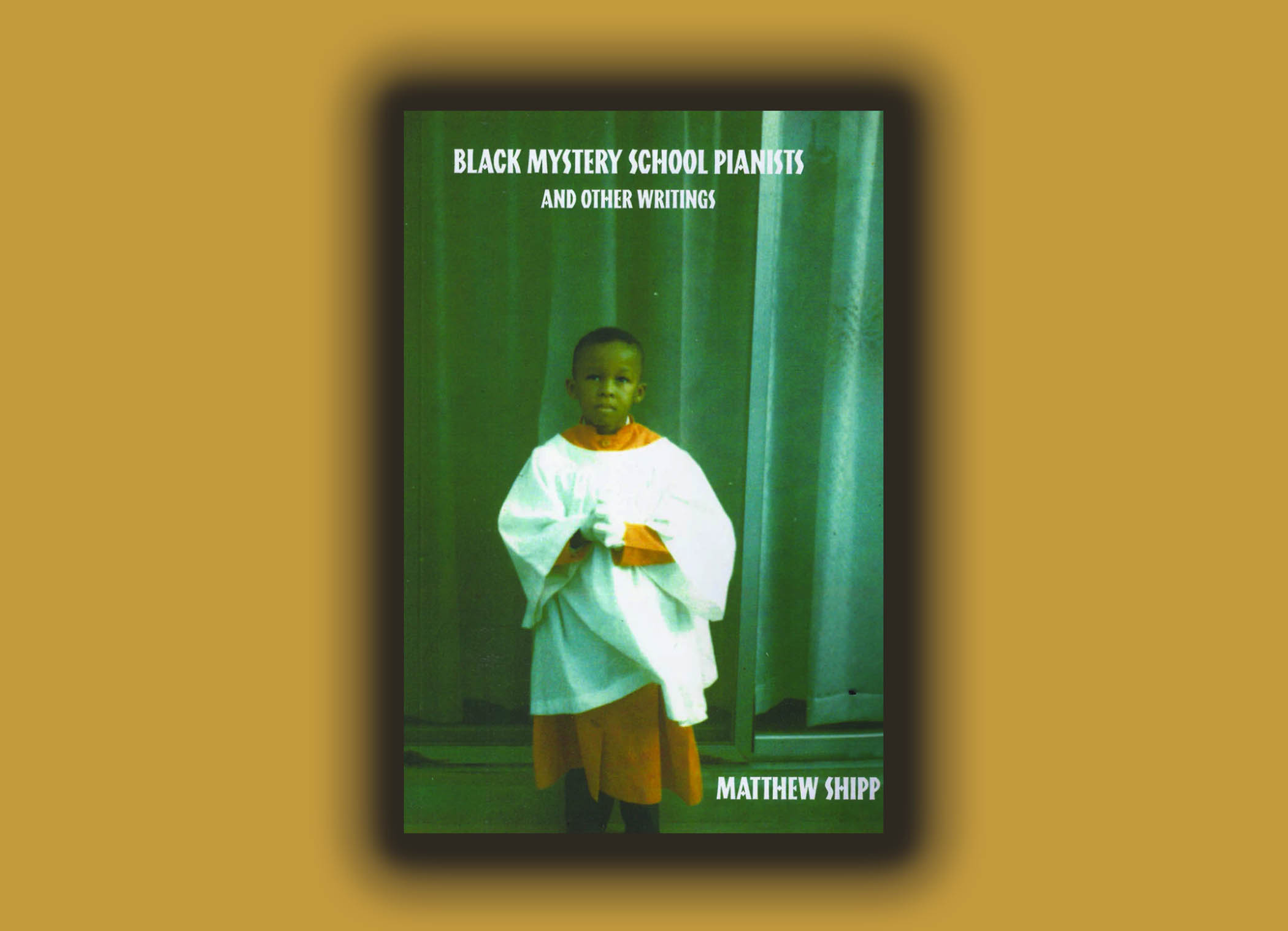
The free publicity couldn’t have come at a more opportune time for Shipp, who just released a book of personal writings called Black Mystery School Pianists. The ever-busy pianist, who turns 65 this year, also has an incredible new solo album, The Cosmic Piano, as well as a collaboration with longtime friend and collaborator saxophonist Ivo Perelman called Armageddon Flower, alongside Shipp’s acclaimed string trio, with violist Mat Maneri and bassist William Parker. The group just played the 2025 Vision Festival here in New York City, in early June.
“A lot of people, it doesn’t even matter if they understand what I do. I feel that they feel that whatever I am, it might be authentically mine and arrived at with integrity.”
Both LPs come out this Friday, June 20, coinciding with Shipp’s trip down to Houston, Texas, where he will be ringing in the summer solstice with an early morning performance in the city’s iconic Rothko Chapel, debuting a new composition titled “The Kinetic Process.”
The Voice caught up with Shipp on the eve of his Texas trip to get the lowdown on the André beef, his venturing to the Lone Star State in the current political climate, and his early days as a New York City club kid. (This interview has been edited for length and clarity.)
[Both The Cosmic Piano and Armageddon Flower will be out this Friday; Black Mystery School Pianists can be purchased now at AUM Fidelity.]
∞ ∞ ∞
Village Voice: I understand that Armageddon Flower will be your final album with Ivo Perelman. What led to that decision, and what was it about Ivo that made him such a successful collaborator for you?
Matthew Shipp: It might be the final studio CD in a group — there could be live CDs of the Armageddon Flower group — plus we have recorded a couple duos that might come out at some point, but we have done massive work together and all good things must come to an end at some point. The collaboration could still grow, but when the cosmos tells us to stop we will stop. We understand each other’s phrasing — we both stay away from post-Coltrane clichés and avant-garde clichés in general — and I think we both have a blend of feeling jazz impulses with the romantic aspects of classical music.
You just played at this year’s Vision Festival with the Armageddon Flower group. Are you noticing younger crowds?
Not at Vision Fest, but overall I think there are — for different reasons and different geographical areas — there’s always young people discovering the music. I mean, there’s always some inflection points where there’s more than others. Obviously, when we were recording for punk rock labels and Henry Rollins and those people were being really vocal in the ’90s, that was an inflection point. There was a real influx of younger people discovering things. And it’s hard to quantify to say there’s an influx of young people because it’s too discontinuous to really tell what’s going on. But there’s a little something happening now. I’m not sure exactly what it is.
It’s interesting to wonder how many younger people are exploring your catalog now because of the André 3000 mishegas.
Well, definitely a lot of them. My name’s in their heads [laughs]. What was really interesting to me is that I got a lot of messages from people who had never checked out my music, but just did when that happened. And they were hardcore jazz people that have been seeing my name for ages and they’ve never heard my music. But this got them to finally check me out [laughs]. Whether they followed through and checked out the music or not is another thing. But my name’s in their head and something could click at any time for them. It could be five, 10 years down the line.

What was your biggest takeaway from the moment?
My takeaway is that this society is ruled by the idea of celebrity and money, wealth, and therefore spectacle, because of that. I’m not saying that he played into that purposely or he’s a spectacle. Whatever I think is meaningless. But I know two things — that society is driven by fame, celebrity and wealth, and with the acquisition of that, a lot of things are allowed.
Now I also took away from it — because there was a lot of backlash against him that was pretty heavy if you actually read through all the message boards and all that. Very few people are happy he did it. Some are willing to allow him, because they are really into him, to explore it. So my other takeaway was that there’s a real thirst for authenticity out here. And I think living in a post-Kardashian universe, and the fact that Trump had name recognition to become president because he was on a reality TV show, I really sense an underlying hunger for authenticity. For instance, a lot of people, it doesn’t even matter if they understand what I do. I feel that they feel that whatever I am, it might be authentically mine and arrived at with integrity. I really feel that it’s out there, and I feel that’s why this cut through so much and was going so strong in how it’s been all over the place. I think it touched a nerve. I’m not saying he’s post-Kardashian. I’m just saying there’s lots of ways that what went down can be viewed, and it might have played into that. And it works partially for him because he is a hip hop star, which has this type of celebrity to it. And it also worked against him in some ways.
If what I’m saying is true, that there is a real taste for authenticity, and if what he did by some people was felt to be inauthentic, he’s saying he’s just trying something out. But the fact that he put it out as a commercial product with publicity and gone to the Met Gala with a piano on his back.…
“Last time I checked the Constitution, I have every right to hate Donald Trump.”
Reading your book Black Mystery School Pianists, my favorite chapter was the essay where you reminisce about your club days in the ’80s, going to the Pyramid and Danceteria and all these places. Were you a big fan of the music being played in such spots?
Oh yeah, I love New Order. I’m a big fan of synthpop. I’m a big fan of early hip hop. I’m a big fan of freestyle. I’m a big fan of ’80s dance music. Every time I hear certain freestyle songs, because I lived on Clinton and Delancey, which was a Puerto Rican neighborhood, I just really feel the whole flavor of the time in the neighborhood, and it really does elicit a real thing in you.
What I find most interesting about that chapter in the book is you were in that club world, but you were also playing jazz.
Well, you know, if you look at Basquiat, he was hanging out in all the clubs and he’s one of the defining elements of that scene. But yet Charlie Parker was his idol. So, to me, it kind of works in a continuum, because New York was a very sophisticated city back then. A lot of stuff happened on a lot of levels, and they could intersect in all kinds of weird ways. So I’m a club kid, but I’m a jazz musician, too. And back then, I’m just young and trying to have fun and do a lot of stuff. It was all a continuum in my life. Even though the city was about a massive party, it was also about people trying to do things. And I could posture myself as a jazz musician in the club scene and be accepted as just another freak [laughs].
Talking about summer, you are planning on ringing in the solstice this week in Houston, Texas, at the Rothko Chapel. What led to this gig?
Well, I wanted to play there for years — I’m a big Mark Rothko fan. And I just told this promoter who lives in Houston, and he contacted them and they were like, “Yeah, let’s do it.” I just mentioned to him that I always wanted to play there, and he made it happen. So, it was pretty easy.
When did you first get into the art of Rothko?
When I was a teenager. I used to stare at abstract expressionist books, especially like Rothko and Pollock. I used to stare at Pollock for my linear sense. There was like counterpoint and brain waves on the canvas, and then Rothko was like pouring the paint out heavily. So one was like a field effect, Rothko, while Pollock, to me, was kind of asymmetrical, lyrical fragments. And Rothko, I think a lot of the heavy way I used to play, which I don’t do as much anymore. I mean, there’s some on the new album, but when I’m really heavy in the bass register, a lot of that is kind of those types of cloud chambers of sound. Rothko really did help me conceptualize that.
It’s amazing how art and music have always intersected, be it through jazz or even through the music you heard in the clubs back in the day.
It’s all interconnected on some level. You can listen to a washing machine and get inspired, because there’s a rhythm, there’s something there. So I’m not trying to compare Rothko to a washing machine [laughs], I’m just saying as a pianist, I don’t just get inspired by jazz. I get inspired by a lot of stuff.
Are you nervous about going to Texas the way it is these days?
Well, I’ve played in Houston quite a bit over the years and I’ve always really enjoyed playing there. There’s an audience for the music there. I have food for the audience that needs to ingest it. Whatever Texas is as a state has no bearing on me going there with the spiritual food that I have for the people who need it.
They can’t stop you from playing jazz.
[Laughs] No, the Republicans in Texas are not gonna stop me from playing jazz.
I am a law-abiding citizen who plays jazz and I hate Donald Trump. Last time I checked the Constitution, I have every right to hate Donald Trump.
Is there anything you can articulate about the piece you will be performing at Rothko Chapel, “The Kinetic Process”?
It’s just a continuation of my soul, which is piano music. It’s not anything out of the ordinary for me. It’s kind of a continuum within my sound world.
Are you planning on playing here in New York this summer?
Yeah, I’m planning on organizing a solo show, because I don’t have anything for the new solo album on the books as we speak. I should organize some solo shows. I might be doing a trio show as well. There’s a new club, and I’m told they want me to do the trio there one night in July. I haven’t finalized it yet, but yeah, I’m probably gonna do that. I will probably do a solo show before the end of the year in New York.
Your new solo album is called The Cosmic Piano. The cosmos has always been a thread through your career in music, and I always wondered where your love for outer space comes from.
Earth is not too great of a planet [laughs]. A lot of people wanna get off of this planet. But I think as a kid, I just intuitively felt the electromagnetic magnetism from space. All of life’s ingredients come from supernovas exploding in space. I’ve always felt that beings on this planet are receivers of messages from outer space. So that’s been something with me as a kid. And then with this kind of post-Christian mythos that I’m involved with, at some point angels and ETs got mixed up. And so, you know, I was a very imaginative kid and I kind of developed my own mythos.
I don’t know exactly how it happened, but I got involved with spatial themes outside of music as a kid. And once I got into music, it was really easy for me to latch onto something like Sun Ra, because I felt at home in the symbolism and all that. The other thing, as a teenager I was really heavy into David Bowie, and the movie The Man Who Fell to Earth really did a number in my head. And also Ziggy was a big thing. I was always into the idea of an outer space messiah of some sort. ❖
Ron Hart is the editor-in-chief of Rock and Roll Globe. As a freelancer, he has contributed to numerous publications, including Billboard, Spin, Rolling Stone, Pitchfork, Vice, and Relix, among others. Find him on X at @mistertribune.


