

On a recent Tuesday night, as I descend the stairs into the damp basement air of Marie’s Crisis Cafe, a sense of calm settles in. The pianist is focused and sparrow-like, perched behind his instrument with eyes fixed downward as his hands glide across the keys. At 67, Jim Merillat, with his wispy grey hair and mischievous smile, is Marie’s oldest pianist, and says that some patrons view him as their “naughty little grandpa — like if Santa Claus just said ‘fuck.’” He wears an old-timey bowling shirt, the cafe’s logo embroidered over the breast, the name JIMBO inscribed beside it. Thin street-level windows smuggle the blue-grey haze of early evening into the basement, as the halogenic glow of old Christmas lights warms the space. Jamie, the bartender, opened the doors just minutes before. Marie’s is churchlike in these moments, the dark wooden seats surrounding the altar of the piano like pews, as the space swells with a familiar hymn. Jim’s regulars file in one by one, released from their working lives, returning to their weekly ritual.
Before embarking on this assignment, I had spent many late weekend nights at Marie’s Crisis, with a small group of friends who share my love of musical theater. Anyone who loves Marie’s knows it’s not a bar you take just anyone to — they have to earn it. On a typical Saturday night, it’s not unusual to find a line wrapping all the way around the corner to the Village Cigars storefront — tourists, locals, aspiring stars, and ex-theater kids, all drawn to the bar’s eccentric energy. Despite my patronage, I had by no means earned the status of card-carrying “regular” — you can’t get that badge until you’ve experienced the other side of Marie’s, the one that springs to life on weeknights, in intimate gatherings of chosen family, friends, and strangers.
Nestled on Grove Street, near West Village hot spots like Bar Pisellino and Via Carota, Marie’s Crisis Cafe beckons with its red-and-white circus-tent awning crowning the door and the sound of muffled show tunes reverberating through the windows. This corner of the Village is lined with historically gay bars — Marie’s is just one of them — a stone’s throw across Seventh Avenue from the Stonewall Inn and the Duplex.
“Marie’s Crisis has lived through many eras of interesting climates. It’s about as resilient as the gay people themselves.”
Marie’s Crisis first opened its doors in 1929 as a restaurant and speakeasy, its name a two-part homage to the bar’s history: to Marie DuMont, the first owner, and to The American Crisis, by Thomas Paine, who is said to have lived and died in the apartment above at the turn of the 19th century. A weathered mural is etched into the mirror behind Marie’s bartop, depicting scenes from both the French and American revolutions, the words “Liberté, Égalite, Fraternité” at the center. A spirit of resistance oozes from the walls, especially if one reflects on Paine’s lively defense of democratic revolution in 1791, The Rights of Man; 1969’s Stonewall uprising; or AIDS activism in the ’80s — generations of revolutions knit together. An American flag is etched into the mirror mural, as rainbow flags hang above our heads. I ask myself what our founding fathers would think of this place, and whether Thomas Paine would feel more at home with the patrons of Marie’s as they belt out (occasionally off-key) show tunes in his basement each night, or with a U.S. president spewing a cacophony of division — including telling people who and how they may love.
On January 20, 2025, the first day of President Trump’s second term, he signed an executive order aimed at “restoring biological truth” to the federal government by requiring federal agencies to recognize that “women are biologically female, and men are biologically male.” Government agencies have been ordered to scrub their archives for language that reflects “gender ideology extremism.” These orders have been challenged in court, leading to notices from the Trump administration disputing the information currently on display on some government websites. This, along with orders to remove any “DEI” (Diversity, Equity, and Inclusion) content from government websites, has amounted to changes that range from truly dangerous omissions (such as removing statistics on HIV transmission) to downright hilarious oversights (like deleting pictures of the Enola Gay, the B-29 aircraft that dropped the first atomic bomb during World War II, because, well, you know … it’s gay — even though the plane was simply named after the pilot’s mother.)
Furthermore, Republican lawmakers are taking steps to urge the Supreme Court to re-try the issue of same-sex marriage. The administration has cut $800 million in funding for research into health issues that disproportionately impact sexual minorities. On June 17, the Substance Abuse and Mental Health Service Administration (SAMHSA) announced that it will be ceasing specialized suicide prevention services for LGBTQ+ youth on the 988 Suicide and Crisis Lifeline. This includes terminating the administration’s contract with the Trevor Project, the largest LGBTQ+ suicide prevention initive in the country, effective 30 days from the announcement. Jaymes Black, CEO of the Trevor Project, released a statement in response, saying: “This is devastating, to say the least. Suicide prevention is about people, not politics. The administration’s decision to remove a bipartisan, evidence-based service that has effectively supported a high-risk group of young people through their darkest moments is incomprehensible.”
Most recently, President Trump’s focus has been on codifying denial of gender-affirming care for transgender youth — a small population with one of the highest suicide rates in our country. Last week, the Supreme Court took steps to do just this: In United States v. Skrmetti, the court’s 6-3 decision held that state-level bans on gender-affirming care are not in violation of the 14th Amendment’s Equal Protection Clause.
The LGBTQ+ community was braced for a challenging four years, and in these first six months of the new administration, it seems we have seen only the beginning. Still, the community at Marie’s Crisis endures. As Drew Wutke, one of Marie’s nine regular pianists, puts it about the politics of the moment, “Marie’s Crisis has lived through many eras of interesting climates. It’s about as resilient as the gay people themselves.”
In the summer of 1975, 17-year-old Jim Merillat visited his brother John in New York City. John, who was a decade older, lived on Washington Street, in the West Village, in a low-rise building just south of the Westbeth Artists Collective. It was Jim’s first time visiting without their parents. He arrived at Penn Station just after dusk, and as he walked to meet his brother in the West Village, a rat ran across his foot and into the basement apartment on the other side of the street. It was during this very encounter, on his first solo walk in New York City, that Jim thought to himself, “Huh. I think I can really live in New York. I don’t care if rats run across my feet.” This story struck me as a charming nod to a line from Hairspray’s opening number: “The rats on the street, all dance around my feet / They seem to say ‘Tracy it’s up to you.’ / So, oh, oh, don’t hold me back / ’Cause today all my dreams will come true.” These lyrics now seem prescient, knowing how Jim’s night unfolded that July evening. On the walk back to the Village after seeing an Off Broadway performance of A Chorus Line, John led his younger brother to a red door with an unmistakable circus-tent awning, then stood back looking at Jim with anticipation before saying, “Come in here, you’re going to love it.”
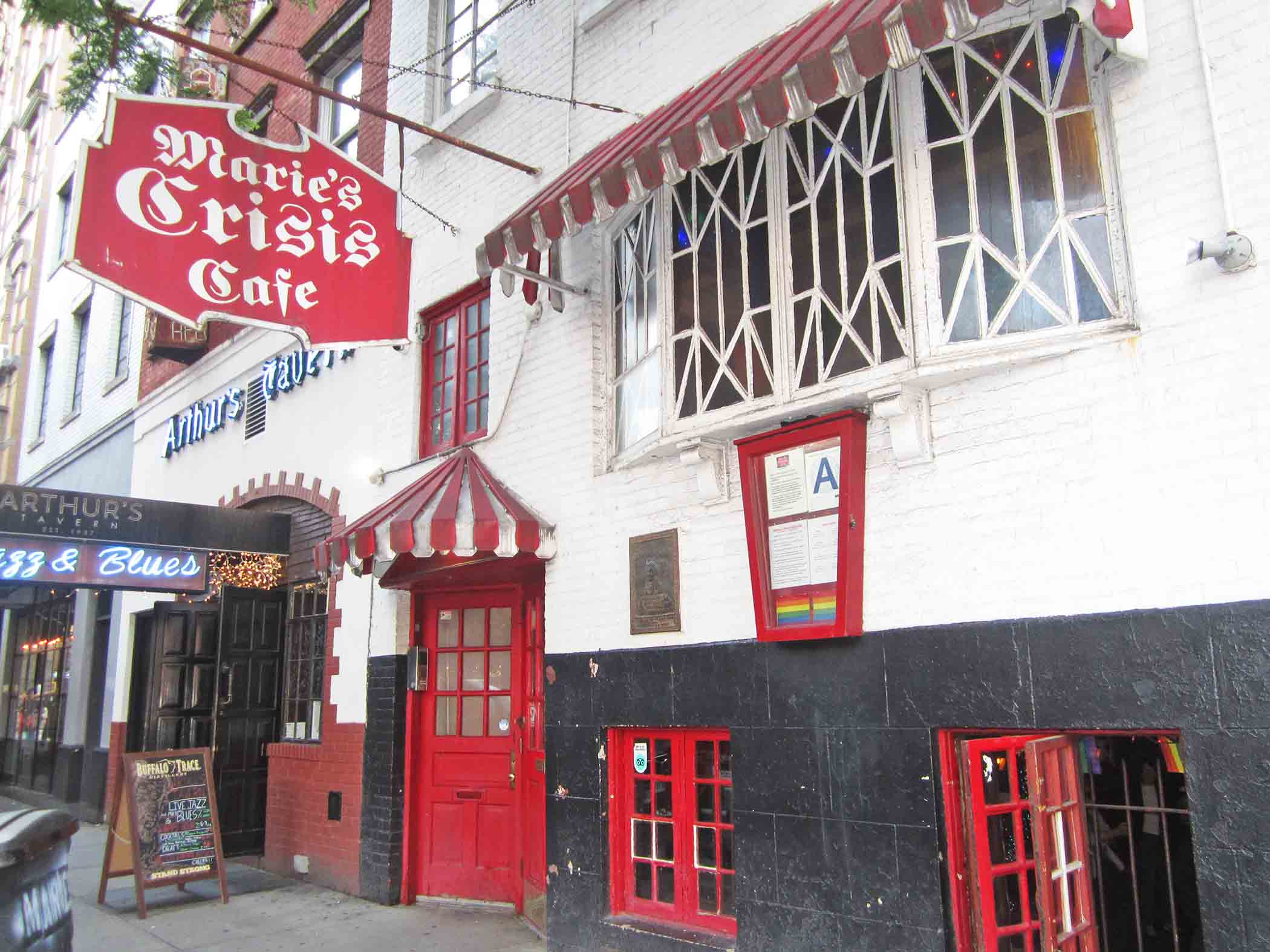
Jim opened the door slowly and stood at the top of a small flight of stairs overlooking the dimly lit basement bar, as the men inside sang and danced to the title tune to Mame: “You coax the blues right out of the horn, Mame / You charm the husk right off of the corn, Mame.” To this day, Jim swears they were doing the original Broadway cast choreography. “I looked down into a room full of gay men who were singing and dancing … and I thought, I found my magic place.”
Fifty years later, that very magic lives on — but now, with Jim behind the piano. His regulars gather around, perched on red leather barstools that wobble with their melodic sways. As the room fills up, strangers meet and sing and dance and drink. Tonight, Maggie and her husband are celebrating their anniversary. AnnMarie strolls in, wearing pj’s — not quite ready to wind down for the night, she took a quick subway pilgrimage to Marie’s to chat with her buddies. Across the room, a slender older gentleman sits quietly by the door, his floral blue pant legs crossed at the knee, allowing a pair of argyle socks to peek out. He’s wearing oversized tinted glasses (à la Elton John) and tapping his foot to the music.
Jim McDermott (we’ll call him “Patron Jim”) sits on a barstool beside Piano Jim. Patron Jim is in his early 50s, with broad shoulders and a kind aura. He’s dressed in a classic navy sweater over a crisp button-down, his smile wide. The Jims have become close friends over the past five years. In March 2020, McDermott was living in L.A. and using Facebook to livestream his sermons during the Covid lockdown — he had been a Jesuit priest for over three decades. Across the country, Merillat, along with the rest of the staff at Marie’s, had resorted to livestreaming their shifts in an effort to keep the spirit of Marie’s (and their livelihoods) afloat. That’s how Jim found Jim — and Marie’s Crisis. During this time, these livestreams became a lifeline for McDermott, who was in the midst of reevaluating his role in the church and his life in L.A., while dealing with the isolation of lockdown. “I needed something … and Marie’s became that thing.”
In particular, McDermott was struck by the way Piano Jim would casually “gender twist” the song he was singing — playing a ballad meant for a man to sing to a woman, but with the simple flip of a pronoun, it would take on a whole new meaning. “It blew me away,” McDermott says. At the time, he was talking with his Order about his desire to write publicly about being gay — a conversation that felt heavy. Seeing someone casually revel in their identity felt revolutionary. It shifted his perspective, while underscoring the reality that “for most people in the real world, it’s not that big of a deal.” As he watched Piano Jim’s unabashed confidence through the screen, McDermott began to see another version of himself — one freer, lighter, more comfortable in his own skin, a funhouse mirror of what could be.
After the pandemic, McDermott, in the midst of personal upheaval and professional transition, moved to New York and quickly found a second home in Marie’s Crisis, a queer sanctuary where faith, music, and selfhood could quietly intertwine. What began as casual visits evolved into ritual. McDermott has since taken a leave of absence from the ministry, and has developed a weekly tradition of communing over show tunes at Marie’s. He jokes, “I went there to be accepted, yet what I keep being taught is about acceptance.” For a gay man raised in the Catholic tradition, Marie’s became more than a bar — it became a space where contradictions could coexist and soften. At first, Patron Jim kept his identity as a priest closeted at Marie’s, meanwhile looking to those around him for inspiration to accept all parts of himself. “Some of the younger [piano] players — MJR or Brandon — they’ll wear nail polish. I am so afraid of doing something like that,” he says. “That’s freedom, there.”
Piano Jim, in his quietly mischievous way, used to coax Patron Jim into “outing” himself as a priest to other folks at Marie’s, sometimes just to see their reactions. It drove McDermott a little mad at first: “That’s my thing to share,” he’d say. But eventually, that tension gave way to a deeper understanding of what Marie’s really offers: the radical permission to simply be. Piano Jim’s coaxing showed him that at Marie’s, all parts of his identity were safe. Since then, regulars have come to rely on Patron Jim as a trusted ear, someone who is always there to listen. “I didn’t go looking for that, and I don’t want to manufacture it either … But I feel grateful for it,” he says, adding, “In a way, I actually feel like more of a priest now.”
Throughout my conversations with Marie’s patrons and staff, the same metaphor has resurfaced time and again: Marie’s Crisis is gay church. The chorus of voices. The call and response. A leader at the pulpit. Glasses raised and communion shared. And most of all, the congregation that knits it all together.
Drew Wutke, a pianist at Marie’s and former pastor in his own right, waxes philosophical when he talks about the bar’s place in the West Village community: “If we’re talking about villages as this beautiful collection of sacred things, a sacred space, and church itself as a huge interconnected group of people, then Marie’s brings the hymnal. Marie’s brings the words and the angst and the courage and the melody and the harmony and the lyrics and the power — and the Scripture, quite frankly — to remind people of why this music meant so much when they grew up.”
“It’s not about escaping,” he says. “You’re getting armed and nourished. You’re filling your cup up so that when you walk out the door you can go and continue to be fabulous and do your thing and not let them grind you down.”
Tonight, as the room dances merrily to Merrily We Roll Along, snaps to Chicago, and belts Pippin, Jim McDermott isn’t ministering. He’s not looking for absolution. He’s just sitting. In communion with the rest of us. And that, somehow, is enough. Lyrics from La Cage Aux Folles echo through the room: “I am what I am / And what I am needs no excuses / I deal my own deck, sometimes the ace, sometimes the deuces / There’s one life, and there’s no return and no deposit / One life, so it’s time to open up your closet / Life’s not worth a damn ’til you can say / “Hey world, I am what I am!”
In August 1981, Jim Merillat moved to an apartment in Soho and became a regular at Marie’s Crisis Cafe. During this time, he explains, the New York bar scene was segregated — there were bars for gay men, bars for lesbians, and bars for everyone else. The cabaret bars were a bit more mixed, indicating the beginnings of a more homogenous queer scene in the city: “If you were going to Marie’s, you were automatically identified as gay.” For some in the queer community, Marie’s was not just a safe place — it was home. For decades, the staff would serve Christmas and Thanksgiving dinners, welcoming anyone who wasn’t welcome in their family home. To this day, Marie’s is open 365 days a year — Patron Jim says that the holidays are some of his favorite times at the bar.
Throughout the ’80s and ’90s, smoke-filled Sunday afternoon bingo at Marie’s turned into late night singalongs, as Merillat became more and more entwined with the community that formed around the piano. For Piano Jim, the joy of that era is eclipsed by aching memories of AIDS rampaging through the city’s gay community, claiming the lives of countless friends, partners, mentors, and strangers — even family. In 1992, his brother John passed away from AIDS.
Over two decades later, in 2018, after Merillat had begun periodically filling in on the keys for longtime Marie’s piano player Jim Allen (yes, a third Jim!), he agreed to take on a regular shift at the bar. Now, every Tuesday evening, Piano Jim sits on his perch and imbibes the energy of the room. He feels an obligation to pass down not just the history of Marie’s but the history of what it was like being gay in this country during the struggle for expanded LGBTQ+ rights within his own lifetime, and the cultural progress that’s been made.
As Pride Month paints the town rainbow each June, younger generations have been vocal critics of corporations’ “rainbow washing” — the performative activism of merely “checking a box” when it comes to representation, slapping a Pride flag on their logo and calling it support. This gets Merillat worked up. “Twenty years ago, we were just hoping that a big corporation would pay attention to us,” he says. “We were begging for corporate America to look at the gay community and say: There’s a market here and we need to acknowledge it.”
Merillat’s age and experience gives him a bird’s-eye view of cultural history — a constant reminder that progress is still recent, and codified protections for the LGBTQ+ community remain tenuous and threatened. We’re seeing this play out day to day amid an increasingly divisive political climate, with large corporations such as Mastercard, Garnier, and Anheuser-Busch pulling funding for 2025 Pride celebrations across the U.S. In May, a spokesman for Heritage of Pride, here in New York, told The New York Times, “Some folks have definitely mentioned the fear of potential blowback from the Trump administration if you are a big corporation and you are publicly supporting D.E.I. initiatives.” From Piano Jim’s perspective, none of this is surprising.
For regulars, the sanctuary of Marie’s has grown all the more essential since Trump’s reelection. As McDermott sees it: “I have this responsibility to be there. I kind of made a commitment to those people. I feel it more now since the election. All we have is each other.”
Such was the case on the night of the 2024 election. Andrew Duggan, 25, was at a gay cocktail bar in Hell’s Kitchen with a group of friends, but as Trump took an early lead in the polls, the energy of the room went dark. “Everybody was standing like statues, watching the television … completely paralyzed,” he says. “Nobody spoke. You really felt like the hope was being sucked out of the room.”
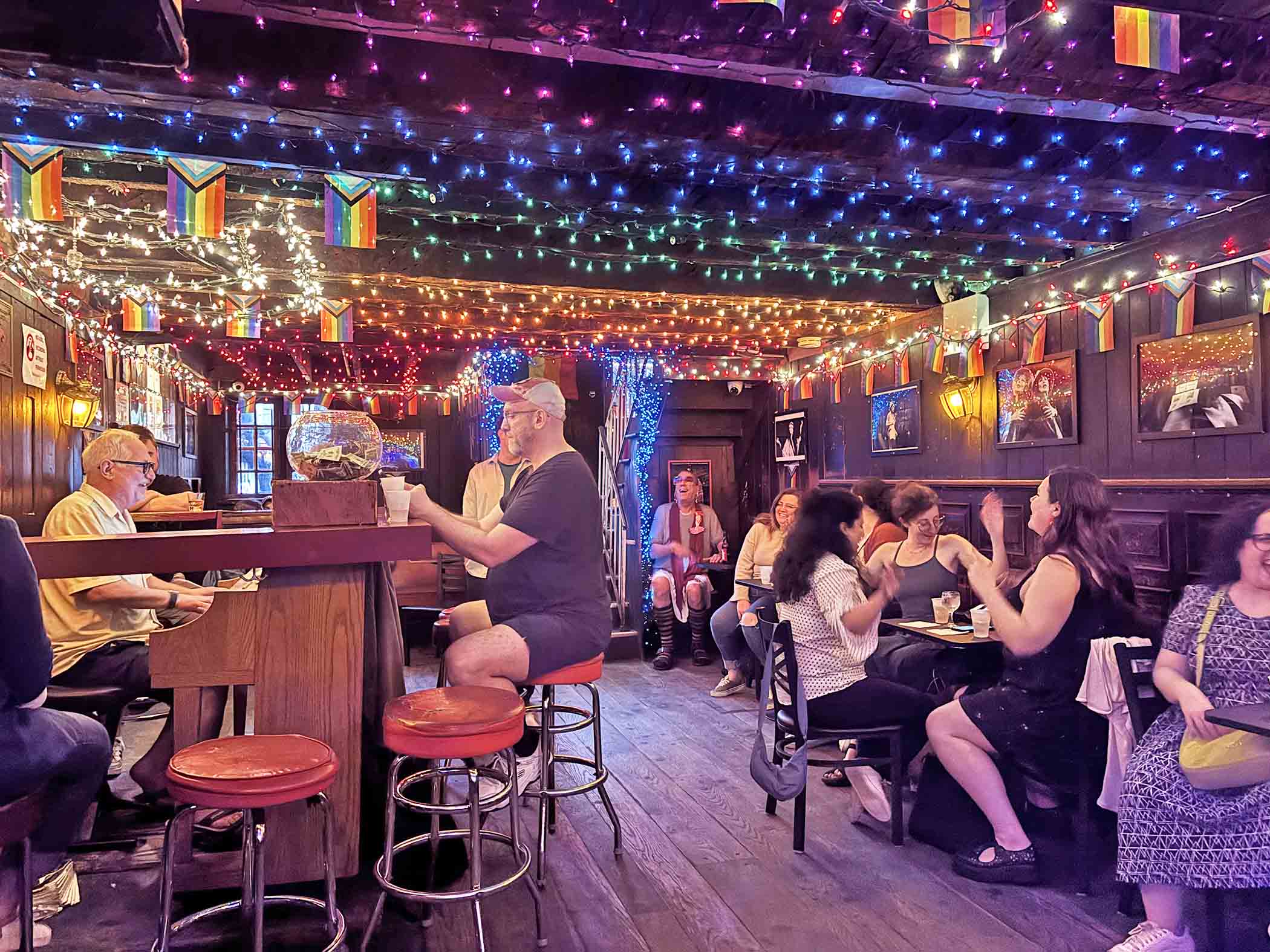
It was then that Andrew decided a change of scenery was in order. He left the cocktail bar and headed straight for Marie’s Crisis. Piano Jim had just finished his set and turned the ivories over to Tuesday’s late-shift pianist, Franca Vercelloni. The energy of the bar was now in Franca’s hands, and the mood was defiant. “It was dance or die,” Andrew says. “You just have to keep expressing and experiencing joy, or else they win.”
Every few songs, Franca would ask for an update on the polls, and then keep right on with her set. “She was on fire that night,” Andrew recalls. “I think she played ‘Do You Hear The People Sing?’ half a dozen times”: “Do you hear the people sing? / Singing a song of angry men? / It is the music of a people / Who will not be slaves again / When the beating of your heart / Echoes the beating of the drums / There is a life about to start / When tomorrow comes.”
This was just what Andrew needed. “For as long as I was in that space, it was really like there was nothing that could hurt you,” he explains. To him, the refuge Marie’s offers isn’t a way to shut out the outside world. “It’s not about escaping,” he says. “You’re getting armed and nourished. You’re filling your cup up so that when you walk out the door you can go and continue to be fabulous and do your thing and not let them grind you down.”
Each Tuesday, as Piano Jim sits in front of the keyboard, he takes in the room he first set foot in over 50 years before with his late brother — the same damp underground with a vibrant rainbow glow. He thinks of John — a fighter, a marcher. On some shifts, Jim will dedicate the last song of the night to him. Typically, it’s Judy Garland’s “Somewhere Over The Rainbow,” which he calls the Gay National Anthem — fitting, as “friend of Dorothy” is an old code-word for gay men.
Before this closer, he’ll give a brief overture to the crowd about what Marie’s Crisis represents and the history that resounds in their voices every night. “We owe our existence in this bar to a lot of people who came before us,” he says. “We sing in their spirits and we stand on their shoulders.” The room is filled with regulars he’s come to know well, a chosen family — a mostly younger crowd, a new generation besotted with show tunes. Sometimes, but not often, he will look over the piano and see the faces of men around his age. When he does, a knowing glance lingers between them, there’s no need for words. As piano Jim tells me, the eyes say it all: “Ah, you escaped too, somehow, didn’t you?” He takes it as both a mission and a gift that he has the chance to pass down to younger generations of queer folks and allies a history of what and who came before. To arm and nourish them with hope, even in darkening times.
Tonight, as he begins his build-up before the final flourish that’s soon to come, he plays “One Day More,” from Les Mis. We all know this one.
One day more
Another day, another destiny
This never-ending road to Calvary
These men who seem to know my crime
Will surely come a second time
One day more
The air reverberates with celebratory defiance. The swell of a common cause. The precipice of resistance. Our voices are resolute and celebratory.
One day to a new beginning
Raise the flag of freedom high
Every man will be a QUEEN!
The staff and regulars screlt (vocalist jargon for a collision of screaming and belting) the lyric change from the score’s “king.” That one lyrical twist says it all. Toto, we aren’t in revolution-era France anymore.
In a dingy basement bar, in the heart of the West Village, there’s joy in resistance. In the hymns that connect us. We find friends among strangers, and family among friends. Revolutions aren’t just fought on political fronts (or portrayed on Broadway stages) but in places like Marie’s Crisis. As Andrew puts it: “This is what makes being alive good — and it’s okay if sometimes that’s just surviving in a basement.” ❖
Grace Kelleher is a freelance writer based in New York City.