





Fantastic Cat is a group, and they’re most definitely a super one. But are the NYC-based furry foursome, who coalesced in 2021, capital “S” super? “We started off calling it a “Stupor Group,” jokes Anthony D’Amato, a beardy Jersey-born singer/songwriter with five acclaimed solo albums to his credit.
“There are super things happening,” adds Mike Montali, who is also frontman of the Queens-based band Hollis Brown. “I played drums on national television, and I never played drums in front of anybody before this band. So that’s pretty super.”
They’re not always that “punny,” but Fantastic Cat manages, in their impressively extensive branding, video, and merch, to fall squarely on the side of clever, charming, ironic humor. Which only adds to their often poignant, pointed songs and deeply felt, authentic musical collaborations.
To wit: their “Folk Rock For Pussies” T-shirt. They recall that when D’Amato uttered that phrase, “We’re like dying laughing. But also, ‘We can’t use that.’” Yet they did, and then the joke became “We’re working on our first hit song, but we already kind of have a semi-hit T-shirt.”
More bad-ideas-turned-good? The term “indie rock supergroup” seemed a convenient way to explain the nascent side project. (Yet another problematic term, “side project,” which was briefly accurate but is no longer, with two records out and a full year of Cat commitments for 2024.)
For the uninitiated, D’Amato explains the quartet’s M.O.: “We’re a band with four different songwriters from four different projects, who are also four different lead singers. The obvious comparisons, just because of that architecture, are Crosby, Stills Nash & Young or the Traveling Wilburys, which are genuine, gigantic, supergroups. In a million years, we don’t want to go out there when someone’s asked, ‘What, what’s your band like?’ and say we’re like one of those bands that has the greatest songwriters of all time.” More accurately, he offers, “We’re an all-star supergroup, and you’ve never heard of any of the people individually.”
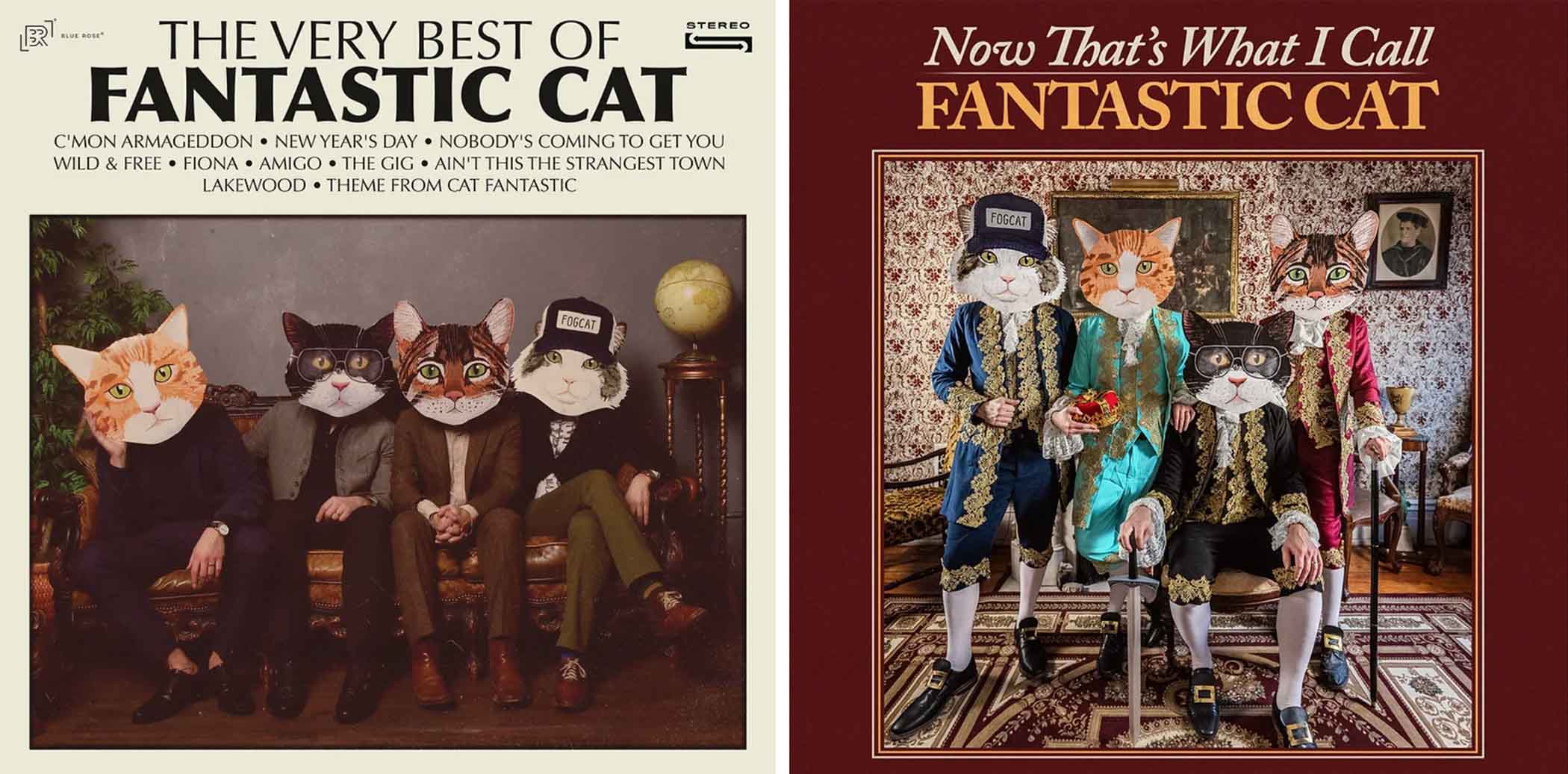
Not exactly true, but Fantastic Cat, rounded out by Brian Dunne (four solo albums, the most recent being 2023’s Loser on the Ropes, out on Kill Rock Stars) and Don DiLego (five solo albums, collabs, production work with Jesse Malin, and music featured on HBO and Showtime) are not household names … yet. The recently released Now That’s What I Call Fantastic Cat — which features musical and visual Easter eggs, such as a “Fogcat” baseball hat in the album cover portrait and the album title, which may refer to the 1980s-launched compilation series Now That’s What I Call Music! — contains 11 collaborative songs, plus a spoken-word “legal disclaimer” as track 12.
“I think a lot of artists feel this pressure to carry themselves with a certain swagger or gravitas. And we laugh at that.”
“It’s not as clean-cut as ‘This is a Mike song. This is a Don song. This is a Brian song.’ These are all Fantastic Cat songs. We like to consider ourselves the Wu-Tang Clan of folk rock,” D’Amato says with a smile. “You never know who’s gonna sing next.”
Now That’s What I Call Fantastic Cat follows their breakthrough debut, The Very Best of Fantastic Cat, which earned the band a national headlining tour, an opening slot with Low Cut Connie, and accolades from peers, press, and fans. The sophomore LP kicks off with the bouncy “Oh Man!,” which serves up painfully funny dashed-dreams scenarios: “If the universe is expanding / Why is my rent still going up? Oh, man, we’re all doin’ the best we can.” The lush, heartbreaking vocals and vibe of “Later On” sit well with the loose, Stones-y, country-tinged barroom vibe of “The Hammer & The Nail.” The album closer, “Head Down, Shots Fired,” concludes Now That’s What I Call Fantastic Cat with a bang. “We wanted to end the record with something that had a little energy to it. Almost like the setlist of a live show — you can jam that one out a little bit at the end and leave people feeling on a high.”
If the original intentions of the band have been surpassed, there’s a bonus. “I think we still, to some degree, have a side-project energy, which is a good thing,” says Montali via Zoom from his Queens home. (D’Amato joined in from Colorado, a few days ahead of Fantastic Cat’s gig there.) “It keeps us from being too precious about it.”
For the first album, the “Hey, this is our fun time to just do stuff we wouldn’t normally do” as Montali phrases it, turned from fun to fantastic thanks in part to an enviable musical versatility. “We all do everything. Even onstage, we all switch instruments between every song. Whoever was on drums goes to bass goes to guitar,” D’Amato explains. “It’s a function of we’re all artists coming from our own projects, all used to being band leaders and being in charge and running the show.”
It can be a beautiful chaos. “We’re all the lead singer. We’re all the driver. We’re all loading in the gear. We’re all working out setlists.” In that democracy dance, D’Amato notes, “I think everybody’s songs come out of the wash better for having gone through the process of three other people’s eyes and ears on it.
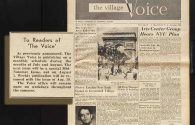
“We used to actually go in person to the Village Voice building to try to talk to anybody we could to get our show featured.… We never got past the door. It was always ‘Yeah, leave your information with us.’”
“The songwriting part and then recording, we take that super seriously. But when it comes to some of the visual side and the promotional side of stuff, I think the most successful things we’ve done have almost always started out as us trying to make each other laugh.”
As in: The band not only replaces their own faces with images of cat heads in promo photos and on album covers, but elsewhere. And the effect is cattily whimsical. “It can be seen as a nod to the cliches of the music industry, and taking the piss out of it and not taking ourselves too seriously and being willing to laugh at how self-serious a lot of the music industry is,” says D’Amato, who has more experience in that realm than most thanks to a post-college stint as a publicist for creators he admired, including Bon Iver, St. Vincent, and Grizzly Bear, plus other, more vainglorious musos. “I think a lot of artists feel this pressure to carry themselves with a certain swagger or gravitas. And we laugh at that.”

So, back to the cat heads, created by illustrator and artist Jane Beaird, D’Amato’s spouse. They’re based on reality … somewhat. “Brian’s is based on Brian’s actual cat,” explains D’Amato. “And soon it kind of spiraled into ‘Well, if we got them printed out large enough, and then cut them out and attached them to foam core and put Velcro straps so we could wear them.…’ That became the press photos and that became the album art, and then that became the entire calling card of this band.”
Though they might have preferred actual songs as the initial “calling card,” “It worked out great,” quips Montali, “because you can be hungover, you can be depressed, you can be whatever you like and you don’t have to worry, because your face is covered. It’s the perfect photo shoot trick.”
D’Amato adds, “No one’s ever blinking in our photos.”
There are, however, no songs about felines. As longtime bandleaders, “We all obviously come into this with our own strong opinions and ideas about the way things should sound and look and can be done,” D’Amato explains. “But for me, one of the fun aspects of this band is that, after a decade of being a solo artist, I know exactly how something I do by myself is going to come out. When I put a new song to Fantastic Cat and say, ‘I have this idea’ and start to play it for them, then someone says, ‘Well, what if we move this here? What if we change these chords,’ and all of a sudden, it becomes something different than I ever imagined.”
“A lot of artists have the mindset, ‘I don’t want to know anything about the business side, because it’s gross. I just want to be a capital “A” artist.’”
Taking that leap of faith requires focusing on the greater good. “To Anthony’s point, it’s riding the wave a little bit of an idea that you might not instinctively vibe with off the bat, but just seeing where it takes you,” says Montali. “It’s an organic process, all of our voices are heard. It makes the whole record more interesting, I think, when we’re able to let go a little bit of the control that we’re used to having. It’s not an easy thing to do for us, but when we do it, I think it’s a better result.”
As lyricists, they’re discrete. Montali, a fan of author Raymond Carver, enjoys the “thing left out kind of literary trick,” he explains. “Almost a feeling you’re trying to get across with words without necessarily being very linear or as narrative.” He also considers himself a writer of “mainstream rock, which I think, oftentimes, the melody leads the way and you don’t necessarily sacrifice words for melody.”
Montali’s more abstract, emotional approach can be in marked contrast to the three other Fantastic Cats. D’Amato concurs. “I probably come more out of the folk tradition world, where it’s kind of the opposite. The lyrics lead the charge, and you figure out the music around it. My favorite writers are, like, Leonard Cohen, in terms of talking about poetry stuff. I am always drawn to writers who can tell a story. Then maybe two days later, you step back, and you’re like, ‘Oh, wait, there’s another level to that, that’s what they’re writing about.’”
Dunne is a similarly “lyrics-first” writer. “Brian and I both grew up on a very heavy diet of Bruce Springsteen and that really influences us in a lot of ways,” says D’Amato. “If Mike brings in a kind of abstract song, and Brian or I put a concrete image in a place where it’s primarily been abstract, suddenly it’s just this little flash or something unexpected. And hopefully, that’s the kind of thing that draws you in.”
The savvy born of separate careers and cutting their teeth in the NYC scene has served these cool Cats well. Their local bona fides are strong: They count Jesse Malin as a galvanizing, influential part of their individual careers, and Montali recalls Village Voice forays when he began Hollis Brown. “We used to actually go in person to the Village Voice building to try to talk to anybody we could to get our show featured,” he says. “We never got past the door. It was always ‘Yeah, leave your information with us.’”
D’Amato’s brief time on the business side of music also plays into the band’s approach. “A lot of artists have the mindset, ‘I don’t want to know anything about the business side, because it’s gross. I just want to be a capital “A” artist.’ I always got the feeling that the more you know, the more equipped you are to have a career with some longevity, and it never hurts to understand what’s going on behind the scenes.”
Mutual respect and democracy are qualities that often dissipate in successful bands, but so far, so good for this quartet. “To begin with, you’re coming in with something that you feel is strange and interesting. Then you’ve got to be willing to let go of that a little bit or know what battles to pick and know when someone else’s input is going to help it grow and evolve into something greater.” Or, conversely, concludes D’Amato, “to know when there’s a specific vision that you need to see through in some regard. And that’s been the creative joy and challenge in this band.” ❖
Katherine Turman has written for Entertainment Weekly, Spin, Variety, and other publications, and is the author of Louder Than Hell: The Definitive Oral History of Metal. She lives in Brooklyn.

