




On Kristallnacht, the “Night of Broken Glass,” during WWII, November 1938, Jewish homes, hospitals, and schools were ransacked as Nazis demolished buildings with sledgehammers and rioters destroyed more than 1,400 synagogues and prayer rooms throughout Germany, Austria, and the Sudetenland. More than 7,000 Jewish businesses were damaged or destroyed.
A few short months later, the Silver Levy of 1939, also known as the Silberzwangsabgabe, was instituted, a Nazi decree requiring German Jews to hand over their precious-metal possessions as part of a broader process of persecution, dispossession, and shame.

German Jews stood in lines for hours on the streets at pawn shops, waiting to sell their items, which were all meticulously recorded by owner, description, dates, and amount of sale. The pawnshops were transit stations; they bought the objects from the families under degrading circumstances, which was the whole point of the exercise. There were huge quantities of materials, including everyday Judaica such as kiddush wine cups, menorahs, Shabbat candlesticks, thimbles, Jewish spice boxes, and silverware. In Munich alone, this added up to almost 10 tons of pure, quality silver. The Nazis referred to it as Jewish Silver, and around 99.5% of it was melted down. Two-thirds of the last owners did not survive the Nazi regime and were murdered in death camps.
The Bavarian National Museum, in Munich, was given the opportunity under some problematic circumstances to buy 350 items, in 1939 and 1940, that survived the Silver Levy. Until a few years ago, these items sat forgotten and neglected in a cupboard at the museum. That is, until they began haunting Dr. Matthias Weniger, the museum’s Head of Provenance Research, when he arrived in 2019. They didn’t belong there. They belonged with their families.
He began researching the items and came across an old inventory that listed names and descriptions. He tracked down descendants of those families, many of whom had perished during the Shoah in Dachau, Theresienstadt, and Auschwitz, and has personally returned all but 20 of the items. His mission and restitution trip to Israel were documented in a moving film by Liv Thamsen, Dr. Weniger’s Auftrag (Dr. Weniger’s Mission).

With the support of the Bavarian State Ministry of Science and Art, the Bavarian National Museum has published its acquisition records from 1933 to 1950 online. At the Forschungsverbund Provenienzforschung Bayern, the Bavarian network for provenance research facilitates the identification of Nazi-looted art in the museum’s holdings, listing the circumstances of access to works of art that came to the museum between 1933 and 1950. According to the museum, “Not every acquisition during this period (purchase, donation/endowment, bequest, exchange, etc.) has an unlawful, violence- or persecution-related context. For data protection reasons, redactions had to be carried out in some places.”
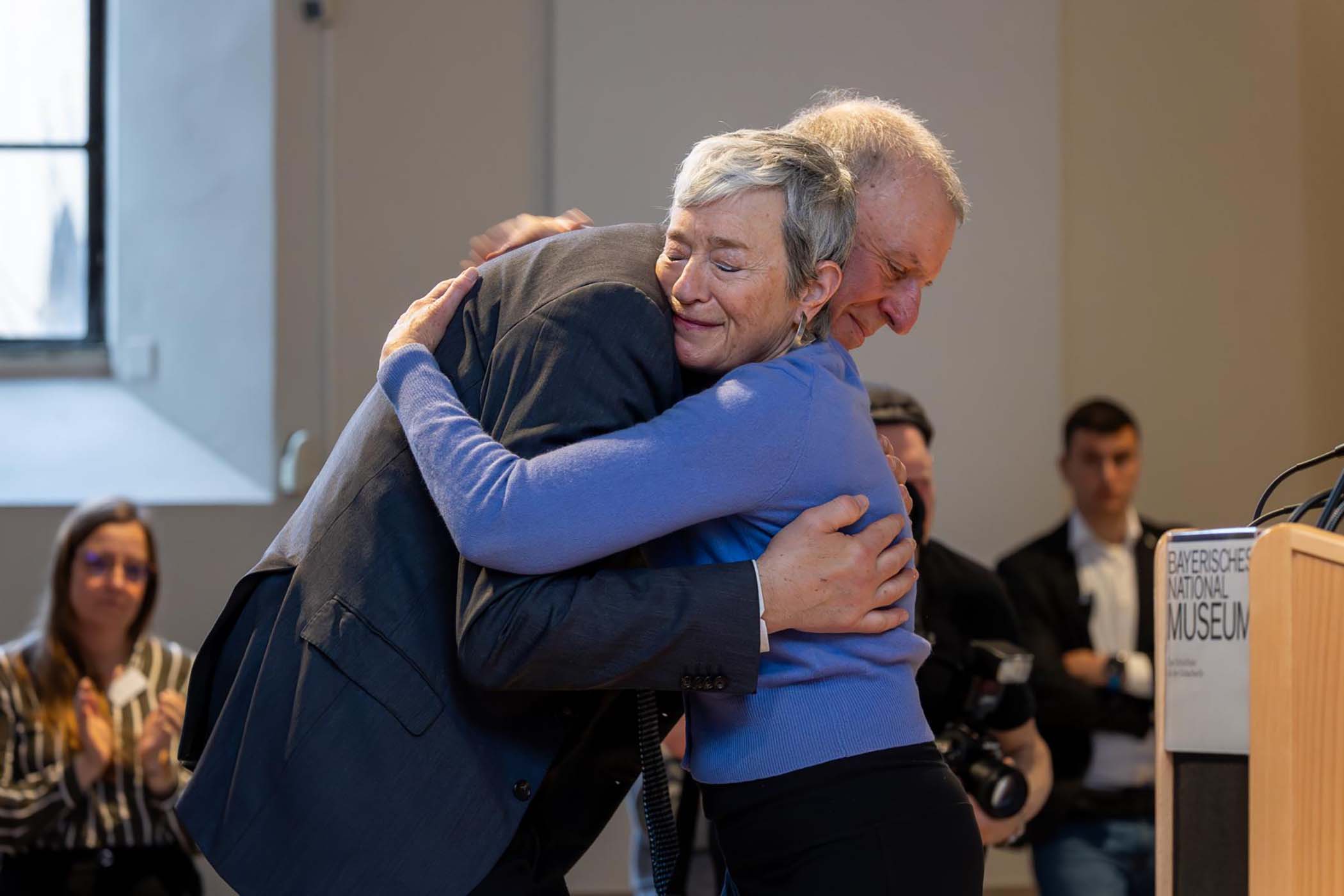
Last week, at a reunion one year in the making, Dr. Weniger brought together about 80 descendants from 20 families from across the world to Munich, for a weeklong conference that included the installation of memorial plaques across the city honoring those relatives who died in the Shoah, walks through historic German Jewish neighborhoods, visits to synagogues, Jewish cemeteries, and Dachau, and a private tea at the historic Nymphenburg castle, given by H.R.H. Duke Franz of Bavaria, who himself spent 10 months in Dachau because of the royal family’s anti-Nazi outspokenness.

The events began with a memorial ceremony for five victims of the Shoah: Hermine Bernheimer (with a tribute to her sister Rosa Frei, the oldest survivor of Theresienstadt), Hermann Binswanger, Minna Hirschberg, and Erna and Friedrich Sigmund Marx. Speakers from three families, AnnaMaria Abernathy, Ellen Kandell, and Merilyn Moos, addressed the crowd at the Bavarian National Museum.
“We got this beautiful kiddush cup that belonged to my grandfather Sigmund and his wife, Emma, who lived with us from the time they arrived in the U.S. in 1940 until they died,” Gabrielle Gropman, who made the trip with her daughter Sonya, told the Village Voice. “I knew they had turned in valuables before they left Germany. They left in August of 1939. We didn’t know anything about this cup, it was a total surprise and pretty shocking when I got an email from Matthias Weniger in Germany asking me if I was related to Sigmund Marx. I have no idea how he found us, and have no sense of how he managed to track us all down.”
Not only did Dr. Weniger deliver the cup to the family in New York, he first went to visit Gabrielle, in Gloucester, Massachusetts, to get her signature to receive it, and then to New York to deliver it to Sonya’s cousin. “They dot every i and cross every t in their process of restitution,” said Gabrielle.
“He brought the cup to us last year,” said Sonya, who co-authored The German-Jewish Cookbook: Recipes and History of a Cuisine with Gabrielle. “My mother was unable to make the trip to New York for the return of the cup, with my cousin and his family. It was very hamish. We had bagels and cream cheese in my cousin’s new apartment in New York. Matthias slowly unwrapped it and gave it to us, it was very emotional. Then one of my cousin David’s little kids, Alison, who was about 3 years old, held the cup. It was low-key but very meaningful.”

Max Bernheimer, a recently retired art historian who worked for 33 years at Christie’s in New York, as the International Head of the Antiquities Department, took part in the reunion, which included a memorial plaque dedicated to his relative Hermine Bernheimer, and also commemorated her sister Rosa Frei, probably the oldest survivor of Theresienstadt. He says, “I’m the fifth generation of my family in the art world, as my great-great-grandfather opened L. Bernheimer here in Munich, and founded the Arts and Antiques business in 1864. I’ve been coming to Munich almost every year for the last 20 years. I still have relatives and love it here. With the increasing anti-semitism in America, I decided as an escape route to get my German citizenship. Note the irony in that.”
One of the many Silver Levy items returned to the Bernheimer family was to Max’s cousin Celia Bernheimer, who lives in Arkansas. “She had a piece delivered by Dr. Weniger last year, a 17th-century silver-lidded vessel with images of Native Americans on it that may have been a tobacco jar,” Max said. “She called me after he came and delivered it and said, ‘I don’t have any heirs, can I gift it to you upon my death?’ and I said, ‘No, but you can give it to my daughter.’”
Ellen Kandell, who was also part of a large contingent representing Bernheimer descendants at the reunion, which included her cousin Naomi Karp, shared her silver story with the Voice on a crisp spring morning in Munich.
“This restitution would not have happened if not for Matthias,” she explained. “Hermine Bernheimer owned a silver cup that was in the collection, which we thought originally was a kiddush cup but turns out it was a baptismal cup. We have no clue why this Jewish single woman had a baptismal cup in her collection. It had engraving on it and was from the early 1700s. We donated it to the town where her family was from, Göeppingen, where they have a small Jewish museum where school children can come and see it.”
There are still some unclaimed silver items left in the Bavarian National Museum. Whether this is a matter of bureaucracy or finances, they remain in a case waiting to be reunited with their families. Some families have not responded to the museum’s outreach.
“It can be an emotional issue,” says Dr. Weniger. “Some people feel it’s a long journey to make and a costly process just to retrieve a spoon.” ❖