



Did Beatles manager Brian Epstein and John Lennon consummate a love affair while vacationing together in Barcelona, Spain, in 1963, as the Beatles were on the cusp of international superstardom? This remains one of the more intriguing questions of Beatles lore. Lennon denied it, and Midas Man, a new Epstein biopic directed by Joe Stephenson and starring an elegant and appealing Jacob Fortune-Lloyd as the ill-fated impresario, overlooks the entire incident. (Screenwriter Brigit Grant explains in our interview, below, why she chose to omit any reference to what might have happened in Spain.) In fact, the impact of Epstein’s homosexuality on his relationship with the Beatles isn’t touched on at all. But this engaging film, based on what’s known and verifiable, is the story of a wealthy and famous gay man in England at a time when homosexuality was a crime. And Epstein’s sexuality is at the center of Midas Man, as the intense pressures of mega-success and having to hide his true nature from potential blackmailers and the press drive him to drink and drugs.
You see Epstein embracing a stranger on the banks of the Mersey, and you see him in a dark alley, about to have sex with another man — who suddenly puts a knife to Epstein’s genitals, steals his watch, says, “I know who you are,” and later telephones his house, where Epstein lives with his parents (Emily Watson and Eddie Marsan), in an attempt to blackmail him.
Speaking directly to the camera, Epstein — who would die in 1967, at age 32, from an accidental overdose of barbiturates at the height of the Beatles’ Summer of Love fame — says that this is the kind of thing that happens “when you’re forced by law to live in the shadows.” He describes how a man once beat him with a broken milk bottle and went to prison. “When he gets out,” Epstein says, “I help him find a job. I feel sorry for him.”
The pseudonymous John “Tex” Ellington (Ed Speleers) — a real person named John “Dizz” Gillespie, unknown even to most Beatles obsessives — is Epstein’s love interest. A struggling actor reminiscent of Midnight Cowboy’s Joe Buck, Tex picks up Epstein in a New York bar and follows him to London, where he becomes his live-in boyfriend. The relationship ends in San Francisco, during the Beatles final tour, just before their last concert, when Tex vanishes with a briefcase containing pills and $20,000 cash that Epstein left in their hotel room. Epstein falls apart. His lawyer Nat Weiss (James Corrigan) wants to “take care” of the problem, but Epstein tells him no. “He deserves the money,” he says.
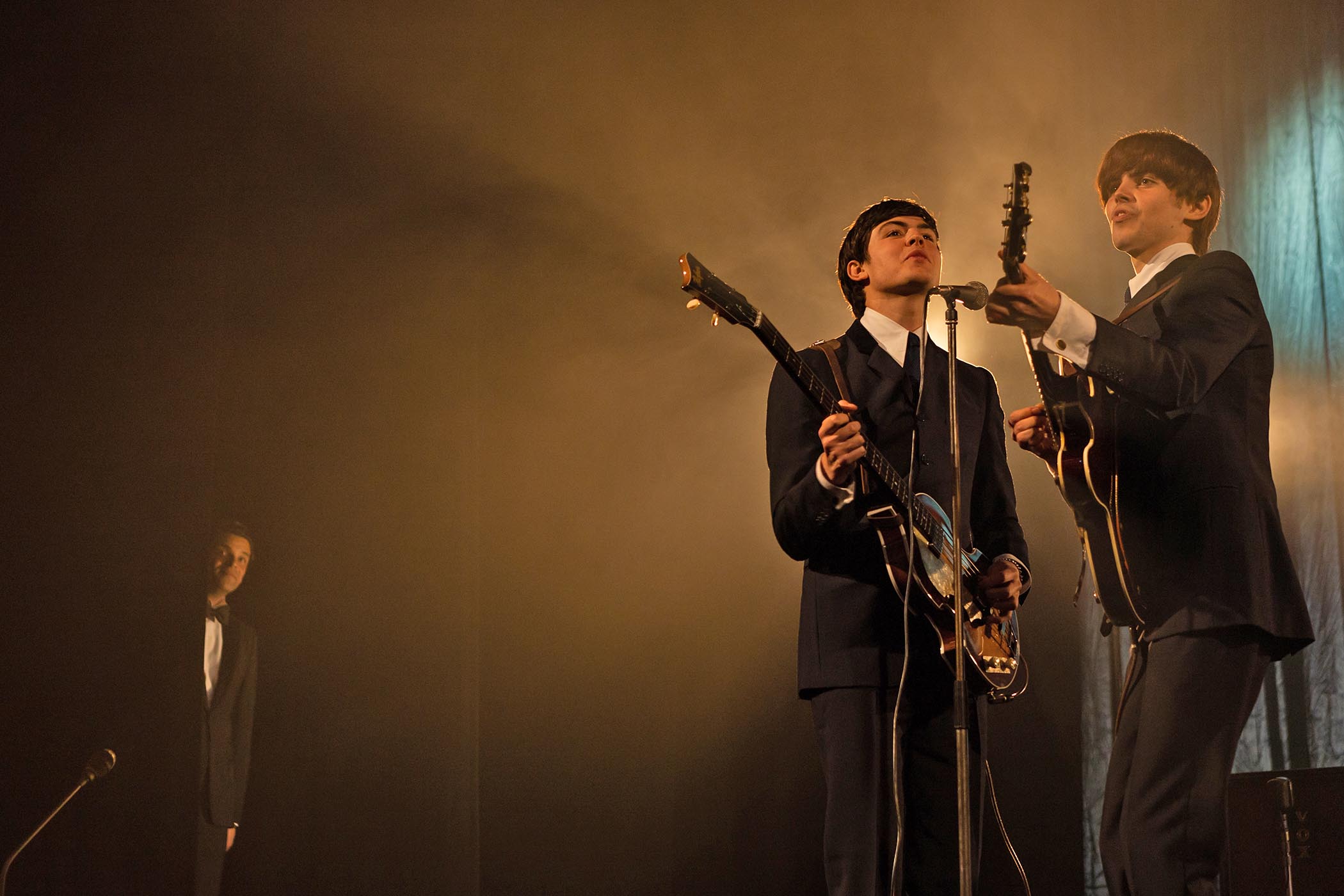
Though the Beatles themselves often come off as cartoonish, and their individual identities are barely differentiated, Jonah Lees, Blake Richardson, Leo Harvey-Elledge, Adam Lawrence, and Campbell Wallace (John, Paul, George, Pete Best, and Ringo, respectively) play their instruments and sing (as does Timothée Chalamet as Bob Dylan in A Complete Unknown, which Midas Man’s performance scenes bring to mind). Only two scenes show Epstein interacting with an individual Beatle. One of the film’s best moments dramatizes an incident that still reverberates, 64 years after the fact. Epstein fires Pete Best, the drummer, telling him that he’s being replaced by Ringo. Best thinks Epstein’s kidding. Then, near tears, he says, “I’m the beat in the Beatles … Ringo’s my friend … The fans will never forget this.”
The other scene takes place after a demo recording session goes badly. Epstein tells an infuriated Lennon, “Nobody will work harder for you than me.”
Yes, Epstein did love Lennon more than any other Beatle, and in the context of this film, it’s irrelevant if that love was consummated.
• • •
Brigit Grant, executive editor of Life Magazine & Features, Jewish News, a British publication, wrote the screenplay for Midas Man. We spoke in New York at the Arthouse Hotel on January 15. (This interview has been edited for length and clarity.)
Robert Rosen: Are you in New York to promote the film?
Brigit Grant: Absolutely. It’s opening at the New York Jewish Film Festival at Lincoln Center tonight.
You’re Jewish?
I am indeed.
And you’re an observant Jew?
No, no, not at all. But I am very much a Jew, and since October 7 it’s been my mission. I’ve spoken at Downing Street. I’m basically standing up for Israel. I struggle with the idea of Israel being able to defend itself.
Is Midas Man your first screenplay?
For a movie, yes. I’ve worked on television dramas. I did one called Red Top, which is about the phone hacking scandal in the U.K.
How did you get the gig?
When I lived in New York I edited Gay Pride, a British magazine. I’m not gay but the producers knew that I knew about the gay stuff as well as the Jewish stuff. And I happen to be married to one of the biggest Beatles fans. My husband, Neil, saw the Beatles in Bournemouth when he was 11 years old. He has been besotted with the Beatles. He is a fundamental part of the research process for Brian.
When did you start filming?
Four years ago. We had a break because we had three directors on this film.
But Joe Stephenson is the only one who’s credited.
Yes, because the bits that the others filmed that are included are minuscule.
At the end of the film, in the credits, it says, “Brian’s journey follows facts known to the public.” What does that mean exactly?
When we first announced we were filming, you had the Epstein scandal here, so now when you Google “Epstein” you get Jeffrey, and so many people would go, “Oh, you’re making a film about Jeffrey Epstein!” No, not Jeffrey Epstein at all. You have to be careful. Depending upon the surname you get landed with, you can be confused with so many people.
Tell me about it.
The pronunciation of Brian’s name was a real issue because in the U.K. there’s a tendency to say Epsteen as “Epstine,” as in pointing out the Jewishness of the name. Jeremy Corbyn, who could have been prime minister, made a big thing on television of talking about stine. It’s being anti-Semitic. And Brian went to many schools, and even when he went into the army he made a point of telling fellow students and staff that the pronunciation was steen. He was very keen on that anglicized version of the name.
How did you interpret history and how is that reflected in the film?
There’s going to be a million interpretations of anything connected to the Beatles, and particularly in Liverpool, everybody wants to own that story. The older generation particularly lays claim to it, and everybody thinks they know the story better. Whoever came on board, it was almost like they took ownership of it. I spoke to as many people as I could so that I’d have a more personal perspective from the point of view of the family, bearing in mind that so many people have passed away. My journey started with Basil Hyman, Brian’s first cousin, the nephew of Queenie, Brian’s mother. Queenie’s brother was Basil Hyman’s father. When Brian first came to London from Liverpool, he’d stay with the Hymans. Brian would speak to Beryl Hyman, the father, a lot. Basil went to a Jewish boarding school with Brian and told me millions of stories. Unfortunately, he died before the film came out. He told me what Brian was like growing up, how he would sing Sophie Tucker songs. He was kind of an innate performer.
That wasn’t included in the film.
In my first draft it was. I have a lot of very personal stuff about Brian that was in the original draft. The producers said, “Put everything you possibly can into this about Brian.” How he was at boarding school, the anti-Semitism he suffered, the fact that he was expected to go into the family business, and how much he wanted to be an actor. The reason the acting didn’t work out was because he got arrested in London for soliciting. He was approached by a plainclothes officer in Hampstead.
How old was he when this happened?
He was in his early twenties. He got into RADA [Royal Academy of Dramatic Arts]. He got friendly with a theatrical company, Liverpool Playhouse. He mentally fell in love with one of the actors, not physically. The thing about Brian is that he was so multifaceted as an individual but he was battling his own demons with regards to his sexuality. He was conscious of coming from this very proper Jewish family, and of course he got engaged as well.
To a woman?
A young Jewish woman, Sonia Seligman. She became an actor. Her family were jewelers in Liverpool. They were both from wealthy families. They’d holiday in the South of France and Brian would take regular trips to Spain. While they were dating, people would leave notes in her coat pocket saying that Brian was queer. In the wider part of Liverpool people knew that he was someone who would go and cruise, à la George Michael. It was illegal until 1967, when it was legalized in the U.K.
Was it legalized before he died?
Weirdly, and this is the tragedy, it was legalized two months before he died. But because of what he was caught up in, with the management and the traveling and the drugs that he was taking, the uppers and downers, he was completely unaware of what was happening. And that made his journey even more impressive because he became a manager with no template for what management was. There was only the Colonel and Elvis. He created this entire template for what a manager’s role should be, from the merchandising deals to the concert planning. I know this sounds like a crazy thing to say, but I felt like he was part of my family. I felt protective. I wanted people to love Brian. There’s that line in the film — Queenie asks him, “What did you do when you fell off your bike?” He says, “I asked Daddy to buy me a car.” But that wasn’t really Brian. He came from money, and a lot of young people come from money. But he carved out an extraordinary journey for himself given those advantages, and with all the turmoil of his personal life. I cry at the end of the film when I know he’s going to die — when we filmed the last scene in Liverpool, of them filming “All You Need Is Love,” and knowing that he dies less than two months after his father, Harry, died.
The last shot, when he’s walking across Abbey Road, is that supposed to be him transitioning to the other realm?
I think it’s open to interpretation. It could be the crossing over. I like the open-endedness of it. It feels so emotional because that’s a complete re-creation of the Abbey Road cover.
You shot that on Abbey Road?
No, it’s impossible to shoot on Abbey Road. We’re actually in Studio 2. All the music is shot in Studio 2, where the Beatles played. Do you know that they’re playing live, the guys? They’re really talented. And Blake Richardson, who plays Paul, he plays bass the opposite way to how he would normally play. He plays the same as Paul in the film.
He’s not left-handed, like Paul?
Blake is right-handed. He’s in a band in America.
You said you tracked down all these people, like Brian’s cousin Basil. How difficult was it to find them and who did you speak to?
Basil was key. He also told me about Brian’s life in London because he spent a lot of time there. When Queenie comes and has lunch with Tex Ellington in the film, the outside is a shot of Brian’s real house in Belgravia. Basil told me all about the parties Brian threw in that house, about the socializing, what it was like to be around the Beatles then. And I spent a lot of time with Freda Kelly. She ran the Beatles fan club and was Brian’s secretary, as well. She told me about what life was like, the difference between her family, working-class people, and middle-class Brian. She told me that Brian took her to the Derby, which is a horse race in Surrey. He took her to the theatre. She told me what he was like day-to-day in the office, how he could be temperamental and could have angry outbursts. I met Don Black — he was a friend of Brian’s. He wrote “Tell Me on a Sunday” and the lyrics and libretto for Sunset Boulevard. He had offices on Argyle Street near Brian’s offices, when he moved the operation to London.
Did you speak to Paul or Ringo?
No. The Beatles were off-limits.
Even Pete Best?
Pete doesn’t talk about it anymore. That scene with Pete is key. The mindset of Liverpudlians is about remembering. They had Hillsborough, when all those people died [in a crowd crush] at the football event. They’re very patriotic, Liverpudlians. It’s ingrained in me now, being with them. In terms of the Beatles themselves, we didn’t know at the time they were going to be making four films with Sam Mendes.
He’s making one film about each individual Beatle?
Yes.
But not Pete Best?
No.
Pete still tours.
He does. I mean how you ever swallow that, how you ever get over that, I don’t think I would have.
I thought the scene when Brian fires him was one of the best scenes in the film.
I cried. I’m so invested in the story. Somebody asked me to do the Vivienne Westwood story with Malcolm McLaren. It’s a fantastic story and it’s marvelous roles for actors. But I don’t think I could ever love anyone as much as I love Brian.
You said Pete wouldn’t talk about what happened with the Beatles.
I didn’t have access to Pete. I kind of pushed it with Freda. I have access to Alan Williams’s family — he managed the Beatles before Brian.
Let’s talk about the Jewish theme.
John Lennon wasn’t nice about Jews.
We’ll get to that. But first: How do you think Judaism plays into Midas Man and why do you think it’s important?
Brian’s work ethic is a Jewish work ethic. His grandfather was Yiddish-speaking, from Lithuania, and he set up North End Music. Brian says in the movie, “My grandfather arrived in this country not speaking a word of English.” Brian’s father, Harry, wanted to be on the synagogue board. He was very active at Greenbank Synagogue, which is no more.
So the Epstein family regularly attended services?
Yes. Harry worked on Saturday. He kept the shop open on Saturday. It’s so true for a lot of Jewish people. It’s fairly typical — unless you’re religious, unless you’re observant in that way. They needed to keep the shop open. It’s how they were. Brian was part of that. They were kosher at home.
That doesn’t come across in the film.
In Brian’s memoir, A Cellar Full of Noise, he said he didn’t want Kaddish said at his funeral, perhaps because of modesty or uncertainty about his faith. This is a boy who wrote his will when he was 23, 24 years old. How many people do that? That’s the mindset of Brian. He wanted his personal effects to be sent straight to Israel.
Did he feel doomed?
Maybe. He was definitely a solitary overthinker. He knew that people who could help him in the music business were also thinking “Jew.” They tolerate us, but do they want us here? Not so much. “Anti-Semitism is in the soil in the U.K.,” said Judith Kerr [who wrote a holocaust book and whom Grant interviewed].
When Brian left home did he continue to practice Judaism? Did he keep kosher?
No. He lived a very grand life. He was born on Yom Kippur. I always thought he felt he was born guilty. A journalist on the Daily Express [Ivor Davis, who traveled with the Beatles on tour] wrote about how Brian asked if he could get him tickets for Yom Kippur services in Hong Kong or wherever they might be. He never went. He only asked for the tickets. Getting back to John Lennon, he suggested that Brian call A Cellar Full of Noise “A Cellar Full of Goys.”
“How bloody cool is Britain? It was the pinnacle of cool. To have the Beatles, with Mick Jagger sitting about in that studio, we were the coolest things on the planet. There was nothing else. What we’ve got is this extraordinary moment in time, and Brian Epstein had made that happen for the Beatles.”
[Laughing] I hadn’t heard that one. But there is the notorious incident when Brian asks John what the title of the book should be, and John says, “Queer Jew.” Did you consider including that in the film?
I had more anti-Semitism in the earlier draft. I had more anti-Semitism when Brian was at school. “Jew boy”… being slapped around the head — which is why they moved him to a Jewish boarding school. He was suffering. Harry suggested that Brian change his name when he went to London, but he said no because he thought it would bring him luck. He met Lionel Bart, who wrote Oliver. He was gay and Jewish, and hung out with him. The relationship with John Lennon is a really difficult one because everybody always goes back to the question of did they sleep together. Paul McCartney has said, at the point when Brian asked John to go to Spain with him, anybody would have jumped at the chance to go. They were young lads from Liverpool. There’s no way they wouldn’t want to go. Brian loved to travel — he managed an English matador, Henry Higgins his name was. I’m not the biggest fan of John Lennon. I know you’re not supposed to say that. His talent was unbelievable. The fact that he was intellectually superior to everyone he was around. He knew how to play Brian. He knew how to make Brian feel insecure. There was obviously an attraction for Brian in this rough exterior of John, who was intellectual but also, like they say, a yobo in that sense — we say it in the film, it’s a hooligan.
Did you consider addressing the Spain incident in the film?
Yes. I had a scene in the film where they go to Spain, and Brian takes him to an empty bullring, and John was sad, and Brian does a theatrical presentation to John, a faux bullfight, representing his challenges and fighting the enemy. I thought that would answer a lot of questions about that relationship. There has been an independent film …
… The Hours and the Times. It shows them naked in a bathtub, kissing, and sleeping in the same bed.
Brian was my hero. John Lennon’s a lot of people’s hero, especially in New York. I think we live in a time when people are too willing to sacrifice people’s reputations. Paul always said that John and him used to sleep head to toe when they were on the road. Also, at the point when we still thought there was a chance that maybe Sony would say yes to us buying the music — we had the money for the music. We thought something that would tie the Beatles to something murky in that way, then Sony would not sell the rights. Jonas Akerlund, the first director, was very keen on the gay aspect of it, making it very blatant. I went out on the street in Soho, in London, to the gay bars that are along there, and I sat with some of the guys outside, youngish guys, and I asked, “How do you like seeing sex on the screen?” They didn’t want it. They’ve got their private viewings for that.
What do you think happened between Brian and John in Spain?
I honestly think there was a barrier between him and John, that there was respect. That would have crossed a line. Brian was very proper. They were his boys. He was protective of them: “There was nothing I won’t do for you.” He was godfather to John’s son Julian. Brian had a flat in Liverpool where he let Cynthia and John live when they didn’t have money to live anywhere else. Once Cynthia was on the scene there was no way … no, I don’t believe it.
You didn’t touch on how Brian being gay affected his relationship with the Beatles. How did it?
When I talked to Freda Kelly, I asked, “How much did it get discussed that Brian was gay?” Look, she was 17; the Beatles fan mail was being delivered to her house. At first it was a few letters and suddenly then it was sackloads. They couldn’t find the electricity bill amongst all the letters. She told me she had no idea about Brian’s sexuality. No one was talking about it.
But they knew. They must have known.
One day Brian was being particularly vicious. He chucked a teapot across the office, and Freda was upset. John Lennon came into the office and she said, “What’s up with him? He’s always flipping out. One minute he’s nice, next minute he’s not.” He said, “You know what’s wrong with him, Freda?” She said, “No.” He said, “Look, put it this way: You and him are on a desert island, you’d be safe.” It was illegal. It wasn’t addressed. Brian was deeply upset when Cilla Black found out he was gay. She loved Brian. She loved him like someone who’d rescued her from the cloakroom. And it wasn’t the Beatles’ story. It was Brian’s story. People had asked them if they knew he was gay. Yeah. Did it matter? Did anything matter in the ’60s with these people?
Can you tell the story of John “Tex” Ellington, as he’s called in the film?
Real name John “Dizz” Gillespie. Met Brian in New York. They had a thing. He then came to London, He was signed up by North End Music, Brian’s company.
And they put him on the payroll for 50 pounds a week.
Which is a lot by today’s standards. Brian refused to be answerable on it. He was exactly as you described in your email, Midnight Cowboy’s Jon Voight.
Were you thinking that as you were writing the script?
It was more that that was what I learned about him. And the fact is that he was a hustler. He had tried to blackmail Brian before, in New York.
And that was cut out of the film.
It wasn’t a Netflix series. There was a limit. What’s annoying about this is that people just seem to think I invented Tex. It’s nonsense. He was a real person. He came to the Walter Reed Theatre, in 2001, to see the documentary about Brian that was made by BBC Arena. He was peeing next to somebody in a urinal there who said, “What did you think of the documentary? It was good?” And he went, “Yeah, it was good. I’m Dizz Gillespie.”
So he was mentioned by name in the documentary?
Yes. Because he’s a hustler our producers had this decision to make [about the name]. Dizz was a real person. I don’t know if he’s still alive.
When you started working on the film did you try to find Gillespie?
No, I didn’t ever look for him. I wanted people who’d tell the truth about Brian, and Dizz, in 1965, when Brian brought Cilla to America to be on The Ed Sullivan Show — that was when he blackmailed Brian for the first time. He got paid off, and Nat Weiss, Brian’s lawyer, a New Yorker, gay, was completely against it. As far as he was concerned, Dizz was a $10 hustler. He hung out on the street. But Brian was taken with him. He romanticized him. It was Nat Weiss who said, “He could chill a warm beer with his heart, it’s so cold.” It sounds like a line from a Raymond Chandler novel. Brian was completely terrified of blackmail. He’d been blackmailed in Liverpool. He had too much at stake. If the boys found out, if his parents found out again.…
If the Beatles found out he was being blackmailed?
Not that he was being blackmailed, but what Dizz would reveal about homosexuality, about the drugs. Dizz was holding that. He was jealous of the Beatles, these young lads who were the same age as him, having this amazing life, managed by Brian, the man that he’s sleeping with. That’s why Dizz said, “You have to be somebody’s son to get ahead.”
You said that the relationship with Gillespie was far more intense than portrayed in the film. How so?
There was a huge fight. He took a knife to Brian’s throat at the house in Belgravia. It was in my original script. Lonnie, his houseman, who John Lennon took the piss out of royally because Brian had a Black man working for him in the 1960s.…
A gay Black man.
And they connected.
Brian and the butler connected?
Yes.
I like that character. He comes across in a very appealing way.
Yes. And Lonnie loved Brian. It was a difficult job. You have to have a grapefruit cut a certain way; you have to have it quartered. Always have the same meal when he entertains.
So Gillespie pulled a knife on Brian and Brian still stayed with him.
He threw him out in London. The first time he blackmailed him was in 1965. And he said that he wanted money. Brian was always defending him. Dizz wanted $3,000 and a car. He was forever blackmailing Brian.
In addition to pulling the knife, you said there were a number of other incidents.
You’ve got limited time in a film to show what the impact of a person is on another person. The best way to do it was to marry some of those things together. Because ultimately Brian’s loneliness, longing, and fear that he always let people down, that they always left him, that he never had traditional love, that is all encompassed in the scene when Dizz took Brian’s briefcase from the hotel in San Francisco. And then, of course, his breakdown which sent him to the Priory [a rehab hospital], and they realized how many drugs he was on.
You said Brian paid off Gillespie’s debts. How much money are we talking about?
Ten thousand dollars. In the end, Nat Weiss wanted him finished off completely.
You mean killed?
Yeah. Nat organized a sting where Dizz would turn up. He’d give back the briefcase if he got the money. The police picked him up there, and Brian always regretted the fact that Dizz was arrested.
You mentioned that you had the money to get the music rights from Sony, but they wouldn’t do it.
I wrote the then head of Sony, Jeff Jones, a personal letter asking him to come to a screening. He declined. I think the film is beautifully told. It leaves you with a love for the band and a love for Brian. There’s nothing in the film that’s contentious, that isn’t true. And that’s what pissed me off, that people thought this was an invention. Because it bloody well wasn’t.
Many films about the Beatles have run into the same problem — they can’t use original Beatles music. It’s noticeable when you’re talking about all these different songs but you don’t hear them. How difficult was it to work around the fact that you couldn’t use the original music?
In the beginning they told me to put all the songs in. My own personal favorite is “Eleanor Rigby” — “all the lonely people” — a blistering song if ever there was one. I think of Brian as “The Fool on the Hill” — “day after day alone on the hill.” “Hide Your Love Away,” supposedly written for Brian by John. The producers let me think that we were going to get the music. When I did another draft, they said to put all the songs in that you think will be relevant. Then they said take the songs out. [I had a scene showing] how Brian’s family sat around and listened to “Love Me Do” on a record player on the floor in the house.
When Brian was in London seeking a deal for the Beatles, walking around to all the different record companies with that reel-to-reel of them singing … that lonely journey of all the lonely people. I have him going into the cinema on Lower Regent Street, after he was rejected by Decca, and watching the Dirk Bogarde film Victim, which came out in 1961, about a barrister who’s outed for his homosexuality. The film is streaks ahead of its time. It’s a remarkable film.
Beatles music is incredibly illustrative, and when you know it as well as me and my family do, it was easy to lend it to the film. But when I watched it for the first time, not once did it enter my head that something was missing, and this is the truth.

You do the “All You Need Is Love” scene without the song, except for the beginning of “La Marseillaise.”
“All You Need Is Love” is the Coca-Cola of Beatles. It’s like [singing] “I’d like to teach the world to sing.…” Most people don’t know about that first satellite live broadcast. They have Norwegian maypole dancers and crazy boys from all around the world. That was so emotional. We filmed it in Liverpool; it was done at Abbey Road in reality. We copied to the letter what everybody wore — all the costumes, every set, everything was identical to how it was in the real thing. We had the orchestra there like they had. Jacob, who plays Brian, came out and gave me a hug. He said, “Don’t make me cry,” and I said, “Okay, promise.” And when the music started up, everyone was crying. When I watch it now and see the ending, that televised broadcast was a piece of global history. How bloody cool is Britain? It was the pinnacle of cool. To have the Beatles, with Mick Jagger sitting about in that studio, we were the coolest things on the planet. There was nothing else. What we’ve got is this extraordinary moment in time, and Brian Epstein had made that happen for the Beatles.
How did the film go over in Liverpool?
We opened the film in Liverpool. There were a lot of Liverpudlians that lived through it. We had people from John Lennon’s first band, the Quarrymen, come to the screening. They all loved the film. Liverpool loves the film.
The Beatles in the film are always treated as a group. You make no real effort to differentiate the characters.
It’s not about them. It’s only about Brian. There was also the fact that James, Paul’s father, felt the reason they should go with him is because he’s Jewish and they might be successful. Brian drove a Zephyr Zodiac.
Ironically, Pete Best, who got thrown out of the Beatles, is the one whose character is most clearly delineated, because of the scene when Brian fires him. You get to understand how much being a Beatle meant to him.
John says to Brian after they’ve done the recording at Decca, “And you, Little Lord Fauntleroy, arriving in your car and we have to come up from Liverpool in the freezing cold weather, and you’re still telling us what to do and you can’t do anything that we do.” With John, you get a very clear sense of him. There’s enough. It was about Brian. I was asked to write a film about Brian Epstein, not about the Beatles.
How difficult was it to cast the Beatles?
Dan Hubbard is the casting director and he did a brilliant job of casting them. He found lads that sounded like them, that had a wonderful kind of Beatles rapport with one another. When they were together they became very Beatle-ish in their behavior on set.
How difficult was it to cast Brian?
Loads of people have wanted to play that part throughout history — Tom Hanks was going to do a film about Brian and the Beatles. Our producers considered James Norton, but Jacob had that look. He’s a very handsome man and he’s Jewish. ❖
Robert Rosen, the author of Nowhere Man: The Final Days of John Lennon, is working on a memoir about his time at Observation Post, a radical student newspaper at the City College of New York in the 1970s.
Correction: In the interview, the quote “Anti-Semitism is in the soil in the U.K.” was originally attributed to Brigit Grant. The quote is actually from author Judith Kerr.