



One of Broadway’s most legendary flops, Merrily We Roll Along, has a score by the great Stephen Sondheim and a book by Tony winner George Furth (who scripted Sondheim’s episodic 1970 classic, Company), but their brave experiment failed to ignite when it debuted, in 1981. Spanning 20 years in the rocky relationships of three friends — composer-turned-sellout-movie-producer Franklin Shepard, idealistic lyricist/playwright Charley Kringas, and alcoholic writer Mary Flynn — Merrily updated the 1934 George S. Kaufman/Moss Hart play of the same name while maintaining the reverse-chronology gimmick that was more fun for audiences to talk about than to experience. (The musical starts in 1976, at a personal nadir for the trio, and ends in 1957, when they’re young, chirpy, and optimistic.)
In ’81, director Hal Prince had the cast of 20-somethings in identical pants and T-shirts, with the characters’ names emblazoned on their shirts. Watching the show already required a lot of mental cartwheels (“Wait a minute. So this is actually happening before the last scene?”), and while the Mouseketeer-like costumes were intended to diminish those calisthenics, they wound up adding to the audience’s distance from the material. The musical closed after only 60 performances — shocking, considering that Sondheim’s previous show was the hit Grand Guignol masterpiece Sweeney Todd — but through the years it’s done better with off-Broadway and out-of-town revivals, which have often tweaked the script to make things clearer without the use of labeled T-shirts. Everyone wants to be the one to play their own time-travel trick and make this thing into a hit.
While endlessly striving, Shepard forgets that success is not necessarily a matter of dollars and popularity.
Along comes the soaring Maria Friedman–directed production, which opened at New York Theatre Workshop last year and now arrives on Broadway. This one has notable names, all doing excellent work: Jonathan Groff (Spring Awakening, Hamilton), haunted and faux-charming as the infernally driven Shepard; Daniel Radcliffe (Harry Potter, plus four previous Broadway credits), expertly acidic as Charley, Shepard’s pained collaborator, who demands more work and less pandering from him; and Lindsay Mendez (Tony winner for Carousel), sad and vulnerable as Mary, the frustrated author who spouts wisecracks as she craves a more personal kind of attention from Shepard. Friedman has said that she purposely cast older actors than those in the original production because she felt that the ’81 cast came off like kids playing dress-up. This time, when the plot melodramatics hit — full of hurt feelings and missed opportunities — the trio (aged 34 to 40) plays them with an aching realness that makes the intricacies of the characters’ fragile bond sing out more than before.
The show basically provides its own prequel, and as the onion layers are peeled, you see the roots of what ended up happening, the past clearly dictating the future. “We go way back,” notes Shepard of the core friendships, toward the beginning of the evening. “But seldom forward,” snaps Mary.
Along the way, there are amusing moments of irony (“I think Charley and I will handle success very well,” notes Shepard, after — I mean, before — things sour). And it’s interesting to have the piercing ballad “Not A Day Goes By” (“Not a day goes by / Not a single day / But you’re somewhere a part of my life / And it looks like you’ll stay”) serve two purposes in the reverse chronology. First, it’s sung as a bitter wail of torment by Shepard’s first wife, Beth (a fine Katie Rose Clarke), who’s divorcing him for his infidelity. Later in the show — meaning, earlier in time — it turns up as a happy song for their wedding, a loving ode to their mutual devotion.
As in Company, there are lots of clinking cocktail glasses and people offering unwanted advice to the lead character as he floats toward his idea of gratification. Right off the top, Mary makes a drunken scene at a premiere party at Shepard’s Bel Air home and yells at the attendees, “You are all junk!” — then focuses on Shepard and snarls, “And you — you deserve them!”
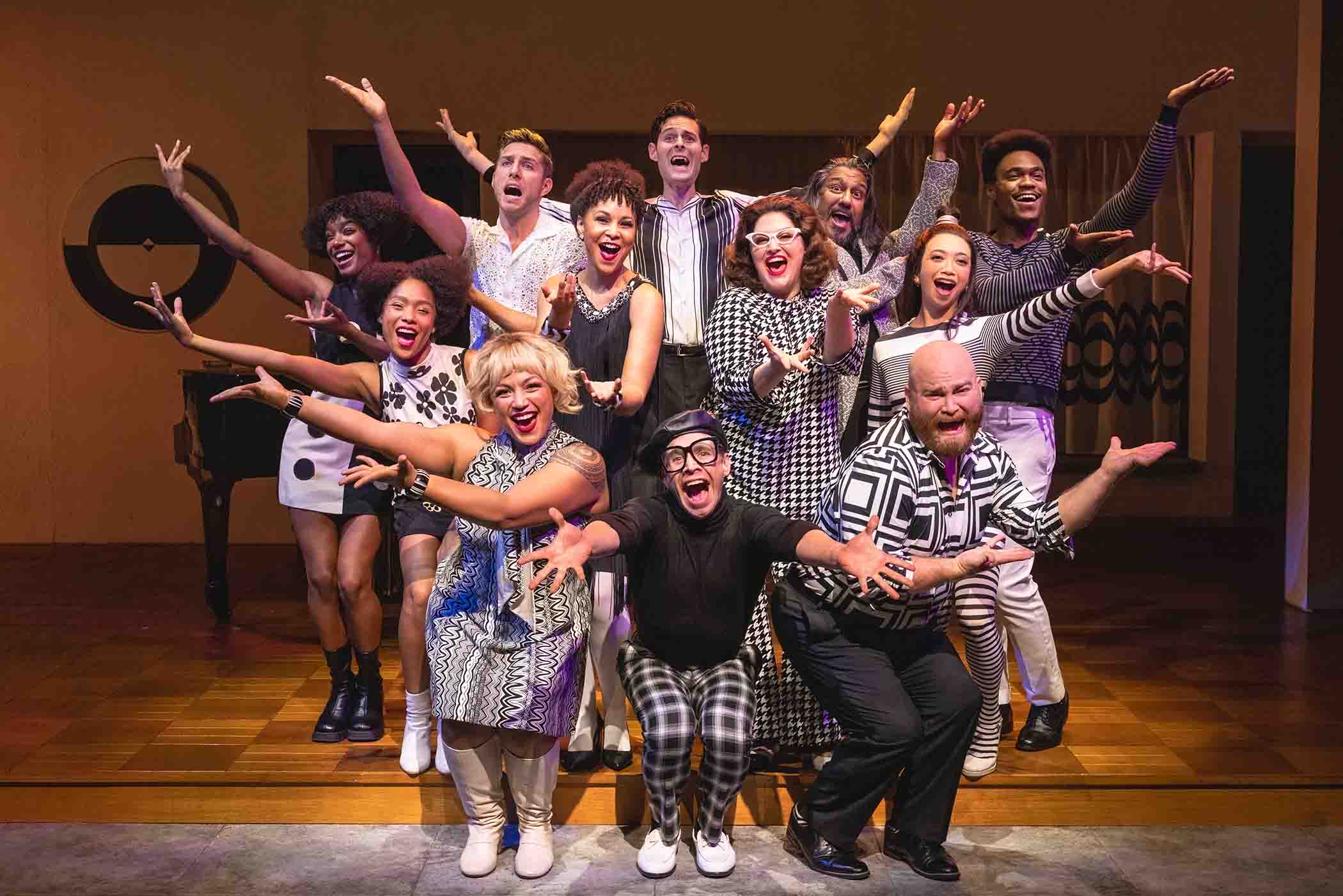
One of the phony party people is Shepard’s second wife, Broadway actor Gussie Carnegie (a name she made up), who admits she’s self-created and going places, if not at all happy. In the first scene, we see Shepard cheating on Gussie, and as the show goes on (i.e., as time reverses), it’s obvious that he’d cheated on Beth with her. We also observe how Shepard has dropped his creative trajectory for the proverbial three-picture deal, and how, like Gussie, he’s become a fake and a heel and he knows it, though he can’t seem to help himself. While endlessly striving, Shepard forgets that success is not necessarily a matter of dollars and popularity.
Krystal Joy Brown is glamorously persuasive as Gussie and Broadway vet Reg Rogers is pricelessly loopy and believable as Joe, the producer husband she dumps for Shepard, leaving him on the path to obsolescence.
The score may not be one of Sondheim’s most consistently dazzling, but four songs — “Not a Day Goes By,” the defeated “Good Thing Going” (“We had a good thing going, going, gone”), the rollicking “Old Friends,” and the angsty title song — have become standards, a testament to the fact that even good Sondheim is better than great almost anything else.
“Bobby and Jackie and Jack” is a witty satire of the Kennedy clan — poking fun at their large numbers, their golden attractiveness, and their cultural aspirations — which Shepard, Charley, and Beth perform in a club in ’61. That the scene is set before the assassinations take place adds an intended subtext of darkness, unknown to the giddy characters. As per usual, they should only know what lurks in the future.
But Act Two has some unmitigated joy too, particularly “It’s a Hit,” an ecstatic ditty the three leads sing with Joe when they realize the new show Shepard and Kringas have written, Musical Husbands, is scoring and their lives have been irrevocably changed (“No more writing clever little shows for those basement saloons,” sings Shepard. “No more proclamations from the pros that ‘You can’t hum the tunes’”). Well, more than four decades after it premiered to quizzical expressions, Merrily We Roll Along is a hit. Kudos to Friedman and company for going back in time to see what went wrong. ❖
Merrily We Roll Along
Hudson Theatre
141 W 44TH Street
Michael Musto has written for the Voice since 1984, best known for his outspoken column “La Dolce Musto.” He has penned four books, and is streaming in docs on Netflix, Hulu, Vice, and Showtime.