



Here’s a tale from another time: It was the tail end of the last century, the term “information superhighway” was being bandied about by presidential hopefuls, there were still serious art galleries in SoHo, and alternative spaces dotted the visual arts landscape like mushrooms. One of the most venerable of those venues was (and remains) White Columns, then located on Christopher Street.
If you were an unknown artist struggling to get someone — anyone — besides your befuddled (if not outright skeptical/hostile) family members or your slacker friends to look at/critique your work, you could always turn to White Columns’ slide registry. (And yes, they required actual 35 mm slides — not those newfangled JPEGs that only prickly IT guys knew much about as the Internet was gathering steam — which you attempted to shoot with the correct, Hades-hot photo floods for proper color balance.) Once your plastic sleeve of cardboard-mounted frames was on file, you would probably, at some point, receive a visit from WC’s then director, Bill Arning, who would trek to the farthest reaches of the five boroughs to see in the flesh just what you were up to in your cramped studio. He might not put you in a show (there are only so many exhibitions possible in a given season), but you got the impression from the man’s insightful questions and genuinely helpful comments that he was filing your work in a mental flat file for future consideration.
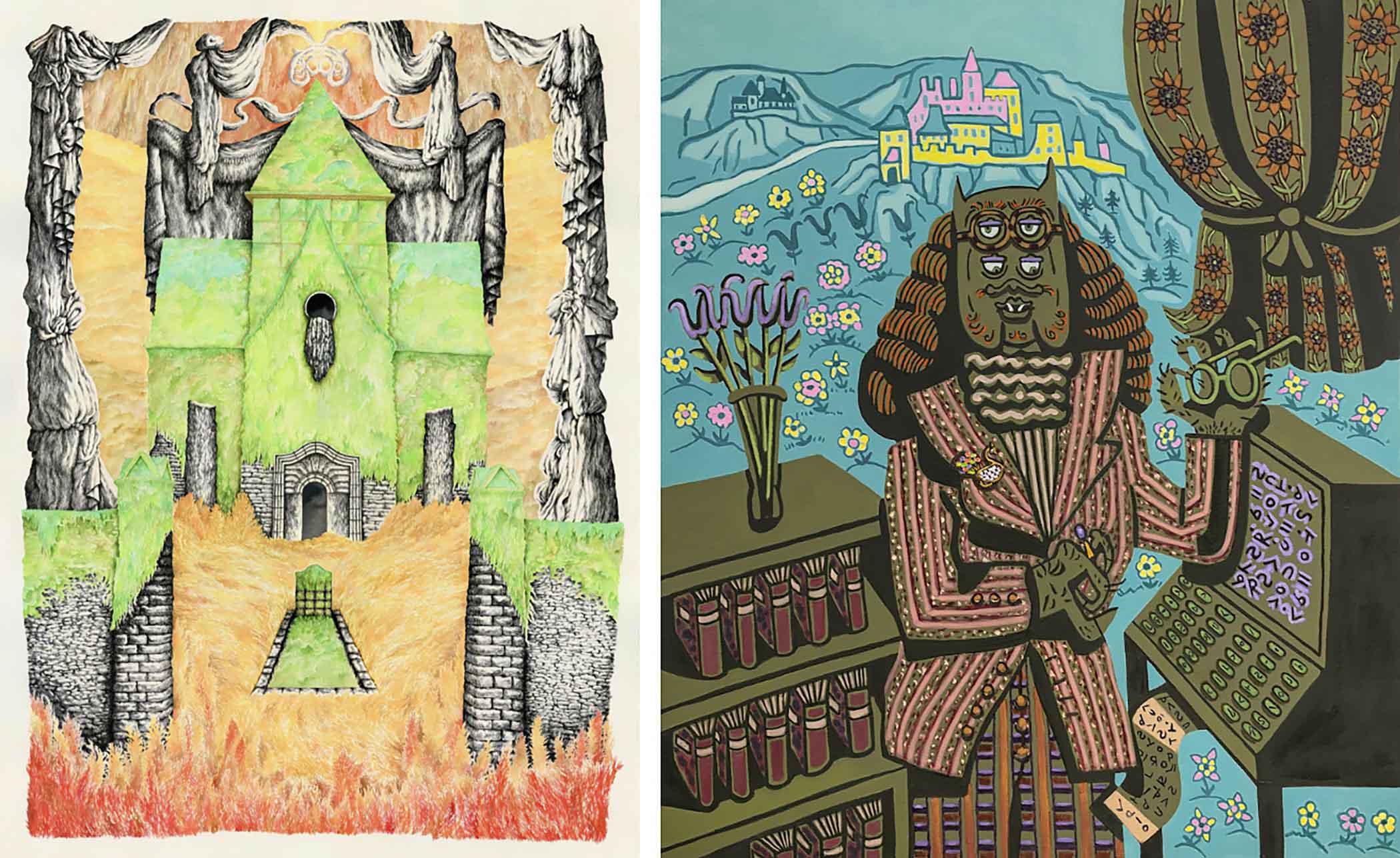
Arning moved on to many other projects (including, in 2016, a survey of the scintillatingly witty Mark Flood, at the Contemporary Arts Museum Houston) but never lost his touch for fusing far-flung artistic sensibilities into coherent group visions. He continues that tradition with his latest curatorial foray, Ambiguous Storytellers, at LUNCH (Located Under NADA’s Central Headquarters), on East Broadway. Gathering artists from across the country, Arning conjures lively dialogues between disparate works, as in the way Ario Elami’s deliciously creepy and vivaciously colorful watercolor of a moss-enshrouded stone structure, “Slaughterhouse” (2025), dovetails compositionally with the robustly sculptural beast in Hannah Barrett’s 2024 painting “Spectacles.” Beyond a powerful frontal solidity, the pieces share a coherent phantasmagorical plane, as if Barrett’s gothically stylish creature, surrounded by books and an odd typographical contraption, lives inside a room in Elami’s foreboding — if eerily inviting — abode.
Similarly, the way the spectral figure in Jeffrey Heiman’s 2024 painting “Panel 1: A Light Burned Through Me” seems to be searching for something crucial amid a quiet domestic setting echoes the contemplative concentration of the blue-skinned, pink-winged being in Tyler Brandon’s “Cause & Effect” (2026). Heiman’s beautifully delicate oil washes summon a poignant atmosphere, as if the disembodied figure frustratingly lacks the physical presence to open the mysterious little box on the bureau, while Brandon’s gauzy flora and landscape provide the perfect backdrop for whatever enigmatic missive is being held up by azure fingers to be studied through a backlit, slitted gaze.

Stories ping around the gallery, affinities perhaps just beyond mental grasp, but engaging and delighting one’s eyes and emotions. “For a long time, much of visual art treated narrative as an impurity, something to be avoided,” Arning writes in the press release, adding, “Yet a small group of artists could never quite abandon art’s oldest function: telling through showing. The storytelling that survived did so by welcoming ambiguity — not as a flaw, but as a source of vitality.”
Indeed, as Philip Guston — enroute to transforming elegant abstractions into fulsome cartoon tableaux — once famously related to the poet Bill Berkson, “I got sick and tired of all that Purity! Wanted to tell Stories.” Arning is carrying through on this exhortation from one of last century’s — any century’s, actually — greatest painters.
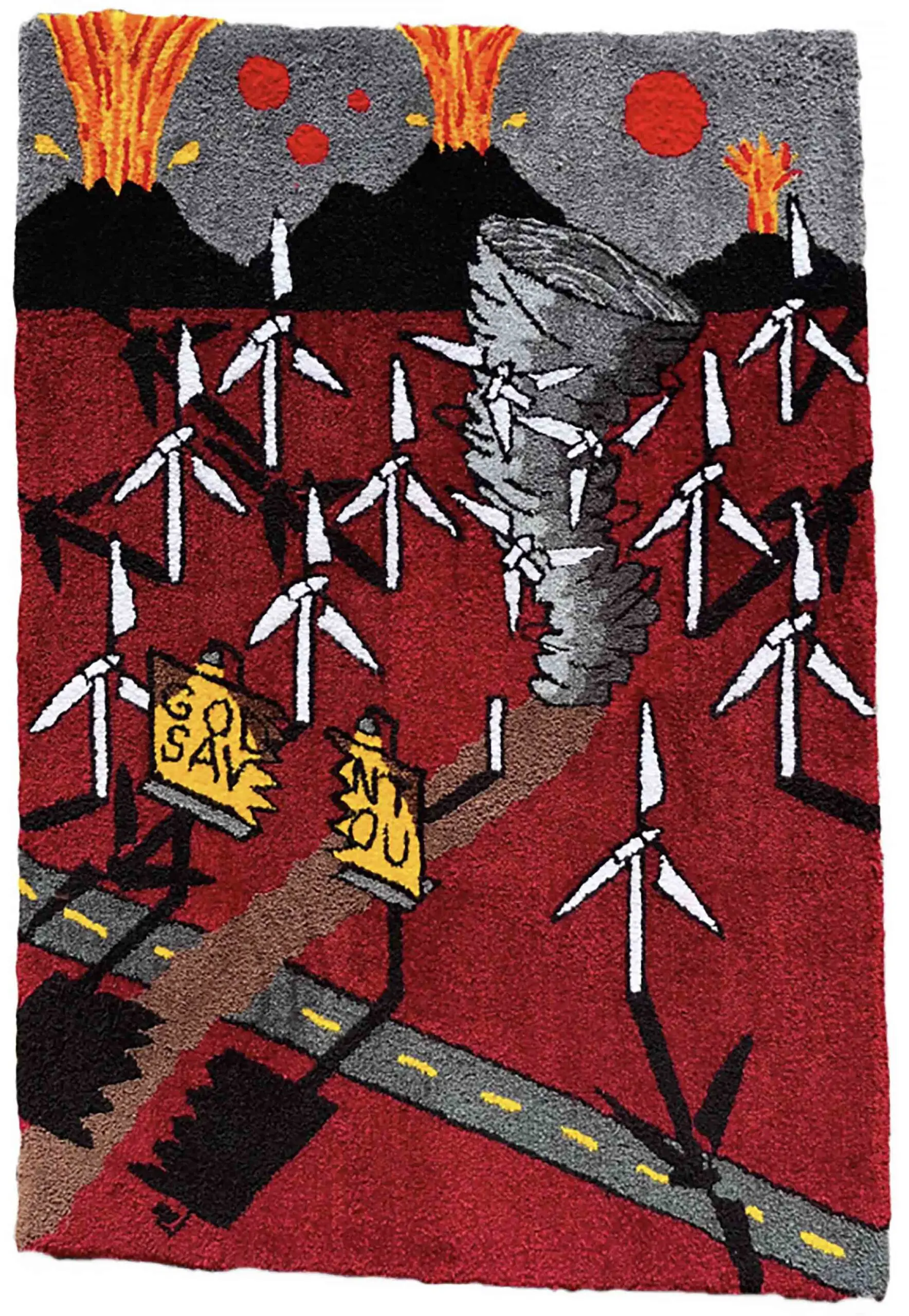
That almost all of the roughly two dozen works here are paintings — Matthew Gilbert’s five-foot-plus tall, high-octane tapestry, “Flat Parts On Their Buzzcuts” (2024), featuring volcanoes and a tornado menacing a wind farm, being the exception — makes sense. We have no idea what those antediluvian painters were saying to each other in caves around the globe all those millennia ago, but their animal imagery and abstract symbols impart thrilling — if enigmatic — stories right down to our own day. For instance, the narrative purpose of all those handprints layered on the raw rock walls of Argentina’s Cueva de las Manos over an approximately 8,000-year period might be lost to us now, but there’s no denying the graphic allure of humanity bequeathed to us through these graffiti-quick stencils blown through bone pipes. And while the long march of civilization is potholed with too many eruptions of cultural violence, perhaps, with a bit of luck and some serious social commitment, the two handsome gents of a certain age embracing in Brian Kenny’s 2025 “Slow Dance” will still be on view somewhere in the year 10,026, and our great-grandkids (times roughly 320 generations) will still be a bit flummoxed, as we are today, by that dinosaur with the stylish pink talons in the background. ❖
Note: The gallery will also host readings and performances: David Mramor/Enid Ellen will perform on Saturday, January 31, at 7 p.m.; Jason Schneiderman and Wayne Koestenbaum, who were originally reading on January 30th, have, in solidarity with the National Shutdown action on that day, rescheduled for Sunday, February 15th, at 5 p.m.
Ambiguous Storytellers
LUNCH (Located Under NADA’s Central Headquarters)
311 East Broadway, Floor 2
Through February 21