



A film of many pleasures, even if it sputters a bit in the homestretch, writer/director Mike Flanagan’s big-screen adaptation of the Stephen King novella The Life of Chuck is a story told in reverse, in three different time frames. Chuck’s life, like yours and mine, has three acts, and Flanagan and King begin with Act Three. Chuck won’t become a proper speaking character until Act Two, but he’s omnipresent nonetheless to the inhabitants of the opening section, who appear to be facing something akin to the end of the world. Nick Offerman is the all-seeing narrator who explains this apocalypse; among other disasters, California is falling into the sea, there are volcanoes erupting in Germany, and, to the dismay of many, Pornhub is down for good.
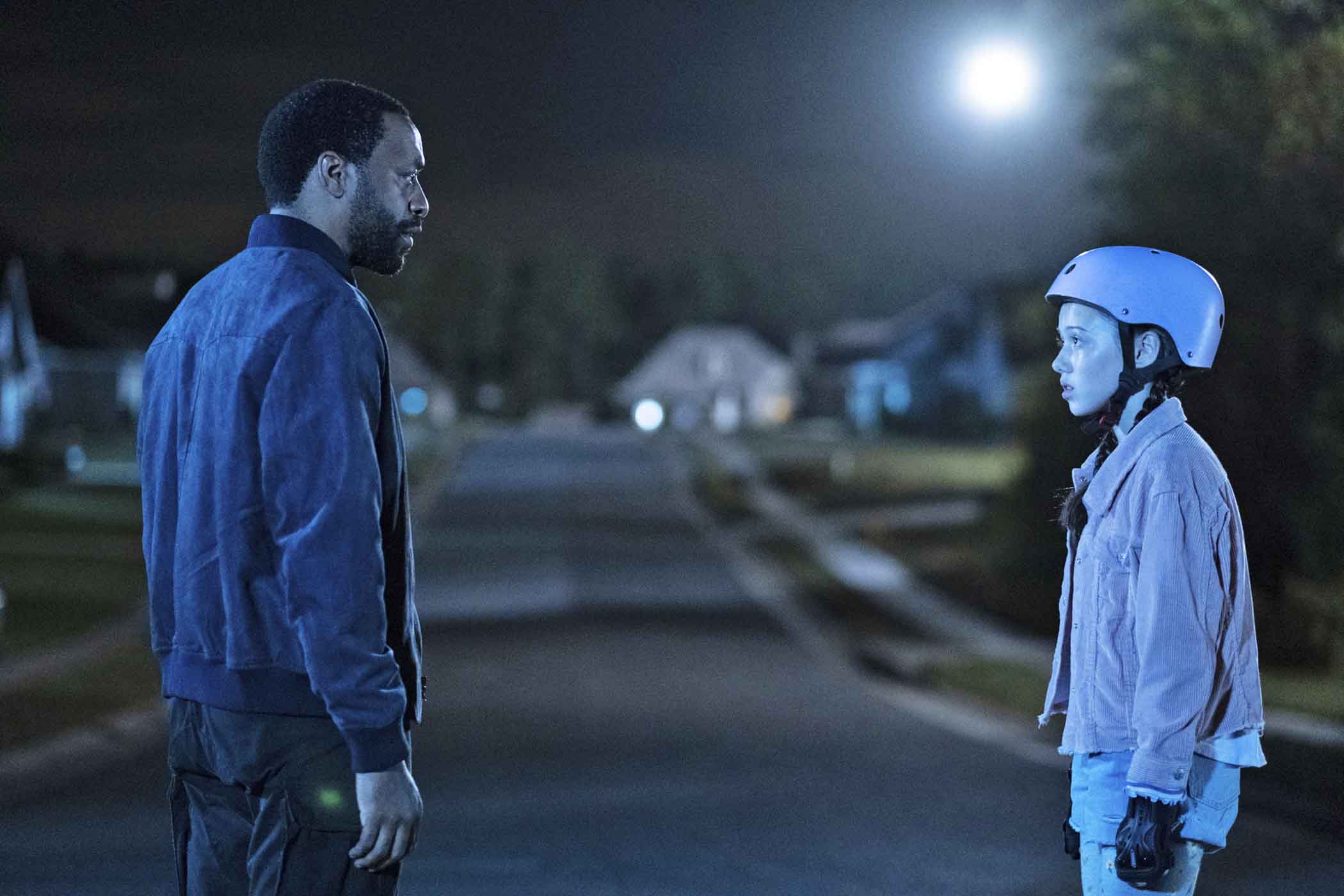
Like his Midwestern neighbors, school teacher Marty Anderson (Chiwetel Ejiofor, superb) is trying his best to carry on with daily routines amid the bad news. On his way home from a day of humorously pointless parent-teacher conferences — the parents are more worried about the faltering WiFi than their kids’ grades — Marty looks up in traffic to see a billboard celebrating the retirement of one Charles Krantz: “39 Great Years! Thanks Chuck!” There’s a photo, too, of Chuck (Tom Hiddleston), a white guy in black-framed glasses. Perhaps an accountant, many speculate, but surely too young to be retiring. The Chuck ads are soon appearing on every possible screen, and later, on windows and even written across the sky, on the same day a giant sinkhole appears in town.
Chuck’s joyful dance on the avenue might prove to be the director’s lasting film legacy, as it’s likely to be for Hiddleston.
Unnerved, Marty calls his ex-wife, Felicia (Karen Gillan), a nurse, to see if she’s okay. Their dialogue is straight from King’s story, but Flanagan has added to it a beautifully written lesson given by Marty on the theory of the Cosmic Calendar, as it was once explained by the late Carl Sagan. Felicia indulges Marty in his excited monologue because she’s exhausted, and because she knows he needs to talk. Teachers gotta teach, even at the end. If Marty is right, and they really are in the “last 10 seconds” of the cosmos, he’s the one she’d want to spend them next to. Chances are, even then Marty will still be trying to figure out why the Chuck ads are increasing. And why Chuck isn’t looking as content as he first did.
At the start of Act Two, Offerman advises us that a street drummer (Taylor Gordon), just starting her day of busking, has been inspired to strike a new beat by the confident stride of an approaching tourist she dubs “Mr. Businessman.” This would be the mid-life Chuck Krantz, an accountant visiting from out of town, who surprises the drummer, and himself, by beginning to shake his hips in time to the beat. Soon he’s gliding across the walk like a vacationing Gene Kelly. When a crowd forms, Chuck reaches out his hand and invites a young woman (Annalise Basso) to join him, and together the duo make a memory, for themselves and for the circle of delighted onlookers.
Flanagan has kept busy (Doctor Sleep, Netflix’s Midnight Mass, a forthcoming Carrie TV series), but Chuck’s joyful dance on the avenue might prove to be the director’s lasting film legacy, as it’s likely to be for Hiddleston. The high-energy choreography is by La La Land’s Mandy Moore. In her staging, she and Flanagan do a seemingly simple thing that those behind modern movie musicals often neglect: They clear a wide-open space for their dancers to move in, and in doing so, allow us to really see them.
Directly after this dance, Flanagan, who also edited the film, lingers longer in this mid-life Chuck time frame, perhaps, than he should. Like many a filmmaker before him, he’s being overly faithful to Mr. King. But he’s then on to Chuck’s adolescence, which is being spent in the home of his grandparents (Mia Sara and Mark Hamill) after the untimely death of his parents. For a time, the narrator tells us, it’s a sad place, but soon 11-year-old Chuck (now played by the gifted newcomer Benjamin Pajak) is getting dance lessons in the kitchen from his grandmother, who can really swing, and venturing into an afterschool dance class, “Twirlers and Spinners,” where he rules. Later, getting cold feet on the night of the Fall Fling dance, Chuck will step outside for a breath of courage, where the night sky resembles that beneath which Marty and Felicia sit near the end of the film’s opening section.
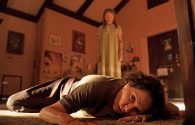
Have we mentioned the haunted cupola room? Well, there is one, and Chuck’s Grandpa Albie keeps it locked tight. Did the novella need the cupola? Does the movie? That’s a question for future debate. A college-age Chuck (played by Jacob Tremblay) will eventually open the locked door, but what is revealed might not prove as impactful to moviegoers as the lovely talk he’s had with his middle-school English teacher (Kate Siegel) about Walt Whitman, or Albie’s advice to Chuck about the “art” inherent in being a gifted accountant, a speech Hamill delivers with the hushed, gravelly intensity of a man who’s waited all his life to say this one true thing. Albie’s grandson is savvy with numbers and graceful on the dance floor — imagine the artful life he might be destined to live. ❖
Chuck Wilson is a Los Angeles–based writer who has written for the L.A. Weekly for over 25 years and has been a longtime contributor to the Village Voice.