






If you haven’t heard much about FESTAC ’77 (also known as the Second World Black and African Festival of Arts and Culture), you are not alone. But considering that the landmark gathering in Lagos, Nigeria, brought together some 17,000 artists, performers, writers, and philosophers from around the world, plus untold thousands of journalists, curators, producers, and audience members, as well as spiritual and civic leaders, it’s past time to fix that. The current exhibition at Gray Gallery, “So Be It! Asé! Photographic Echoes of FESTAC ’77: Roy Lewis, K. Kofi Moyo, Bob Crawford,” offers a tightly curated entry into the archives of three photographers who traveled to Lagos with the United States delegation, documenting in exhilarating scope and detail their journey and the wealth of stories the month-long festival offered.
The exhibition is on view through January 19, but for its curator, Romi Crawford, the quest to tell this story is only just beginning. Crawford, whose father was the photojournalist Bob Crawford (1939–2015), is a professor in the Visual and Critical Studies and Liberal Arts departments at the School of the Art Institute of Chicago. Her work explores dimensions of race and ethnicity with regard to American visual culture, including art, film, and photography. In many ways this exhibition sits at the intersection of her personal and professional backgrounds — but given the focus of her practice, in an art historical sense, it was also inevitable.
“Musicians were talking to poets, poets were talking to dancers, dancers were talking to visual artists.”
“It starts with family,” Crawford tells the Voice. “My father was one of the artists who went to FESTAC. But also, oddly enough, it’s something that I did not want to query, not for a long while. But I kept coming back to it in my research. At a certain point you’re like, oh my gosh, okay, I can’t deny my destiny. It’s absolutely such a wild, wonderful case for me.” Crawford finally decided to dive into her father’s archive, and to pay attention to the related photographic archives of Roy Lewis and Kofi Moyo — and that has both changed and deepened the course of her career.
For 29 days in early 1977, delegations from dozens of African countries, as well as Brazil, India, the Caribbean, and the United States, presented performances, exhibitions, screenings, concerts, panel discussions, lectures, fashion shows, dance parties, readings, and more — as each nation chose for itself a representative cohort of painters, sculptors, dancers, fashion designers, ceramicists, and musicians. What the Photographic Echoes exhibition does so well is not only to give a sense of the power and variety of individual artistry but also the immense scope and scale of the overall undertaking — and it does so while simultaneously highlighting the distinct styles, interests, and visions of the three photographers.
The Chicago-based Bob Crawford, Lewis, and Moyo each pursued a calling to document pivotal social and political events. As members of the socially engaged, interdisciplinary Black Arts Movement, inaugurated in Harlem in 1965, the three would have been right at home in a diasporic cultural milieu of collaboration and cross-pollination. “There’s this weird fallacy in art history sometimes that there’s only the art happening,” says Crawford. “And that folks aren’t also listening to music and engaged with the thinkers, curators, and writers who are in their midst. Definitely, in the case of the Black Arts Movement, that’s not how it is. Musicians were talking to poets, poets were talking to dancers, dancers were talking to visual artists. And so I tried to bring that to life a little bit in the FESTAC exhibition.”
Crawford is the founder of the Black Arts Movement School Modality, and previously curated Citing Black Geographies (2022), an exhibition at Gray presenting artists whose practices examine “Black space — the topographies, zones, scenes, and structures that portend Black cultural experience.” While there’s a definite academic and autobiographical Chicago cornerstone to her research, FESTAC also connects with Cuba and Brazil, parts of Europe, and all across Africa, and fits well within her examinations of how geography and cultural identity inform each other. “I mean, it’s just tremendous. That’s one of the issues that I wanted to kind of kickstart with this exhibition,” she explains. “That it does have a sort of rhizomatic history that connects to so many different populaces worldwide.” Crawford sees this curation as a way to intervene and start some of that historical, archival work.
Regarding this exhibition as the first step in what will become something monumental — along the lines of the trajectory of the film Summer of Soul, but at a global scale — is a heady notion. When choosing the roughly 50 photos from the three photographers’ large archives, Crawford had several elements to balance. “Part of what draws me to FESTAC is that element of the atmosphere of it,” she says. “It can be so hard to capture art historically, to articulate it from the perspective of an art historian or even a curator. How do you capture the energy, the spirit, of something like this?”
In Bob Crawford’s works, we encounter a visual style of classic photojournalistic tropes — the kind of richly toned, black-and-white, eye-level, scene-setting and emblematic portraiture one would expect from the best newspaper coverage, but with an irrepressible dose of verve and personal enthusiasm, expressed in jazzy, jaunty angles and a universal sense of ceremony. Evocative of the Magnum Agency photographers and their uncanny gift for infusing dramatic world events with human presence, Bob Crawford laid a suitably stately, official foundation, offering context and a way into an inviting but unwieldy story.
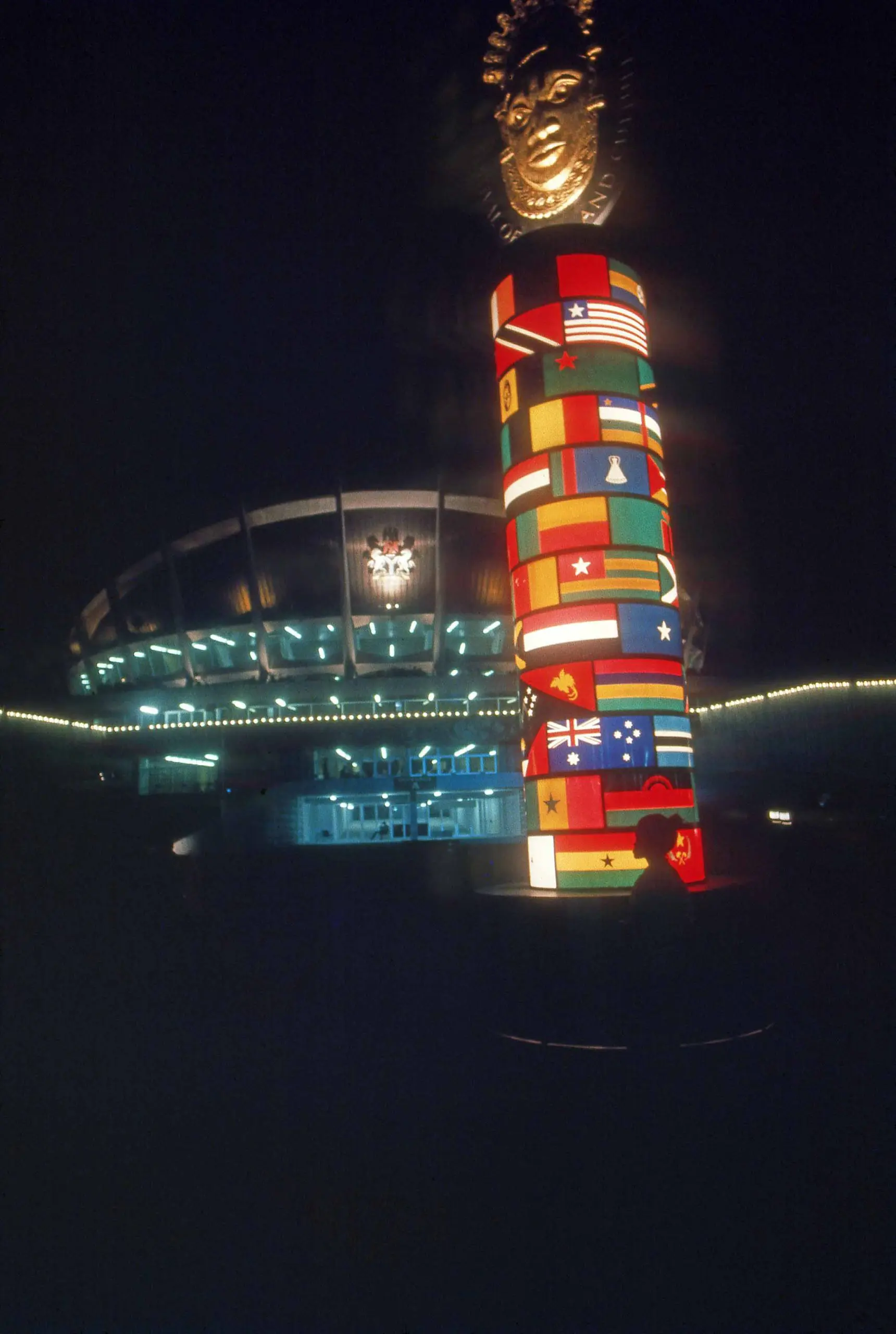
With Roy Lewis, we begin to see some recurring images from Bob Crawford (that we also soon encounter with Moyo), reminding us that these men were all on the ground at the same time and place, and further giving the audience a chance to go beyond merely taking in the information the photographs convey to seeing the individuality of the lensmen behind them. Lewis’s works are colorful, full of motion and dramatic framing. His shot of the National Theater lit up at night, displaying the flags of all the FESTAC nations, is a cornerstone image from the show; his portraits of Jeff Donaldson, Sun Ra, Fela Kuti, Stevie Wonder, and a great many other renowned and charismatic performers are both majestic and intimate, combining onstage and backstage in a warm portfolio that gives a sense of their humanity as well as their genius. At the same time, Lewis’s works also give the research-minded a feeling of campus life in, around, and during the Festival of Arts and Culture — recording not only what happened but also how it felt to be there.
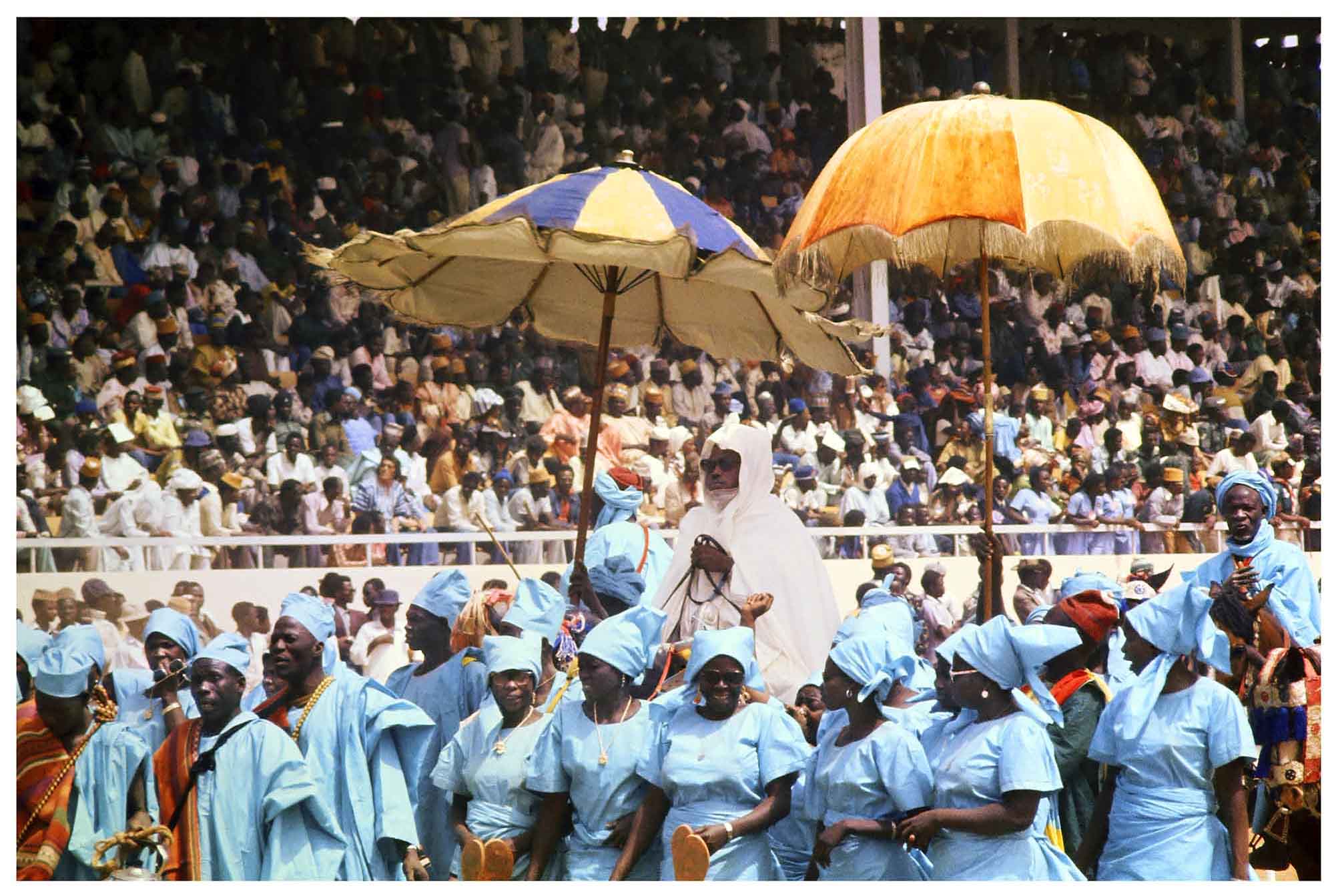
Many of K. Kofi Moyo’s works in the show document the Herculean task of organizing and executing the travel to Lagos itself. For many in the U.S. delegation, this would be much more than just another exhibition, performance, or appearance. Portraying the unending logistical unfolding of the journey lends a further dimension to understanding what it took to make FESTAC happen. Moyo’s interests in Lagos stretched from traditional equestrian performers to the city’s fresh forays into modern architecture.
“I’ve really been trying to think about what it means to make and produce a living art history,” says Crawford. “An art history that we can be invested in. This is not a deep historical span, it’s in the last 50 years. So a lot of people that were there may well still be alive, only in their 70s and 80s. One person who made a book on this so far is the photographer Marilyn Nance. Her archives totally resonate with these. She was actually in the gallery one day before I left town, and she was able to find herself in one of the images. So that is kind of amazing.” It’s clear that this is what Crawford means when talks about a “living” art history.
“And I’m imagining what went on offstage,” she continues. “I mean, some of the things that we’ve heard are unbelievable. There’s so much to get to and find and study.” After all, these 50 images and the hundreds and hundreds more from which they were chosen represent the archives of just three American photographers. Thinking about the literally thousands of personal, professional, journalistic, governmental, and museological additions that such archives scattered all over the world can add to this story is … mind-boggling.
But this kind of research is Crawford’s superpower. “I have just wrapped up a course with research colleagues delving into exactly that, and the outcome project from the group is going to be shown at the Lagos Biennale in February 2024, including some of the original 1977 United States delegation artists,” she says. That kind of full-circle moment is rather breathtaking, and sure to spawn its own sub-documentary within the FESTAC never-ending story.
“It’s just a monster of an art historical object,” concludes Crawford, “and this exhibition is really meant to just get us thinking more actively and aggressively about it — while we have some of the participants still with us” — folks who can tell those stories, put things in context, let us know how they managed to do it, and what it meant to them and their communities to have been part of such a monumental, challenging, unparalleled undertaking. “That’s why I called it So be it!,” says Crawford. “Because FESTAC shouldn’t have happened. It was insane pulling it all together, from what I’ve heard. But they did it. They pulled it off and made it happen. It was incredible. And then it sort of disappeared.” Until now. ❖
So Be It! Asé! Photographic Echoes of FESTAC ’77: Roy Lewis, K. Kofi Moyo, Bob Crawford
Gray Gallery
1018 Madison Avenue
Through January 19
Shana Nys Dambrot is an art critic, author, and curator based in Los Angeles, and is the arts editor at LA Weekly. In 2022, she was awarded a Rabkin Prize for Visual Arts Journalism.