



Master antiquary of the post-Surrealist WTF, Guy Maddin has been with us for almost four decades now, and he’s seen, as we have, the indie film-culture junglescape around him get colonized, stripmined, scorched, rewilded, commercialized, gentrified, and ultimately rewilded again by consumer technology and online overpopulation. He’s always occupied his own freakish and cluttered slice of land out in the boondocks anyway, since emerging with the ’80s indie surge that effectively served as a kind of wily, fringey Narcan-rescue remedy to the opiodal rise of the Reagan-era blockbuster. Of course Maddin is also Canadian, and saw his fusty star appear, in our purview below the border, alongside grotty-dreamy Northern art-house auteurs like Atom Egoyan, Léa Pool, Bruce McDonald, and Patricia Rozema. But even among them, Maddin’s peculiar backward-looking lusts, hermetic priorities, and arcane visual indexings were messages from the subterranean. Cut to today — if he thought he was cooking on the outskirts back then, what must he think now?
I’ve been a devotee ever since I saw Archangel (1990) at the old Bleecker Street Cinema, after reading J. Hoberman in the Voice describe it as “a deadpan whatzit of the highest order” and as “a pastiche — but of what?” Well might we all ask. Staggering out afterward, I ended up thinking that Hoberman, with his trademark jazzy omniscience, was treading delicately — the Maddin Effect was and is an oneiric safari, a Yellow Brick Road grand tour of the neglected and tarnishing past that is kino-kino-kino. From pre-historical times, dreams were often thought to reveal the future, but we’ve known for a while now that they are composites mostly of what has already gone by — including hopes, fears, fantasies, places and people we’d actually forgotten, even other dreams. It has been Maddin’s insight that this is what movies are too: an alternate history, subject to rust and rot but preposterously gorgeous. And not merely individual movies but the entire bright and dirty rainbow of film history, from diehard familiars to the million moments of celluloid no one can recall because they vanished decades ago. Maddin’s films often look and sound like japes, physically stressed to resemble a rundown 16mm TV print someone left in the closet of a small local TV station in Detroit in 1961, or digitally warped to invoke the squirming instability of nitrate decay. But they’re all oblique serenades to the entirely made-up past that movies represent — a past we can still see and remember but which never really happened.
The movie explodes like a Guy-signed bunker-buster — a boiling, nitrate-decay mélange of unfinished stories of doomed submarines, lumberjack gangs, jungle vampires, volcano worshippers, and endlessly on.
Except it did. You can see his predicament: As he plows forward into the unknown of 21st-century post-cinematic media life, he can’t help but keep looking back. For the Maddin newbie sidling into the IFC Center’s feature-career retro (Maddin has never stopped making shorts, more than 50 of them, each distinctive and worth hunting down), it’s perhaps best to begin by characterizing him as he began: a low-budget retro-meta-ironist fabulist who created his own antiques roadshow from obsolete filmic vocabularies (early sound primitivism, Teutonic “mountain” films, silent Soviet propaganda, seminal-stage Dada, etc., plus traces of cinematic traditions no one else seems to know about), in movies that are pulpily grave yet hilariously deadpan, intensely emotional yet farcically plotted, comprised of little more than shadow and cardboard yet vividly visual, incestuously spiked with antiqueness and yet unmistakably the contemporary work of a single movie-drunk impresario.
The first four features (buttressed by some 14 shorts in the same dozen or so years) are a catalog of Maddin’s excavatory impulses. Relegated to the midnight-movie circuit in its last days, Tales from the Gimli Hospital (1988) is a gross-out daydream somehow constituted as an amateur silent movie made by and for devolved Icelandic expatriates trapped in an otherworldly Canadian nowhere — otherworldly because Maddin didn’t dress sets or use locations so much as suggest a nether realm of pretend-play with sheets, shadows, trash, and silhouettes. As almost always, pent-up lusts and unsatisfied ardors, jacked up to 11, drove the jalopy of a narrative, and the 16mm filmmaking was so conscientiously ramshackle that film festival judges sometimes mistook it for hackwork.

There was no mistaking Archangel, still my Maddin to beat, as anything but masterfully crafted detritus, coming entirely disguised as a very indie semi-talkie from 1930ish, complete with scratches, flickerings, missing frames, soundtrack skips, fading title cards, etc., and its own fake studio logo (“Ordnance”). Set in the eponymous Russian city after WWI but quite obviously shot on hand-hammered sets amid strategic shadow casting, the film plunges through a smorgasbord of crisscrossing plotstuff (multiple postwar amnesiacs mistakenly in love, Bolshevik incursions, floods of rabbits into trenches, ghosts, and so on) that’s nearly as head-shaking as its inspired visual inventions. Maddin managed, yards away from the new millennium, to reincarnate the itchy, magical, unprofessional-accidental early-’30s style of Jean Vigo, but with a sardonic grin.
But not just: The film’s rangy invention hints at other influences that have been lost to time, movies everyone has forgotten. Archangel, in fact, wants to be a lost film — a historical paradigm that haunts Maddin, enough for him to have staged “Seances” in 2012, a series of star-studded reinventions of 30 forgotten lost films publicly shot in a trance-y rush (in the Pompidou Center, in Paris, and in Montreal), later to be shuffled randomly on an eponymous website, which creates a new film every time you go to it, and is still in operation. Later, portions of the project were edited together to create the 2015 film The Forbidden Room.
Just as lost, if more ambitious, Careful (1992) has its candy-colored roots in the German, Arnold Franck/Leni Riefenstahl “mountain” films of the ’20s, scrambled with 19th-century novelist Johanna Spyri (Heidi), Wagnerian romance, and, specifically, early-Modernist Robert Walser’s 1909 novel about a butler school, Jakob von Gunten, whipped into a Freudian whirlpool. We’re in an Alpine village (papier-mâche, forced perspective, lens fog) under the constant threat of avalanche; the animals’ vocal cords are cut, and we glimpse a dog soundlessly barking. Unsurprisingly, it’s a hotbed of repressed impulses, and the town’s pastel cheeriness is soon tainted by frantic guilt, incest, suicide, blind ghosts, and murder.
How better to salute a film about reconstituting a lost obsession than by obsessively reconstituting it?
The textual chinks are the big laugh-getters; no other filmmaker has gotten so much from so little. It’s an irony surely not lost on Maddin that the intentional old-timey crudity of his films seems more assured and canny than the polish of contemporary industry mammoths costing 100 times the cash. With its use of mandarin color-tinting, waxen performances, and purplish dialogue, Careful is Maddin’s Euro-epic — a sly movie-movie no less hilarious and gorgeous for its often astounding technical somersaults and authorial jerry-rigging.
With Twilight of the Ice Nymphs (1997) Maddin went off the Earth, set in a nightless fairyland-slash-ostrich-farm and structured, absurdly, around a six-way romantic entanglement complicated by severed limbs, mesmerism, and murder. By now, antique film styles were in the rearview mirror, but with his biggest budget and therefore meddlesome producers, Twilight became such a production debacle it garnered its own making-of doc (1997’s Waiting for Twilight, directed by Noam Gonick and narrated by Tom Waits). Maddin’s regrouping entailed an interlude filming the Royal Winnipeg Ballet’s performance of Dracula, as Dracula: Pages from a Virgin’s Diary (2002), and then, going smaller and more personal than ever, the probably agonizing shift to digital and the twisted anti-autobio silent-psychodramas of what Maddin calls his “Me Trilogy”: Cowards Bend the Knee (2003), Brand Upon the Brain! (2006) and My Winnipeg (2007).
These films weave spirited, lie-packed Maddinesque yarns about Maddin himself (not a new thing; he’s always been the least trustworthy of interviewees), narrated in a very particular present, but still jittery and foggy and obsessed with a cluttered, often absurd past, or pasts, that will not disappear or die. The trilogy, boiling along in a mode of neurotic digital hyperediting and crazed first-person attack, can cook your synapses just as it also reveals to new cineastes how much can be done with very little — shadow, nerve, and raw invention, mostly. As it happens, amidst that bout of tail-eating, and scores of shorts, there came The Saddest Music in the World (2003), maybe the Guy Maddin movie for people who don’t otherwise get Guy Maddin movies, whoever they are, and the one most embraced for its “accessibility.”
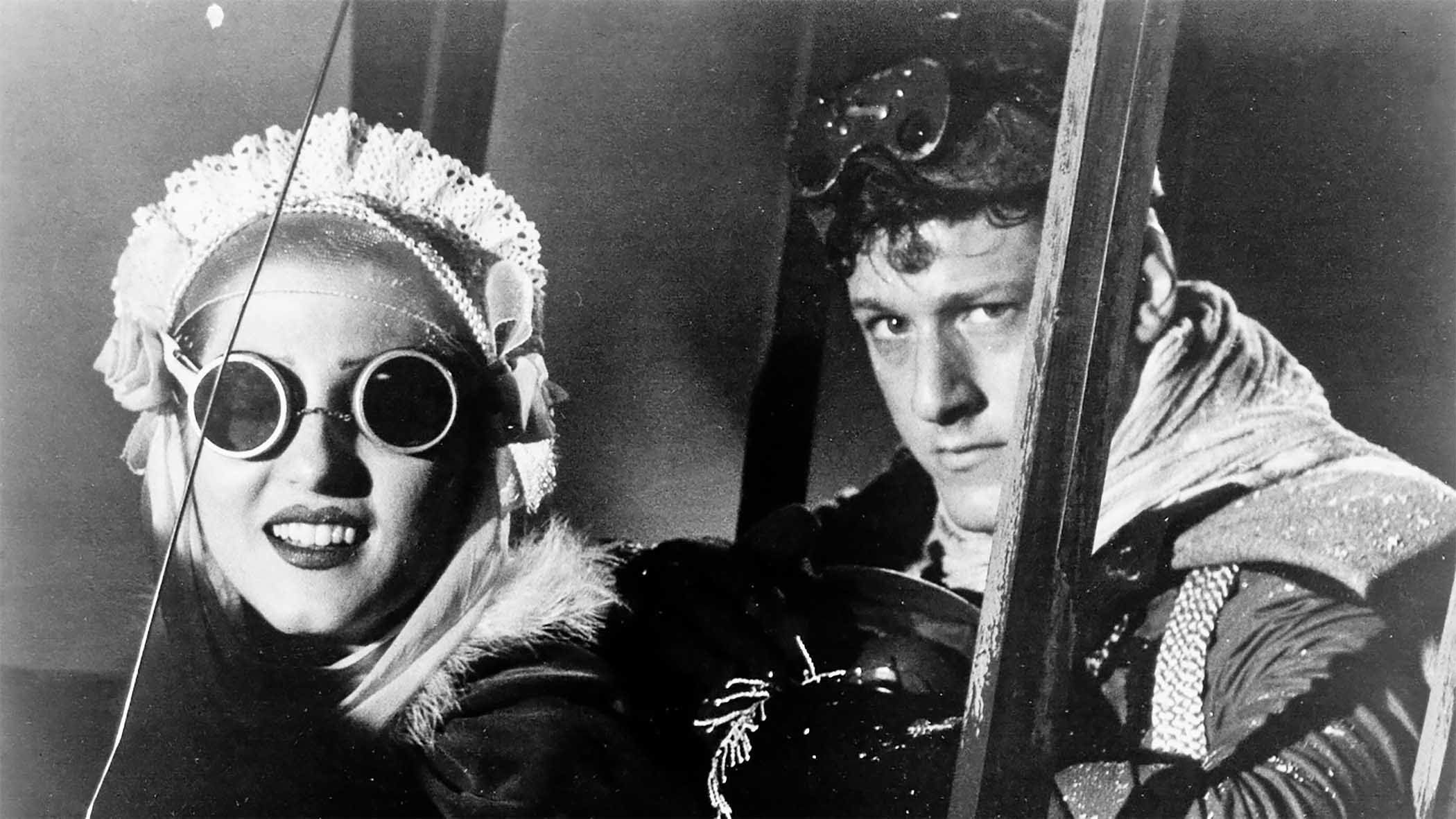
Maybe — it’s certainly the most Canadian thing on Maddin’s shelf, and the most beer-soaked, even if based upon a discarded screenplay by novelist Kazuo Ishiguro and visually stewed in a broth of faux Socialist Realism, cardboard Futurism, underground-amateur Super 8, and fake snow. The story is, again, a knot of impassioned unlikelihoods, set in a sorrowful ’30s Winnipeg and revolving around a love-tortured pentagon of characters, including Isabella Rossellini as a double-amputee brewery queen. Rousingly acted (you might miss, as I did, the found-under-a-rock aura of the earlier films), and affectionately dishing Canadian self-identity, the movie is a lavish flexing of Maddin’s pet gym move: outrageously satirizing the essence of old-school melodrama conventions while insisting that he loves it above all things.
Since 2008, Maddin has been a searcher. The lack of love for the fabulously 80-proof-Maddin mock psychofest Keyhole (2011) — with its undead gangsters and horny ghosts and blind clairvoyants, I’ve always wondered how it would’ve been received if it had been some unknown’s first film — led him to the “Seances” project. In one way, it was a return to his primal lost-film interests, and in another a stride onto new conceptual territory — filmmaking, or reimagined re-filmmaking, as both performance and interactive meta-movie thingamabob. The feature Maddin ultimately built out of the footage, The Forbidden Room, could be one of dozens of possibilities, but as it is the movie explodes like a Guy-signed bunker-buster — a boiling, nitrate-decay mélange of unfinished stories of doomed submarines, lumberjack gangs, jungle vampires, volcano worshippers, and endlessly on. It is, for cinephiles, a Dionysian feast of excess.
It’s also hardly repeatable, and Maddin’s next feature (again, in a sea of eccentric shorts) is a far leaner experiment: The Green Fog (2017), which manages the impossible by effectively remaking Hitchcock’s Vertigo (1958) almost scene by scene (almost), by using only found footage culled from other movies and TV shows also shot in San Francisco. How better to salute a film about reconstituting a lost obsession than by obsessively reconstituting it? Found footage films from Joseph Cornell onward are, for a certain breed of movie geek, ambrosial opiate hits (it’s odd that Maddin hadn’t made one before), and this underseen, under-distributed miracle is a fascinating lyrical hilarity in practically every repurposed shot — particularly if it’s the frequent glimpses of Karl Malden from The Streets of San Francisco (1972–77), or the swoony suite of Chuck Norris clips.
Like The Forbidden Room, The Green Fog was co-made with Evan Johnson, plus his brother Galen; it’s as though Maddin needed a junior-varsity AV squad in his laboratory suddenly, not merely a hunchback assistant (that’d be his frequent co-writer George Toles). Maddin’s new film, Rumors, opening next week, is helmed by all three in equal credited measure, and with it Maddin has taken on yet another entirely different mode: a contemporary, visually glossy political satire, in which world leaders at a G7 summit (including Cate Blanchett killing it as the chipper German chancellor) literally get lost in the misty German woods, get stalked by bog zombies, witness folk-horror bonfire masturbation rituals, and find the giant brain first seen in The Forbidden Room, all the while attempting to cobble together an utterly useless rhetorical “statement” to address “the present crisis.” It’s a skit-show setup run amok, and perhaps a downer for Maddinites, who never wanted to see him make a relatively ordinary movie. The weirdest part, though, is how Rumors targets present-day political nonsense with no thought or love for the filmic past. Damn the march of time — our 21st-century dystopic churn has turned even the wizard of Winnipeg around, away from the lovely, neglected archives and toward the maddening global now. ❖
Forbidden Rooms: The Films of Guy Maddin
IFC Center, 323 Sixth Avenue
Friday, October 11–Thursday, October 17, 2024
Michael Atkinson has been writing for the Village Voice since 1994. His latest book is the new edition of his BFI tract on David Lynch’s Blue Velvet.
