




America lays claim to its expatriates by never letting them forget the nation they left. Whether paying Uncle Sam taxes after decades away or speaking incessantly about political strife back home, the expat wears the U.S.A. like scarlet letters on the chest — and simultaneously as a badge of honor. Americans are blustering, predominantly monolingual, and coddled by their nationality. They rarely need to assimilate to new cultures because their country of origin has sculpted so much of the wider world in its own image: A Yankee can escape the 50 states, but not the clutches of Coca-Cola, McDonald’s, or, for that matter, the CIA and the web of surveillance it’s spun since the start of the so-called American Century.
Paris might be the most storied (non-)home for Americans living abroad. The French sport a national hubris to match our own, and like squabbling parents and children, the two states seem increasingly similar when they assert their differences. In place of new-world innovation, there’s old-world tradition; instead of the social and psychological disease of Jim Crow, there’s systemic and unapologetic hatred for Black and Brown immigrants. The U.S., as it kicks and screams its way down the rungs of international esteem while clinging to an erstwhile global dominance, resembles more and more the imploded empires of Western Europe. And like so much of the planet, France, no matter its pride in a rich heritage, is relentlessly transforming into a chain-store-filled United States.
Americans in Paris: Artists Working in Postwar France, 1946-1962, a sprawling exhibition at New York University’s Grey Art Museum (known as the Grey Art Gallery until it relocated earlier this year), places us at a turning point in the two countries fortunes. The show begins after World War II, as the Cold War was gaining momentum — the Nazi occupation had already mutilated the Paris of Gertrude Stein’s Lost Generation, rendering its creative energy and hedonism a shell of their former, spectacular selves. The French citizenry emerged from the Second World War hungry, poor, and beleaguered; the U.S., having fought Axis foes almost entirely on foreign soil, morphed into an unlikely Pollyanna after its own scorched-earth triumphs. The G.I. Bill offered any American veteran enrolled in classes $75 a month during the school year, plus tuition and money for books, which made them privileged characters — at least in bohemian terms. You could eat and drink well in the City of Light for much less than two dollars a day, and pay about the same pesky sum each month to live in apartments without running water or wintertime heat.
Pretty much everyone watched, from their tiny chambers along the river Seine, trends in New York, among them the ascent of Jackson Pollock and the abstract expressionists who followed him.
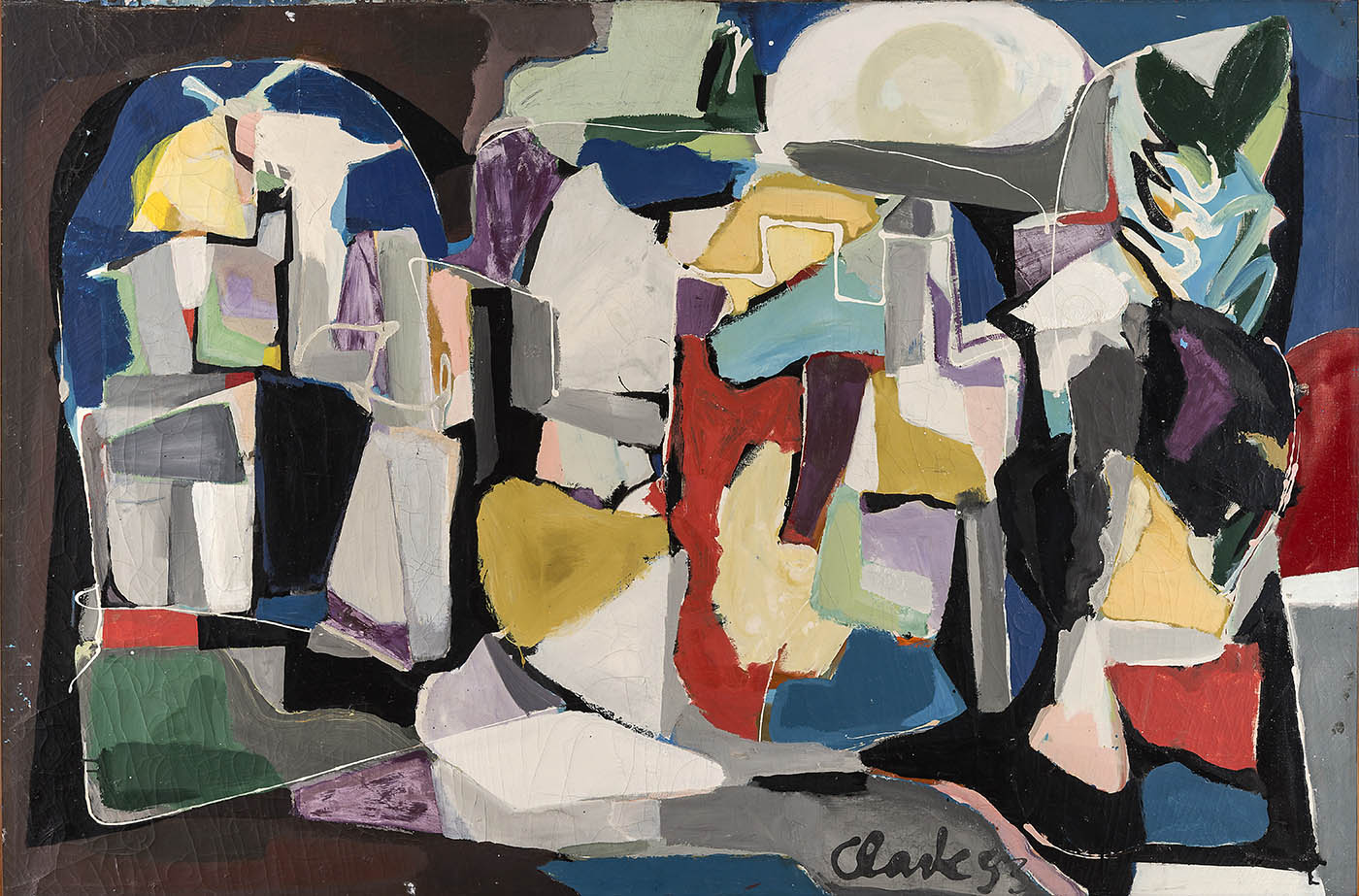
And so artists came flocking: painters Ellsworth Kelly, Ed Clark, Joan Mitchell, Sam Francis, and Beauford Delaney; sculptors Barbara Chase-Riboud, Claire Falkenstein, Shinkichi Tajiri, and Harold Cousins; writers James Baldwin, Richard Wright, and publisher Barney Rosset; photographers William Klein and Emil Cadoo; filmmakers Melvin Van Peebles and Robert Breer. The women, of course, had to figure out ways to bankroll their stays without military funding, as did many of the men, among them Wright and Van Peebles, who came to Paris not on the dime of presidents Truman and Eisenhower but rather to escape anti-Black bigotry on their home ground. The recently active servicemen enrolled in art schools such as the Académie of the Grand Chaumiére, where each month the Veterans Administration checked for ex-soldiers playing hooky, and the École des Beaux-Arts, which had no attendance policy whatsoever. Here they honed their work, and discovered that the planet’s most legendary art city for the past several centuries was stuck in a distant past.
As painter Al Held recounts in the exhibition’s superb accompanying book, there weren’t many modernists in Parisian galleries of the time, beyond sculptor Alberto Giacometti. Young American transplants arrived at a cradle of the early-20th-century avant-garde and found that the rupture of the Nazi invasion had left a paucity of boundary-pushing art compared to what had entranced many of them back in just a small swath of midtown Manhattan, at the likes of Peggy Guggenheim’s Art of This Century gallery and the Museum of Modern Art. Some linked up with influential critics, such as Michel Tapié, whose embrace of gestural art informel suggested a wilder path forward from the pre-war cutting edge sharpened by the rigid forms of De Stijl and the Constructivists. Other Americans fell under the tutelage of European elder statesmen, such as Fernand Léger and Ossip Zadkine. Pretty much everyone watched, from their tiny chambers along the river Seine, trends in New York, among them the ascent of Jackson Pollock and the abstract expressionists who followed him. The earth had been cleaved by war, and slowly the art world formed into the bustling network that defines it today — cultural centers learned from each other until contemporary art crossed borders and too much money entered the mix for national prejudices and pride to hold much sway.
Americans in Paris locates us so close to the beginning of this new reality that history is still in full view. The show centers around a slew of paintings, photographs, and a couple of sculptures that are mounted capital-“S” Salon-style — dense enough on the walls that they nearly touch. Competitive, crowded, ostensibly egalitarian Salons were how Parisians had exhibited art since the 17th century, and the tradition persisted in the post-war city. Americans in Paris recreates this space as a novel means of conveying the potent variety of mostly lesser-known American artists who lived in France. The anonymous installation style allows for surprise: Lyrical double-exposures by Cadoo face off against a large calligraphic canvas by Bernard Childs, Paris—A State of Being (1954), and a thickly impastoed oil, Paris Painting #4 (1956), by the unsung Sal Romano, who would spend much of the rest of his career focused on sculpture. Pieces in this room are far from the doodles of students, and a couple of geometric Kelly photographs from 1950 feel like forecasts of his mature output as a painter. The Salon centers on discovery instead of immersion: We watch a metaphorical graduating class pour out of the late School of Paris and toss their mortarboards into the dark of art’s future.
“There was an extraordinary sense of being an American in Paris. It was really like having wings.”
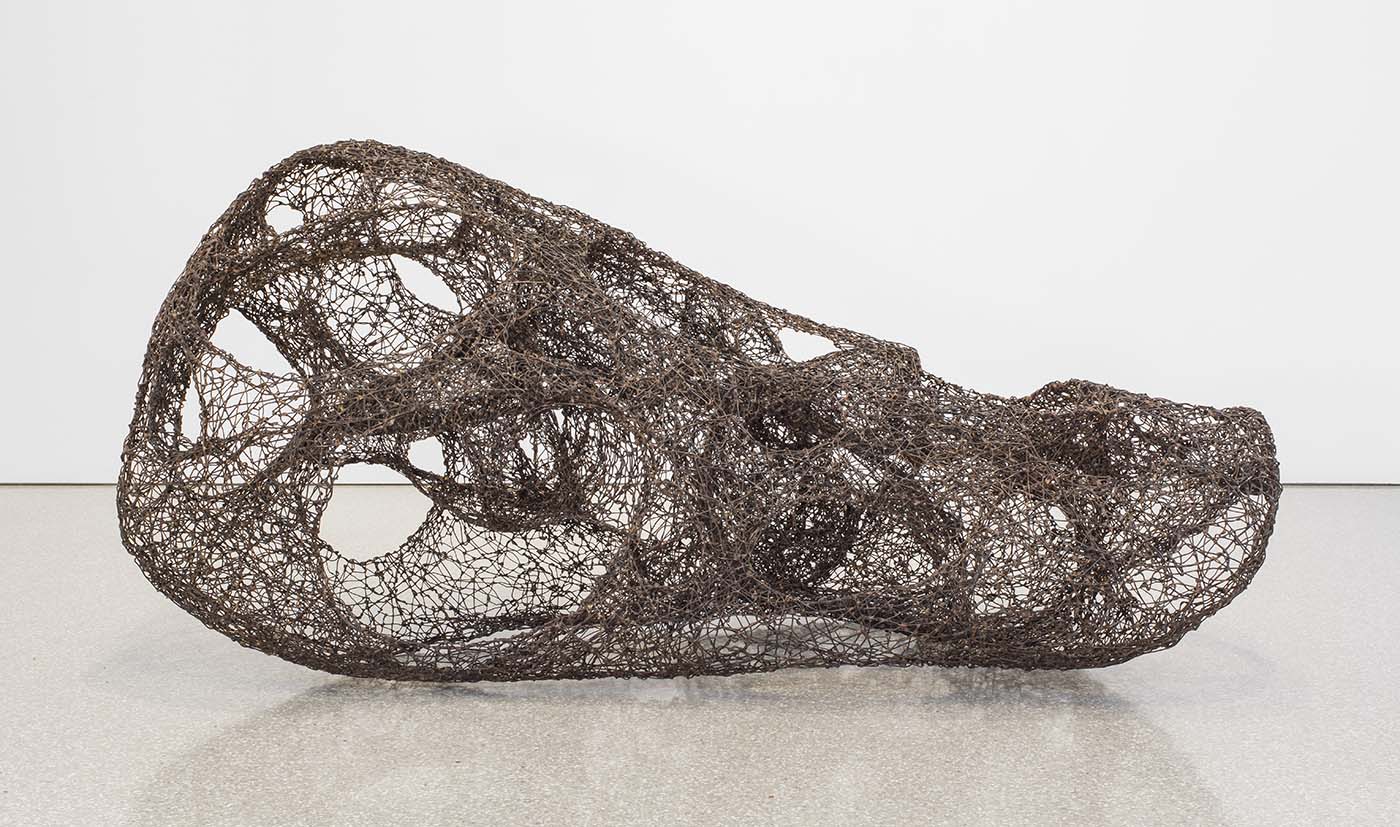
The surrounding galleries contain the future, for artists who found it while they were still living in France, which many of the men left when the G.I. Bill stopped paying out in 1956. Claire Falkenstein, whose sculptures comprise copper, steel, and tin wire, defies her predecessors’ use of bronze and the human form, as well as the stark geometries of the next generation’s minimalism — her constructions Continuum (1956), Sun XIV (1958), and Sun (1959) are amorphous and alien, see-through and unwieldy.
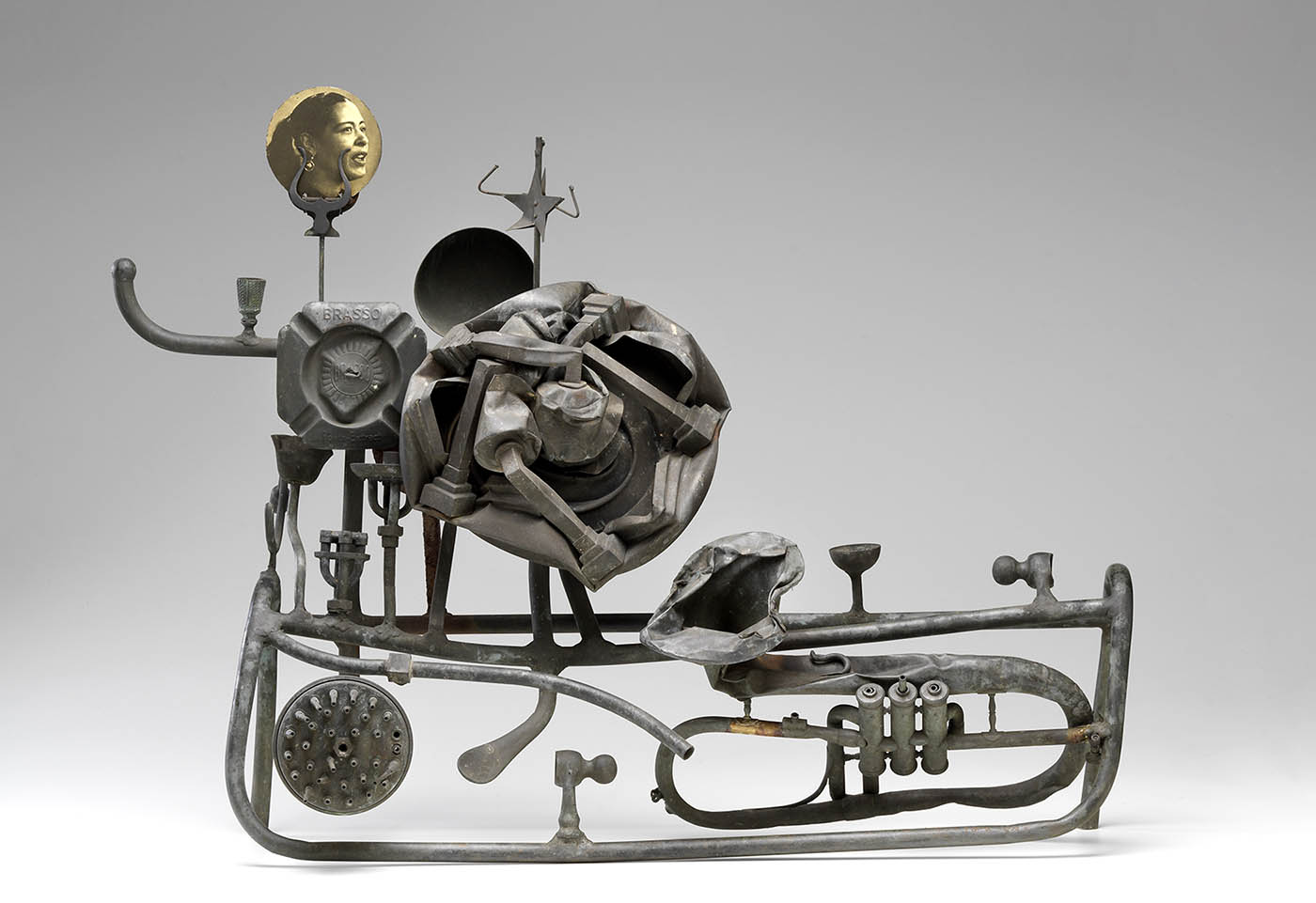
Shinkichi Tajiri’s sculptures are made largely from scrap metal he found along the Seine, and they thrive in an ambiguous space between architecture and anthropomorphism, abstraction and real-world allusion. Wounded Knee (1953) — which references the deadliest mass shooting in American history, conducted by the United States Army in 1890 against the Lakota people — looks like a weapon of mass destruction as imagined by a murderous society many decades before the atomic age. Tajiri served as a combatant in his birth country’s war campaigns, but only after he was a prisoner. The Japanese-American visionary was born in the Watts neighborhood of Los Angeles and spent several years in concentration camps in Arcadia and in Yuma, Arizona, before he gained a kind of freedom by enlisting in his oppressors’ army. Tajiri saw heavy combat in Italy, leaving the battlefield with more than 50 pieces of stone shrapnel embedded in his thigh. Wounded Knee echoes the wire mesh frame of the futuristic Watts Towers in his hometown; it also stands like a Trojan Horse that has no reason to conceal its brutal intentions, with hazardous points protruding from both front and back and a dystopian spire resembling a melted flag pole. This brazen assemblage presents war as both timeless technology and mindless beast, threatening everyone who ever existed and the prospective lives of those to come.
A few abstractions each by Norman Bluhm and Beauford Delaney hang side-by-side on the wall, and while their palettes vary, they all gleam as though the light is shining from within them: Paris’s famous sun, they seem to say, is — to paraphrase Childs’s title — a mindset, one tied to youth and the way that we remember it. As painter Jack Youngerman, who arrived in the capital at the tender age of 21, reminisces in the accompanying book, “Americans were heroes and had it made … it went with being young and then having a couple of years where you had enough to live on, riding everywhere on bicycles. There was an extraordinary sense of being an American in Paris. It was really like having wings.”
Youngerman’s take, of course, is tethered to his experiences as an unencumbered white guy, one who was still a teenager in officer training at the University of North Carolina when Emperor Hirohito surrendered, meaning he was relatively unscarred by the epoch’s great scourge. Others came to Paris to escape racism, find elusive opportunity in a period that offered female artists almost none, or — in the case of some, including Ralph Coburn, pioneer of participatory art — to flee a McCarthyite climate back home. Enduring movements surfaced from this era, particularly the hard-edged abstraction exemplified by Kelly, Held, and Youngerman, which had oxygen to grow in Europe, far from the suffocating ecosystem of ab-ex. Yet these artists all departed for New York in the 1950s to find and redefine the zeitgeist. The art world today is of course multicentric, and those who distinguish between creative trends occurring on either side of the Atlantic increasingly seem to be either splitting hairs or dealing in nostalgic generalities, reflecting a past — true, exaggerated, and freeze-framed in its fading glory by Americans in Paris — in which national custom was a stronger motivator than the relentless circulation of global art-world wealth. ❖
Daniel Felsenthal writes essays and criticism for a variety of publications, including the New Yorker, the Guardian, and the Atlantic, and is at work on a novel and an essay collection. He also helps fight for better pay and work conditions for writers with the Freelance Solidarity Project.