






→ This article from the archives is part of a series celebrating the Platinum Anniversary — 70 years! — of the Voice. The first issue hit the stands on October 26, 1955. ←
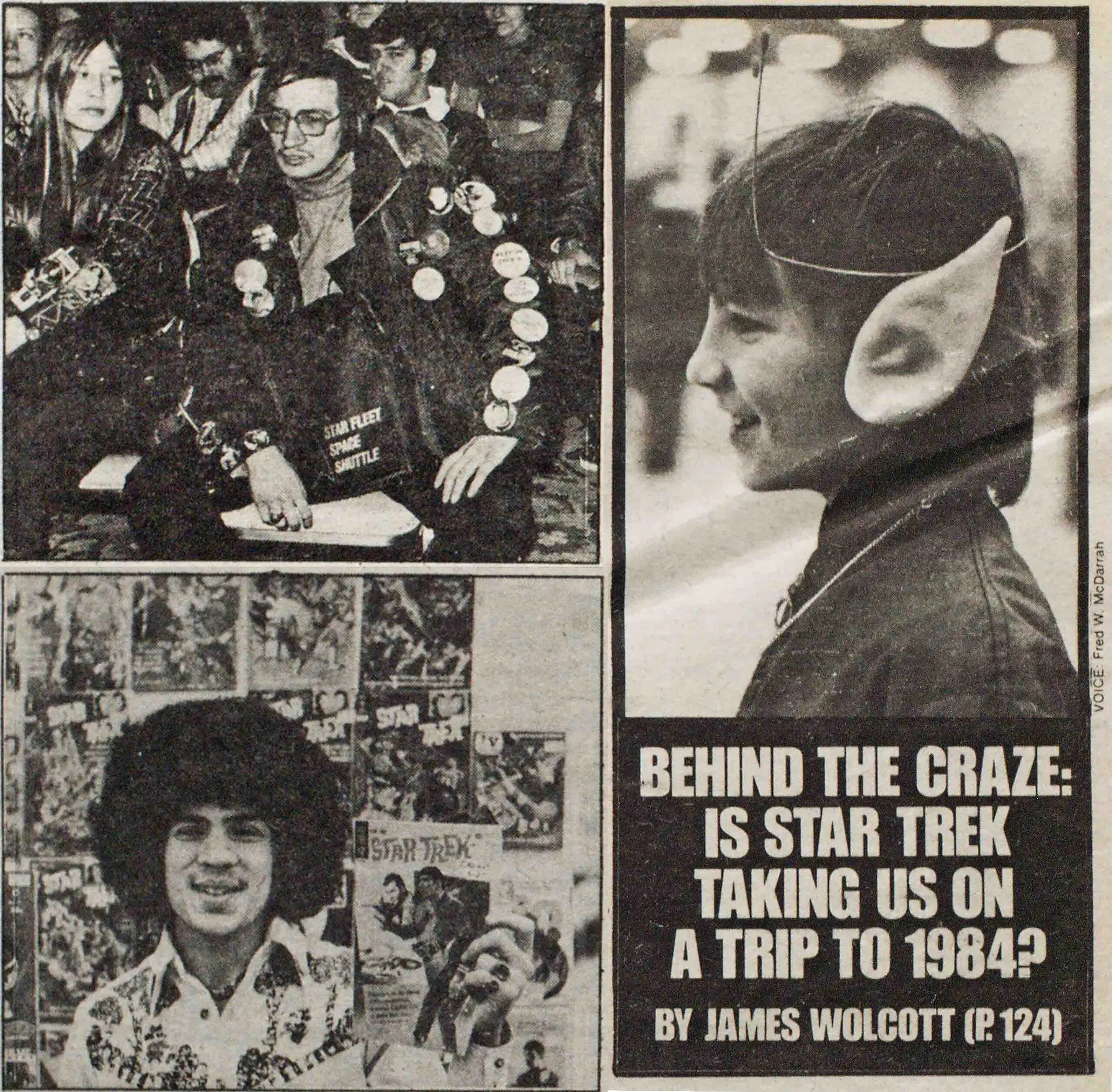
Editor’s note, January 30, 2026: Star Trek first hit the airwaves in 1966. Fast forward a decade, and the front page of the Village Voice features a kid sporting Spock ears, setting a headline editor to muse on whether the show, with its swashbuckling stud captain and disciplined, martial crew, represented a will to power rather than Sixties flower power. A wide-ranging culture critic, he references the civil war that had recently begun in Angola (which would drag on for decades), Lou Reed’s splendiferously abrasive double album Metal Machine Music, dance choreographer Twyla Tharp, literature critic Leslie Fiedler, and numerous other cultural and political touchstones of the day. He concludes, “What one comes to understand is that aside from the show’s superb production values, respectable acting, and intelligent writing, the real basis of ‘Star Trek”s popularity is sex, cool, and technology.” He also zeroes in on its fanatical, not to say cultish, fan base, his pungent observations presaging William Shatner’s iconic “Get a life” sketch on Saturday Night Live, exactly a decade later. — R.C. Baker
Big Brother Is Trekking You
By James Wolcott
February 2, 1976
In the midst of all the merchandise displays at the Statler Hilton Star Trek convention — of Trek T-shirts, posters, buttons, fanzines, pale-blue fuzzy-wuzzy tribbles, Spock ears, and intergalactic jewelry — is a tiny table which the army is using as a makeshift recruitment outlet.
The sight provokes a quick reverie about a true Trek believer who goes through basic training wearing Vulcan ears and mumbling “most illogical” whenever the sergeant (played by Jack Webb) tells him to clean out latrines with his tooth-brush. Standing near a full-scale constructed replica of the U.S.S. Enterprise’s transporter room is a teenager wearing over one jacket pocket a button which says “Serve the Klingon Empire,” over the other a button which says “We Are All Zionists.” A Klingon Zionist? Sounds like Dylan to me.
Which is all very interesting, yet I keep coming back to the sight which greeted me upon entering the Statler Hilton: the omnipresent Isaac Asimov engaged in jovial conversation with a kid who, though dressed exactly like Captain Kirk (right down to carrying a communicator and phaser), looks as if he’s in his pajamas.
Now, I’m a serious writer, sort of, and try to do serious work, more or less, but any movement which attracts converts who parade around during the daylight hours wearing outfits which look like pjs, well, heavy-metal phenomenological gear-meshing seems ludicrous before such a salient sight. Granted, for a show which was only on the networks for three seasons (1966-1968), and has been in rerun syndication ever since (it’s shown locally weeknights on WPIX), “Star Trek” has spawned a fandom akin to a religious cult. True believers or trekkies, as the media have labeled them (much to the fans’ indignation) — watch episodes five, 10, 15 times, know the dialogue by heart, know all of Spock’s facial nuances by heart, buy Star Trek paperbacks (which are just novelizations of episodes they’ve already seen), and either delight or drive their parents up the wall with their full-hearted near-fanatical devotion to, of all things, a defunct television show.
Trek fans harbor a severe hostility toward another TV sci-fi show, “Space 1999.”
Right now the number-one item on the Times quality paperback list is the “Star Trek Star Fleet Technical Manual” (which contains detailed blueprints of Trek equipment and vehicles), and last week’s convention at the Hilton drew anywhere from 20,000 to 50,000 fans, with many more left outside, unable to get in. In Manhattan, there’s a store on the Upper East Side called the Federation Trading Post which sells only Trek paraphernalia; the one time I was there, a group of businessmen were purchasing jerseys, phasers, and tribbles — for themselves. The seven years that “Star Trek” has been in reruns has generated a legion of followers who form a large, ever-growing constituency, a constituency cutting across sexual, racial, geographical, and class lines. Certainly at this moment in America there are millions who care more about the sorrows of Spock than the fate of Angola.
Though Trek fans look cute in their pajama uniforms, and though many of them are so glassy-eyed that one imagines that their brainwaves sound like “Metal Machine Music,” my initial frivolousness faded when I realized that trekkies are not just out on a lark. These kids are serious.
Spooky kids. (And, yes, I know that many are older than the age of consent.) These fans started appearing at science-fiction conventions, setting up their displays of Star Trek memorabilia. As their numbers grew, as stray fans discovered that others shared their passionate devotion to the ethos of the show, a community began to coalesce, which made the straight sci-fi fans nervous and irritated, soon very irritated.
Consider: after years of being sequestered in pulp hackdom, sci-fi writers began to attract that most elusive lit-crit establishment honor — respectability. The best of them began to see the lines of connection between their work and the work of Barth, Calvino, and the blind Borges. So manumission into serious attention is the light at the end of the pulp tunnel and then, cursedly, these kids show up. These goddamn spooky kids in their pajamas and pointed ears — these trekkies — were obviously going to fuck it all up. Bitter consternation was in the air.
Well, these fans weren’t children of Spock for nothing, so they did the logical thing — they organized their own conventions, which were astoundingly successful. The emergence of fandom is breathlessly told in a paperback entitled “Star Trek Lives!” written by Jacqueline Lichtenberg. Sondra Marshak, and Joan Winston. As we shall see, these women have their libidinal thermostats turned up pretty high, hence their prose squeaks and squeals like the rusty springs in a newlywed’s bed, yet the style of their enthusiasm gives much insight into the Trek fan’s mentality. What one comes to understand is that aside from the show’s superb production values, respectable acting, and intelligent writing, the real basis of “Star Trek”‘s popularity is sex, cool, and technology.
Trek fans harbor a severe hostility toward another TV sci-fi show, “Space 1999,” because they feel that the show’s eye-intoxicating special effects are too intoxicating, that they engulf the viewer with visual riches at the expense of theme and characterization. The space technology of “Space 1999” is actually movie technology used too voluptuously. Trek technology, however, is at a more human scale — more utilitarian. Trek fans believe in the inherent benevolence of the machine, and in the ability of men to use machines benevolently — beliefs rooted in an almost childlike fascination with gadgets. Trek fans love gadgets, they’re a generation raised on intimate acquaintance with tape players, TVs, and radios — my 10-year-old brother, for example, never goes to sleep without his Sony AM-FM cradled in his arms — and the phasers, tricorders, and communicators on “Trek” are fanciful, ingenious toys.
Understand that this fascination with technology goes beyond affection into a fervent faith in the ability of technological means to master the future. The authors of “Star Trek Lives!” call this the Optimism Effect and quote from series founder Gene Roddenberry: ‘”Star Trek’ was saying, ‘It’s not all over. There will be a future, and it will be as exciting, as challenging as anything we can imagine.'”
Cosmic Frank Capraism — hokum with a celestial glow — but it has an emotional sway for those who refuse to believe that the earth must end as a radioactive cinder.
I’ve seen kids weep at the episode entitled “This Side of Paradise,” in which Spock falls in love and then surrenders that love because his tragically schizoid nature prevents him from abandoning himself to bliss.
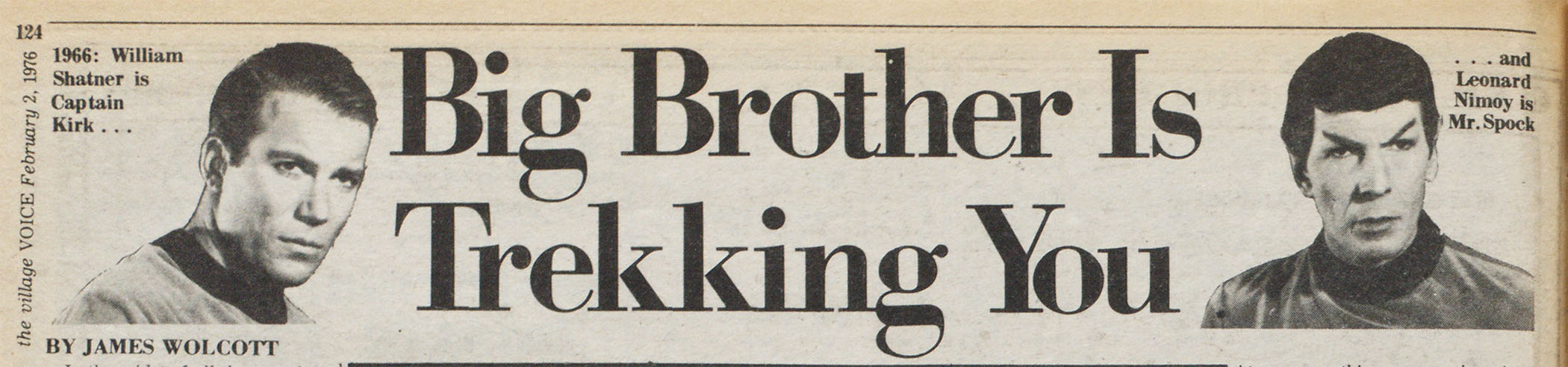
Of course, in “Star Trek” this faith in technology is swashbucklingly romanticized. William Shatner, who played Captain Kirk, based his characterization of Kirk upon the life of Alexander the Great — so he says — and in reference to a particular episode, the Trek triad comment: “… Kirk, knowing the greatness it took to achieve this mastery of our environment represented by the Enterprise and himself, to create the technology, the mechanization, the electronics that hurled us from the caves to the stars, would answer (his accusers) firmly: ‘We armed man with tools. The striving for greatness continues.'” Thatcsounds pretty — I’m ashamed to use the word — macho. The technology on “Star Trek” represents not just power, but masculine will because all those who firmly wield those tools (what a thicket of innuendo) are, of course, men.
Remember the movie version of “The Fountainhead”? Patricia Neal visits the quarry where a sweaty, muscular Gary Cooper is drilling away. The shots jump from his drilling to the aroused reaction of Neal to his drilling. A cigar, said Freud, may just be a cigar but a movie drill, say I, is not just a drill. In Ayn Rand novels the women find their fulfillment after submitting to the sexual sovereignty of phallic heroes like John Galt and Howard Roark. (Together, Ayn Rand and Lina Wertmuller could rule the world.) So I began to get suspicious when the triad printed lush encomiums in “Star Trek Lives!” to Ayn Rand’s philosophy, for it suggested that beneath the Optimism Effect was a vulgarized Nietzscheanism — the will-to-power banalized in the stud-adventurer, Captain Kirk.
After all, the vast majority of fan writers — i.e., those who publish stories in fan publications based upon the Trek characters — are women, and their stories (at least the ones referred to in “Star Trek Lives!”) are sexually charged-up. What are they responding to? Aside from the mastery of power, and the sexual attractiveness of the comically handsome William Shatner (Kirk) and the imperturbable Leonard Nimoy (Spock), what we have here, bless Leslie Fiedler, is the return of runaway boys on the biggest damn raft you can imagine — the U.S.S. Enterprise. Male readers have always been drawn to the story of two men venturing out together, but “Star Trek” also hooks the women by the sexual tension beneath that buddy-buddiness — a sci-fi variation of Newman and Redford. Though much maligned, male bonding is still a powerful theme — indeed, at the end of Sam Peckinpah’s blurred-vision beauty, “The Killer Elite,” James Caan and buddy go sailing off together — and because the character of Spock is so resolute, so quietly forceful, he becomes a parody of the unreachable woman. He’s practically an extraterrestrial Garbo.
Spock is at the center of “Star Trek”‘s appeal not only because women identify with his intensely sublimated
sexuality — such women are only a portion of fandom — but because he’s a hero to kids. Spock is physically strong, which most kids aspire to (which is why ‘The Six-Million Dollar Man” is also a success); literally alienated because of his mixed birth, freakish, because of his pointed ears (most kids feel self-conscious about their looks); and, in his calm earnestness, quite fatherly. He’s also wickedly intelligent, as smart as Twyla Tharp or Eno, hell, smart enough to be in the rock-erit establishment. (Or smart enough to stay out of it.)
But, most of all, Spock is supremely cool. Cool is very important to kids. My brother reveres a character on “Happy Days” called Fonzie. Fonzie is the master of every situation, always in command, a shaman of high school cool — when Fonzie kicks the Coke machine, two free bottles slide out. Essentially, however, cool is holding your own, not losing inner equilibrium no matter what outside forces (teachers, parents, other kids) are battering away at you. If you’re 10 years old, and your teacher is screaming out her lungs at you, and you just smile back, totally unfazed, totally cool; well, kid, such nonchalance is heroic.
No one, however, is totally cool since cool is the mastery of tensions; Spock is the coolest TV hero because his tensions run so deep, rooted in his divided biological/cultural heritage (half-earthling, half-Vulcan); so his mastery over himself — his control — has been won at no small psychic cost. I’ve seen kids weep at the episode entitled “This Side of Paradise,” in which Spock falls in love and then surrenders that love because his tragically schizoid nature prevents him from abandoning himself to bliss. His lover was played by Jill Ireland, who is married in real life to Charles Bronson. Felicitous, because Bronson is the movie-star embodiment of embattled cool — as soon as he appears on the screen in “Hard Times,” you know that his dignity has to be fought for. What both Bronson and Nimoy’s Spock embody is the notion that beneath the facade of cool is a vast potential for violence — violence needed to protect that cool. Kids idolize these men because when they are frustrated — when they’re yelled at by an adult for being “stupid” or ridiculed by other kids for being “fat” or “ugly” — they can’t fight back effectively. They can throw tantrums, or they can endure the humiliation. Their heroes, then, are those who have obviously endured humiliation — a freakish alien like Spock, a beaten-faced prole like Bronson — and transcended it with the crowning pride that comes from holding your poise no matter what pain you’re suffering.
What’s underlying “Star Trek”‘s appeal, what lies beneath the surface of vulgar merchandise and optimism-effect cant, is an inchoate surging of power — technological and sexual — which Trek fans are trying to tap into. On the stage of the Hilton’s Grand Ballroom, a replica of the Enterprise’s command bridge serves as the stage for a succession of Trek stars giving speeches and answering questions for an audience of thousands of twitchy, feverishly tired extraterrestrial orphans. A wave of raucous applause rises to greet the entrance of Leonard Nimoy. He acknowledges their thunder by raising his hand in a split-fingered salute — the Vulcan benediction — and waits for the cheers to wash away before adopting Spock’s richly dispassionate voice to tell them: “You are indeed an enthusiastic group of earthlings.”
Outside, kids unable to enter the overcrowded hall mill around in aimless frustration. One kid — nine or 10 years old — pleads tearfully with the guard (“You’ve got to let me in, you’ve just got to”‘) and, before his sobs can become convulsive, slams his shoulder against the wall to shock himself into composure.
❖ ❖ ❖