




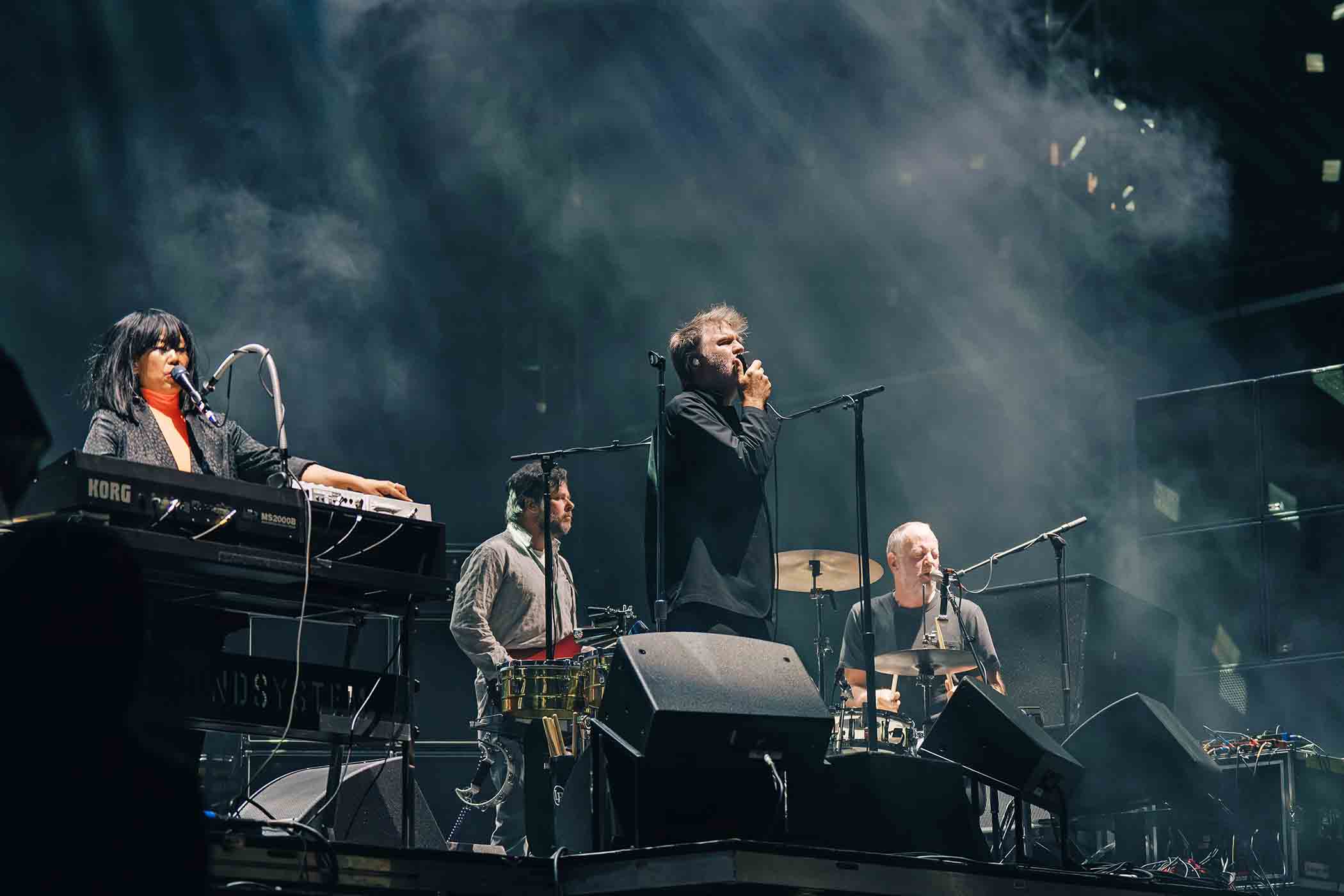
Brooklyn-born LCD Soundsystem, fronted by the redoubtable James Murphy, recently headlined All Points East, an urban music festival in the multi-ethnic district of London’s Bethnal Green, part of a 14-date European tour. At Victoria Park, the Pixies opened for LCD; the bill also included younger acts, including another Brooklyn band, Nation of Language.
Victoria Park has an admirable pedigree, especially in the wake of the anti-immigration riots in various provincial towns that blighted the British summer of 2024. In 1978, an estimated 100,000 people (including my mother) marched the seven miles from Trafalgar Square to Victoria Park as part of “Rock Against Racism,” an initiative often credited with making combating xenophobia cool. My mum may have dismissed punk as bourgeois deviationism, but the majority of protesters were delighted to have their efforts rewarded with a performance by the Clash, at the height of their powers. In hindsight, my first trip to Victoria Park, in 2009, to watch Duran Duran headline the two-day Lovebox Festival, was destined to be underwhelming by comparison. A mid-afternoon set by the reunited New York Dolls in front of a sparse crowd proved to be particularly disappointing — has any band in history been more ill-suited to the daytime than the legendary veterans of Max’s Kansas City? Since then, the stock of New York punk and new wave has risen in London — Patti Smith is playing to bigger audiences than ever, and Blondie is back headlining arenas.
A debut single about losing your edge is an effective preemptive defense against future accusations of dwindling creative inspiration.
A few hours before LCD Soundsystem’s set, 24-year-old East London rising star Aziya entertained a small but enthusiastic crowd with her new single, “Crush (Tom Verlaine).” (Who knows what the aloof Television guitarist, who died last year, would have made of it.) Murphy’s mob, which hit the stage to the sounds of Lou Reed’s “We’re Gonna Have a Real Good Time Together,” has always worn their influences on their sleeves and are particularly indebted to the Talking Heads’ melding of rock and dance rhythms. (An aside: I was struck three days earlier at Taylor Swift’s Wembley Stadium show by support act Paramore not only covering “Burning Down the House” but also lifting much of their stage show from the band’s concert film, Stop Making Sense, including the synchronized dance moves of the roaming rhythm section.)
LCD’s two-hour set found time for a cover of Nilsson’s “Jump into the Fire,” alongside a snippet of Kraftwerk’s “Radioactivity” during “I Can Change.” A rendition of the band’s 2002 debut single, “Losing my Edge,” extended by some ad-libbing, riffed on an ageing scenester’s memories of legendary gig experiences, with excerpts from Suicide’s “Ghost Rider,” Daft Punk’s “Robot Rock,” and Yazoo’s “Don’t Go.” As the band bid farewell to the crowd after the euphoric “All my Friends” — the keynote track from their best-loved album, Sound of Silver — Tears for Fears’ “Shout” was played over the PA system. I prefer the song given this honor last time I caught LCD live, at London’s Brixton Academy, Sinéad O Connor’s “Nothing Compares 2 U.” This wasn’t the only thing I felt was superior about the 2022 show, but perhaps LCD Soundsystem should be forgiven for that: The band had just received the news that their close friend and collaborator Justin Chearno had died. “Someone Great” was dedicated to the Brooklyn food and wine guru, who also contributed musically to Sound of Silver. But really, the problem that night wasn’t the band’s playing, it was the atmosphere, the setlist, and the crowd. The six shows at the Brixton had sold out instantly, with many fans attending multiple nights. That setlist was crammed with deep cuts from each of LCD’s four albums; in contrast, the All Points East setlist was dominated by the most iconic tracks from Sound of Silver. There was room for only two songs off American Dream (2017), that rarest of beasts: a post–band-re-formation album on a par with a group’s original output. (LCD went on extended hiatus from 2011 to 2015.)
Kicking off the performance at midnight took its toll.
The near-capacity crowd at All Points East was a curious blend: nervous-looking attendees in concert apparel that looked as if it had rarely been worn gave the impression that the festival was something done as part of their summer agenda rather than a destination for serious music lovers. Relinquishing beer in favor of water bottles given out by American Express, this largely static crowd was occasionally thrown into chaos by the odd individual tripping on ecstasy. Clusters of original fans, identified by graying hair and faded band T-shirts, danced among influencers of the Instagram age, who seemed aware of being in the presence of legends without actually knowing any of the songs. Nothing chimed with them as strongly as the Pixies’ “Here Comes Your Man” or “Monkey Gone to Heaven,” classics that provided the blueprint for the Nirvana songbook. While Kurt Cobain once said he resented playing to arenas filled with the same small-town jocks he wanted to escape, LCD Soundsystem is usually a very different proposition. As with many of the headliners from the inaugural 2018 All Points East Festival (Nick Cave, Björk, the National), LCD attracts large audiences from diverse territories. Still, the band’s core demographic are urbanites, both in thrall to and made anxious by city living, whose entry into the workplace coincided with the digital takeover of virtually all aspects of human existence.

James Murphy moved to Manhattan from small-town New Jersey to study English at NYU in 1989, the year Taylor Swift was born and Lou Reed released his last indisputably great album: New York. Formed in 2002, LCD Soundsystem provided the soundtrack as New York’s creative center of gravity shifted from the Lower East Side to Williamsburg. Not everyone was converted. As Ryan Leas notes in his book on Sound of Silver, the band was decried by detractors as “false gods for the era of Brooklyn indie.” This was unfair. LCD held the edge over their contemporaries in two key respects: First, the band had musical chops; second, they employed but did not hide behind cool irony and detachment. Performing under their signature giant disco ball is not about kitsch decoration, it’s an invitation to the audience that they need to play their part and dance. At their best, LCD has always thrown one hell of a party, without resorting to frivolity. Footage from the “farewell” shows at Madison Square Garden, in 2011, captivates by capturing a crowd having a great time to a band firing on all cylinders. Murphy split before it stopped being fun. He became a father and opened a wine bar in Williamsburg. (Plans to compose a soundtrack for subway stations across New York, with turnstiles emitting various tones, never came to fruition.) While not as severe a U-turn as Mötley Crüe’s return to the stage after having signed a reputedly binding legal document for “cessation of touring” after a 2015 farewell show in Los Angeles, LCD Soundsystem’s redux was still unexpected. The band will shortly join Blondie and the Pixies in the ranks of heritage acts whose post–re-formation terms outlast their initial runs, though since returning in 2015, LCD has toured extensively but released just one record. On the one hand, a debut single about losing your edge is an effective preemptive defense against future accusations of dwindling creative inspiration. And though Murphy looks older than when he first found fame, his appearance and style haven’t changed all that much in two decades. Conversely, being the perfect band for a specific time and place renders you particularly vulnerable to changes in the zeitgeist. That LCD Soundsystem have thrived and not just survived can be attributed to the loyalty of their original fanbase, at a time when the retirement age for attending live music is on the rise.
Convinced that the limitations of the All Points East show were circumstantial, I took advantage of being in Madrid the following week to watch LCD Soundsystem headline the opening night of the debut Madrid edition of Kalorama, a Lisbon-based festival. The Greater Madrid Regional Council provided generous subsidies for Kalorama, optimistic that it would attract foreigners to the Spanish capital at the end of August, when the punishing summer heat results in half-empty hotels. That strategy didn’t pay off: Kalorama, featuring a similar lineup to All Points East, was nowhere near sold out. Most paying customers were local; there may have been a burger van called Williamsburg, but there wasn’t a New Yorker in sight. Massive Attack, the Prodigy, and Jungle all attracted a larger multigenerational crowd than LCD Soundsystem, but LCD’s few thousand hardcore fans were ready to dance. I have no reliable data on how many 40- and 50-something Spaniards working in the digital and creative industries do yoga and take MDMA, but I’ve never seen such a high concentration of this demographic in one particular place. And kicking off the performance at midnight took its toll, with LCD’s energy levels plateauing an hour in. The band also had a slightly shorter slot, and, fearful perhaps that its meaning would be lost on an audience whose first language was not English, “Losing my Edge” was ditched. It was nonetheless easier to get lost in the music in Madrid than in London. LCD Soundsystem is almost incapable of a truly bad performance, but the audience will sometimes make the difference between the band being good and great. ❖
Duncan Wheeler is a professor and chair of Spanish Studies at the University of Leeds. His latest book is Following Franco: Spanish Culture and Politics in Transition.


