






Editor’s note, February 13, 2026: Franklin Delano Roosevelt and Adolf Hitler came to power within five weeks of each other, in 1933; they both died in office 12 years later, Roosevelt on April 12, 1945, at his sunny “Little White House,” in Warm Springs, Georgia, and Hitler in his cramped air raid bunker deep below bomb-ravaged Berlin, 18 days later. The American president had been elected four times, by an average margin of 12.4% percent of the popular vote. The Führer had been appointed German Chancellor after his party had received only a third of the vote a few months before, but he quickly moved to consolidate power and outlaw other political parties, actions backed by the Nazi’s violent stormtroopers.
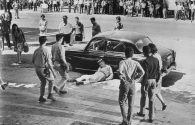
Although, as the picture that accompanied the below article illustrated, Roosevelt was becoming increasingly stooped and frail — never mind the pressures of guiding the U.S. out of the Great Depression and toward victory in a globe-spanning war, FDR was also a heavy smoker and a polio victim — it still came as a shock that this man, who an 18-year-old draftee in 1944 would have known as his president since he was 6 years old, was dead at age 63. It was Roosevelt’s longevity in office that prompted Congress to amend the Constitution to officially limit presidents to two terms, a custom established by George Washington, who chose not to run for a third term in 1796.
Fast forward a dozen years after the end of World War II, when four veterans of the conflict who worked at the Village Voice — publisher Ed Fancher and editor Dan Wolf, two of the paper’s founders; associate editor (and creator of the Off Broadway “Obie Awards,” in 1956) Jerry Tallmer; and assistant editor Dan Balaban — variously recalled hearing the news, through scuttlebutt or over the radio, in a tent or hut or foxhole, struggling to comprehend the end of an era even as the most deadly conflagration in human history continued to rage around them. One of the most famous American veterans of WWII, Norman Mailer, who was the third founder of the paper — the “silent” money guy — was not included, perhaps because he’d already had his say in his wildly popular, 700-plus-page 1948 novel, The Naked and the Dead, based on his experiences as a combat soldier in the Pacific Theater. And Mailer had quit writing for the Voice after a brief stint as a columnist in 1956 — a copyediting mistake that changed “nuances of youth” to “nusiances of youth” outraged him, despite the fact that he inevitably filed his handwritten draft very late and overlong. From then on, he generally settled for simply collecting his share of the paper’s at first meager and then quite ample profits.
So, for Presidents’ Day, take a trip down memory lane and honor a leader for all Americans. —R.C. Baker
The day he died … April 12, 1945
By Dan Balaban, Jerry Tallmer, Edwin Fancher, and Daniel Wolf
April 10, 1957
The day Roosevelt died I was stationed in Foggia, Italy, as part of a Signal Corps team that was installing a transmitter station at the airport there. We were riding back from work and passed some soldiers in fatigues. We waved at them and one of them said: “Roosevelt died, did you hear?” A feeling of panic shot through me. I noticed that the flag was at half-mast and remember thinking that it couldn’t be true because flying the flag at half-mast was such a little ordinary thing to do, such an ineffectual thing to do if Roosevelt really had died.
We went into our barracks and someone turned the radio on. I don’t remember how I felt when the words came nor do I remember anything that was said. We were lying around on our bunks and I remember looking at everybody and especially at Sandy, a fellow from Kansas City who had hated Roosevelt. He looked calm, but he didn’t look happy. Then I thought: “This is the way it will be when my father dies,” and I turned my face away because I started to cry and I felt I wasn’t going to be able to control myself at all. —Dan Balaban
I was in a tent on Guam, at an aircraft-recognition session — one of those things where they try to teach you how not to shoot down B-17’s. There was a guy in my squadron named Joe Lyons, an intense, intellectual (sort of) buck sergeant, sort of a PM-type (PM was a newspaper they printed in those days). I think he was from the Bronx. He had a great dome of a forehead and not much hair; a skinny little guy; radio-repairman, as I remember it.
Suddenly the back flap of the tent lifted (I was sitting near the back) and Joe Lyons stuck his head in. “Did you hear?” he said to me — to me alone. “Roosevelt’s dead.” My heart stopped. “Joe,” I said, “you know better than to go around spreading rumors like that.” “No,” he said, “It’s on the radio, it’s true.” He dropped the tent-flap and went away.
“It was as if a great unreal trick was being played on us — even more unreal, I felt, than finding myself going from jungle to jungle in the Pacific.”
Some of the fellows sitting near me heard it, and began to buzz. The buzz worked its way down to the officers, who were sitting up front. The class ended.
Outside in the sun, my own officers came over and asked me what was up. I said that Joe Lyons had just said that Roosevelt was dead. There was a great silence. Then Captain George, our pilot, said: “Let’s go over to the tent and find out.” We went over to the officers’ tent and put on the radio. Sure enough, it was saying over and over again that the President was dead.
We sat there sweating in the tent, listening to the radio, nobody saying anything, with the hammers dully going boom boom boom somewhere in the heat and in our hearts. Then Jack Schwartz suddenly looked up — he was the navigator, and had married a girl with whom I also had been in love, but that is another story — Jack Schwartz looked up and said, in his high, soft, somewhat haughty voice: “You know what? He was the only President I’ve ever known. All my life, since I’ve known about Presidents, he was the President, the only one.” It was the same way for all of us, even I suppose for the Captain, who was a few years older, and so nobody said anything more, and after a while Andy and I — Andy was the radio operator — went back to our own tent in the enlisted area and did I don’t know what for I do not remember how long. And that night or the next I went to the church services, the ones they put on for the occasion, but these did not do for me what I had hoped they would and I was sorry that I had gone. —Jerry Tallmer
It was a sunny spring day in the Italian hills, and the men were cleaning up around their fox holes and relaxing on the ground. It was peaceful, but there was the latent tension perhaps inevitable in the lull before a big offensive. Then I noticed a quiet rustling spreading from fox hole to fox hole along the rough hillside. My first reaction to the news was anger that anyone would joke so cruelly. Then incredulity. Then a sense of profound emptiness and fear, as if I had suddenly been deserted in an open boat in the middle of the Pacific Ocean. —Edwin Fancher
I first heard the words “Roosevelt is dead’ in a nipa-thatched hut on Luzon early on a very hot morning while I was lying on my cot. Someone passing by had spoken them. I told myself it was just another lie the boys had picked up over Radio Tokio. But I really knew it was true, and could not face it. So I stayed in the hut instead of going to the mess hall that morning. I stayed there hoping that the first of my hut-mates to come back would be the one who felt as I did. Truthfully, I do not remember who came back first.
Finally I went out. Everyone was more excited than sad. Some smiled, but they too were agitated and incredulous. It was as if a great unreal trick was being played on us — even more unreal, I felt, than finding myself going from jungle to jungle in the Pacific.
Sorrow was private — for me and the others. It seems strange now that the most public figure any of us had known had to be mourned privately. Our feelings were too strong, and he was — there is no getting away from it — the “father of us all.” Each sorrow was private to the mourner as mine was to me, and each had to be worked out privately in a corner of that Filipino village.
A number of days later, after orders had been sent down, a memorial service was held. It meant nothing to me or anyone. It was like a eulogy given by a stranger. —Daniel Wolf


