




Your phone might be ushering in the end of civilization as we know it. It’s already driven up societal and mental health ills, including rising rates of depression, anxiety, and loneliness. It’s also decreased your attention span and fostered addiction, cyberbullying, and misinformation, often leading to reduced self-esteem and suicide. And yet no one has been held accountable, and most of us don’t care, so long as we can keep scrolling. “I think there is a species being born,” Gore Verbinski tells me in a conversation about his giddy dystopian new sci-fi comedy, Good Luck, Have Fun, Don’t Die.
“It’s been asked to study us and look at how we consume, what we like and what we hate, and how to keep us engaged. In some ways our worst attributes are written into its source code. And it will be birthed in some crazy warped reflection of us. Right now, it’s ingesting so much off the internet and spitting it back out exponentially, I think it’s drinking its own piss. What is it doing to us? What are we doing to it?”
Sam Rockwell plays the “man from the future,” a scrappy looking homeless guy who turns up one night at Norms, the popular LA diner. He bears a dire message from the future, but most ignore him until he reveals his explosive vest. His objective is to select five everyday citizens for a team that can outwit AI-driven forces and infiltrate the home of a suburban teen who is brewing up a form of AI that will change the very nature of human existence.

Ultimately chosen are high school teachers Mark (Michael Peña), and Janet (Zazie Beetz), stuck in a passionless marriage, Uber driver Scott (Asim Chaudhry), Susan (Juno Temple), a mother who lost her son in a school shooting but has recently had him cloned, and Ingrid (Haley Lu Richardson), a birthday princess for hire who loses her luddite boyfriend to an irresistible new AI driven technology.
The man from the future has been on this journey many times, but has always failed, which he attributes to the wrong combination of teammates. “Our future didn’t send us Arnold Schwarzenegger, they sent us Sam Rockwell,” laughs Verbinski. “That’s how fucked things are. All the heroes are dead or they’re playing ‘Call of Duty’ or something. We didn’t go to the Navy Seal Academy in San Diego, we went to Norms on La Cienega to find the heroes to save the world.”
An Oscar winner for the 2011 animated western, Rango, Verbinski is known to most as the man behind the first three Pirates of the Caribbean movies as well as The Ring and its sequel. In the past, he was a mainstream filmmaker who distinguished himself by making movies that weren’t mindless dreck, sadly uncommon in the current studio climate. A unicorn in Hollywood, he would never last until he started dumbing down. But he didn’t, instead he embraced this bizarre screenplay by writer Matthew Robinson.
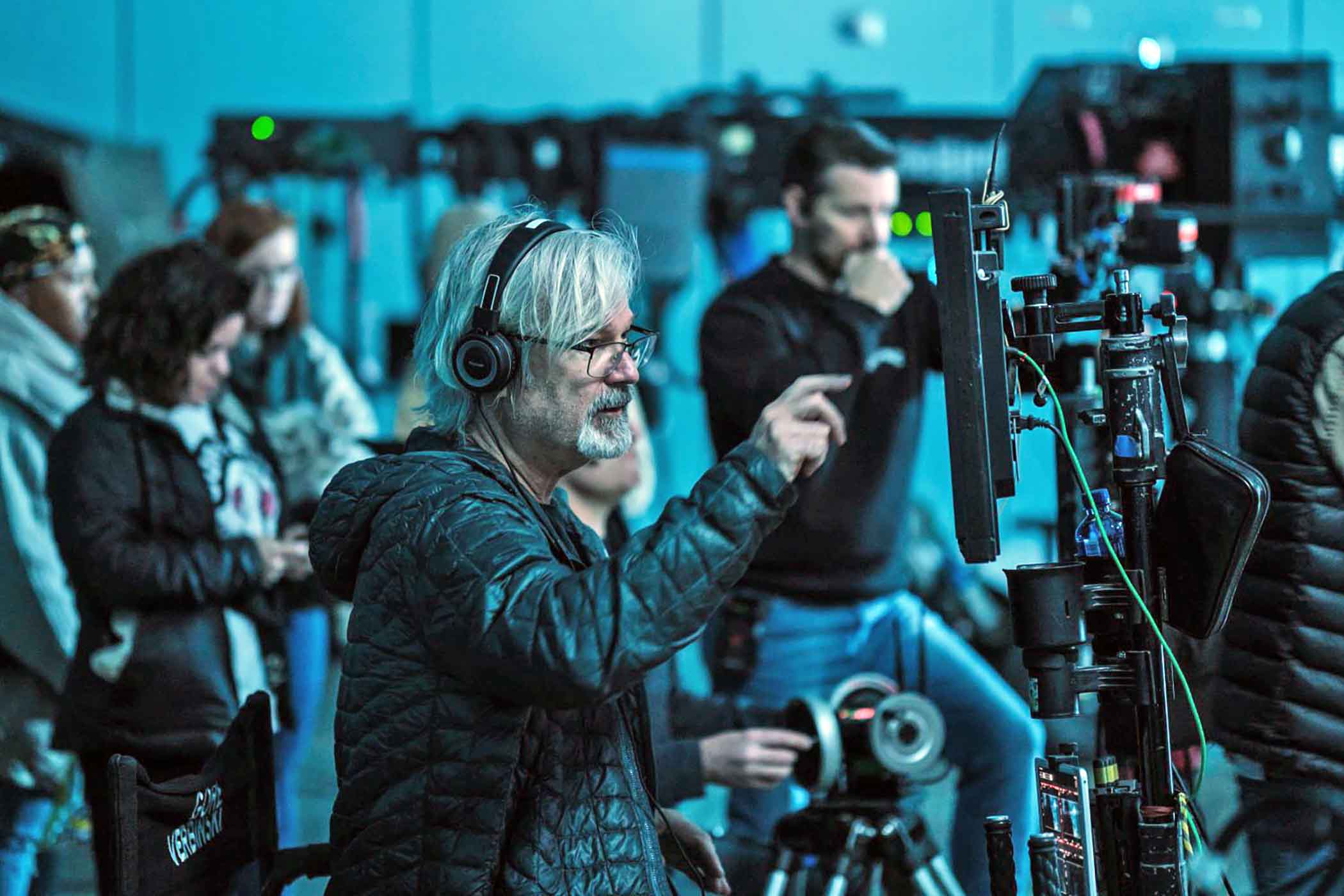
“No studio was interested in making it,” Verbinski says, recalling reading it six years ago. “When he wrote it in 2017, AI was still something on the horizon. After we got the script in shape, I sent it to Sam and he was like, ‘I’m the guy, this is me.’ And then we still couldn’t quite get the funding, kept reducing the budget and the shoot days, and the complexity.”
“The way the algorithms work, things don’t get likes and views unless it’s a stupid funny brainrot reel or a picture of an ass!”
Money remained a problem until casting director Denise Chamian suggested they just put out a casting call, which usually happens after the film is financed. Subsequent meetings with Richardson, Beetz, Rockwell, and the rest resulted in a cast they could take to investors, mainly German financier Constantin Film.
An unconventional movie, Good Luck opens in an unconventional way — an 11-minute monologue delivered by Rockwell. The scene starts with a bravura sequence roaming through the diner, introducing the characters, often with just a glimpse at what they’re scrolling. Once Rockwell makes his entrance, it’s all on him as he introduces the premise and tone in a rambling and vibrant discourse.
“I’m drawn to things that scare me,” says Verbinski, who prepared by recording the monologue as a radio play. After editing it, he replaced it with a recording by Rockwell. With that, he broke it into five chapters and blocked it out. That’s when the crew began building the set on stages in Cape Town, South Africa, designed to fit Verbinski’s blocking, rather than the other way around.
“Sam is a professor. He makes it look easy, but man, he does the work. Intention and discovery are the things you have to balance with him. You orchestrate a kind of circumstance that allows the awkward moment,” he says about Rockwell. “The best thing that can happen when you’re directing an actor, you get to the place where you’re pleased. Then you go to do it again on a different lens, but the actor says, ‘I don’t remember what I did.’ So, you want to make sure you can catch that, you’re not so strict about your marks and frame and composition.”

Originally from Tennessee, Verbinski moved to SoCal at the age of three and grew up in La Jolla, surfing and later rocking guitar in local bands like the Little Kings, which played with Stiv Bators on his cover of “Have Love, Will Travel.” Graduating UCLA Film School in 1987, he was soon working with director Julien Temple at his company Nitrate Films.
“I used to buy him a beer at the Frolic Room, and I could ask him any question. And Julien had a kid named Juno, crazy frizzy hair, running around the set on his videos,” Verbinski recalls his early mentor, known for classic videos from the eighties, including the David Bowie feature film, Absolute Beginners. On Good Luck, Verbinski found Juno to be an indelible part of his cast, and was happy to welcome her father and mother on set.
“Her narrative has some darker comedic social satire aspects of it,” he says of Temple’s character, Susan, who suffers the death of a child, then suffers the death of hope when the cloned version turns out to be an ad-copy-spewing stranger. “Having her play it real, that’s the Kafka of it. She’s human in an increasingly inhuman world. The fact that Juno was den mother to the cast, and they spent so much time together, I think that helped. So when you’re ready to roll, they’re not at different tempos.”
Playing Ingrid is Haley Lu Richardson, who has been on a roll since season two of White Lotus, in which she played Jennifer Coolidge’s subjugated assistant. Her current show, Ponies, about two Cold War spywives who fill in for their deceased husbands, has been well reviewed since bowing last month. And later this year she’ll be in Zi by Columbus director Kogonada. In Good Luck, her character freelances as a princess at birthday parties and lives with a guy who leaves her for a video game.

“As an actor, she’s really honest,” Verbinski says of her. “She can get to a very specific and very real place. I think it’s exhausting. I think she actually fully commits to the process.” For Verbinski, who turns 62 next month, having a digital native like Richardson (30) on set was indispensable.
“It’s life-consuming and it is not real,” Richardson says of social media. “The reminder that it’s not real has to be an intentional thing that I tell myself, cause if I don’t, then I will start to believe it’s real. The way the algorithms work, things don’t get likes and views unless it’s a stupid funny brainrot reel or a picture of an ass! Unfortunately, I’ve succumbed to that a couple of times to post pictures of my butt to sell my poetry book. I want to fucking sell my book, this art I care about, and if I have to post a picture of my ass in a bikini … I’m kind of mad at myself that I’ve succumbed. I’m feeling kind of depressed right now thinking about it. But I guess that’s kind of the point of this movie, to make people thoughtful about these topics.”
Briarcliff Entertainment is planning a wide release of Good Luck, which can mean from 600 to 2,000 screens. It’s Verbinski’s first film since his 2016 psychological horror movie, A Cure for Wellness, a critical and box office failure. Since then, he’s spent years developing Cattywampus, a sci-fi musical with space felines, but it’s been stalled since 2022. Next up for him is anyone’s guess.
“I don’t fit in. I just don’t. I’m a misfit. I’ve never really tried to fit in. You tinker and shit blows up, and sometimes it doesn’t,” he explains about the vagaries of the business and AI’s creep toward dominance. “I think there’s a tsunami coming. Some live in fear, some live in denial and the rest of us are going to have to surf this thing. I think that’s the mantra of our time: ‘good luck, have fun, don’t die.’” ❖