






Like all artists, Jack Whitten (1939–2018) was beholden to those who came before. Early on in the Museum of Modern Art’s scintillating survey of the Alabama-born son of a seamstress and a coal miner we get a suite of five of Whitten’s “gray paintings,” all from 1964, some with such generic art monikers as “Christ” and “Head I.” Evocative as cremation ashes, these ghostly images were created by smearing and scraping down multiple layers of black and white acrylic paint, revealing that the 25-year-old Cooper Union grad was already fascinated by complex production methods. The sense of faces and figures glimpsed at profound moments echoes the scabrous portraits of Francis Bacon, perhaps not surprising considering that the gay Englishman lived in a country where homosexuality was illegal, and Whitten was a Black man from America’s Jim Crow South.
Such ominous undertones suffuse a number of Whitten’s paintings and sculptures, as emphasized by another title in the gray series — “Head IV Lynching.” A roughly life-size oval studded with luminous blips floats on a black ground like a bulbous phantom, exuding dread even as the monotone palette conjures a sense of immediacy, like a blurry photograph.
Hanging a couple of feet away, “Psychic Eclipse” glows like distant star clusters, the title traversing both human and cosmic scales — the infinite possibilities of a human being’s brain cast into shadow.
If Whitten was perhaps looking back at Bacon — who’d been featured in several important exhibitions in New York by the early ’60s — he was also striding forward into a zeitgeist that mixed the supposed documentary qualities of photos with the emotional fiction of portrait painting, a formal one-two punch Gerhard Richter was also divining in Germany through hazy monochrome canvases of, for example, his uncle Rudi, who died fighting in Hitler’s Wermacht in 1944.
“Slugs’ Saloon was the place to be. A lot of great people played there, including Sun Ra. Sun Ra was a staple there. Down on the Lower East Side in Manhattan — hell of a place.”
But while Richter was poking about in the cinders of World War II, Whitten was confronting America’s present in the 5-by-7-foot NY Battle Ground (1967). “I was ready to acquire guns and explosives, go back to Alabama and encourage rebellion at any cost necessary,” Whitten wrote in a reminiscence about the ’60s in one of the journals he kept for over six decades. “Allan Stone, my art dealer, shouted and screamed at me, ‘You are an artist and you better make up your mind!’ He insisted that my job was in the studio. How can anyone justify staying in the studio when your people are dying? What is the artist supposed to do? Start killing White people? What justifies killing for any cause? These were and remain the most difficult questions for me considering the politics of race in America.” Such anguish can be felt in the riotous yellows and oranges and reds and brash drips, palette-knife scrapes, and abraded brush strokes of Battle Ground, where swooping dark squiggles that might be fighter planes swirl around a pink pyramid — or is it a volcano? — that rises into a threatening black pall. Whitten had again grasped the pulse that other artists also felt coursing through the art world: Sometime after he began working on his caustically sublime cartoon paintings, in the late 1960s, Philip Guston said to a reporter, “What kind of a man am I, sitting at home, reading magazines, going into a frustrated fury about everything — and then going home to adjust a red to a blue?”
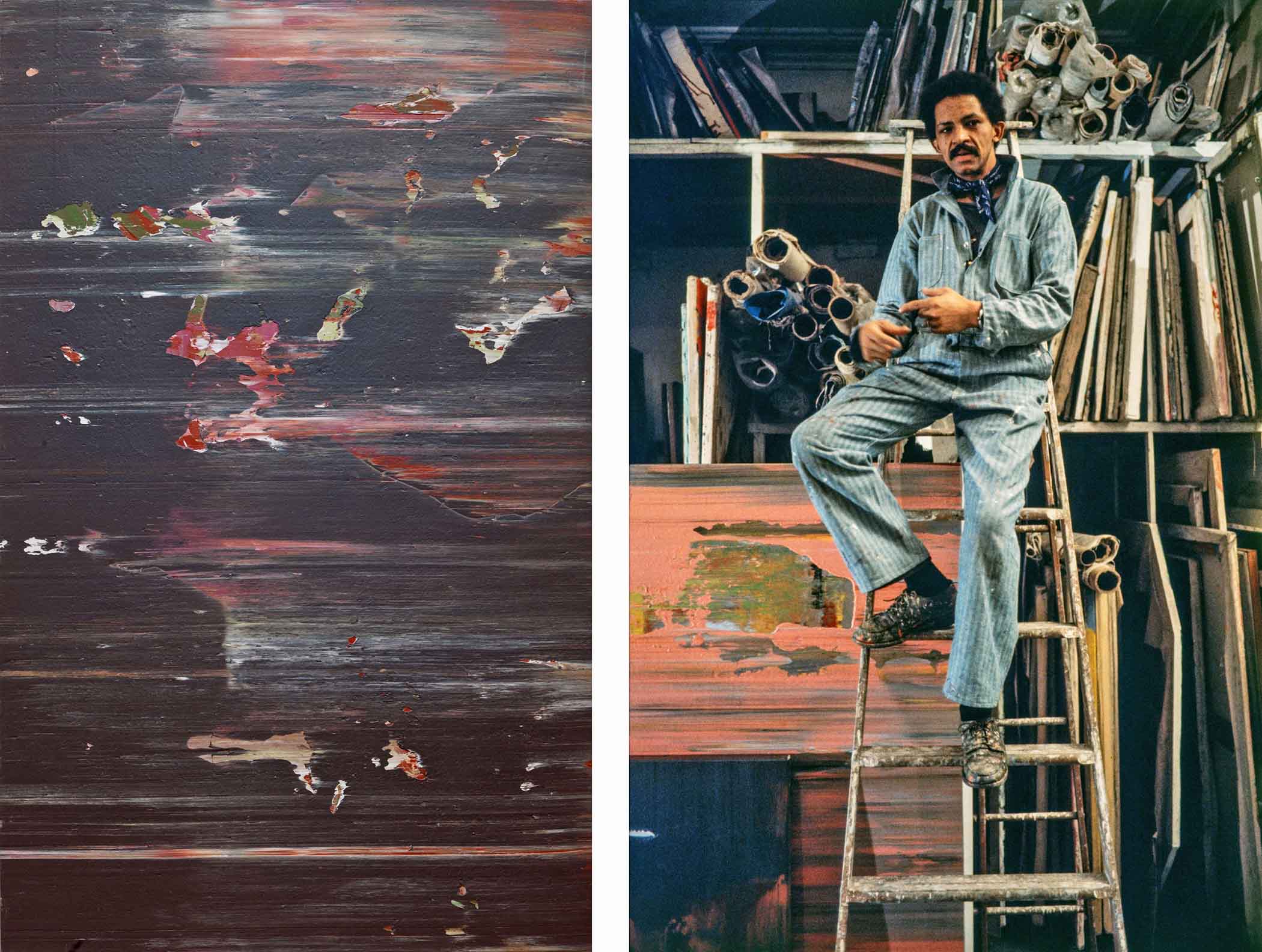
As Whitten moved into the early ’70s he retained a pointed consciousness in his work, but he also began pushing the technical boundaries of painting using a tool of his own design that he christened the “Developer,” a long-handled rake-like device that he would drag across the ever-broadening expanses of his canvases, sometimes scraping emphatic rows into planes of thick acrylic paint, in other instances attaching squeegees or metal blades to blend large swathes of colors into contrasting slabs. (In the 1990s, Richter journeyed into similar abstract realms, using a squeegee to eradicate any imagery under thick layers of oil paint.) In Whitten’s 6-foot-tall Pink Psyche Queen (1973), color seems to flash by, an effect achieved by placing “disruptors” — stones, sheet metal — under a canvas lying on the floor as he dragged the Developer across its surface, mixing the paint like a fast-flowing river coursing around large rocks. The roughly 9-by-13-foot Asa’s Palace, from 1973, revels in blunt contrasts — green gobs by turns murky or acid seem to erupt from a horizontal field of sharp pink and brown striations, giving the impression of the aftermath of a phantasmagorical party. (Whitten shared with Guston a love for pink’s swooning garishness.)
In 1974, Whitten experimented with copier toner during a residency at Xerox, one of the era’s most cutting-edge corporations. In the letter-size, dryly titled Topographical Space #11, you again feel Whitten pushing his materials into new arenas, coaxing vigorous abstractions — in this case, a bent cross seems caught in a radiant sandstorm — from a machine designed to reproduce business correspondence and account ledgers.
At the end of the decade, Whitten brought his ever-expanding technical prowess to the fore in the exquisite 42-inch-square DNA and the more intimately sized Annunciation XIV, in both of which Rothko-esque lozenges of muted color glow and shimmer like visitations in a fog. Up close, the luminous oscillations are revealed to be maniacally regimented grids of minute squares, which might remind older viewers of the pixelated static of yesteryear’s television sets.
A devastating studio fire in 1980 interrupted Whitten’s work for three years. Later in that decade, though, he regained his footing with the “skins,” works derived, literally, from the streets of New York — Whitten made plaster molds of such mundanities as manhole covers that he would then fill with steel-gray acrylic paint. With its re-creation of crosshatched metal plates, flattened tin cans, and other gutter detritus, the forbidding edifice of the 6-plus-foot-tall Door to Manhattan might solicit a grim chuckle from the locals: Physical entry into the city’s most expensive borough can be had for the price of a subway ride, but achieving a full life on that isle of primeval rock is too often the stuff of legend and fantasy — one of the more foreboding of the universe’s doors of perception.
Whitten’s street-level consciousness eschewed cynicism even as it grappled with American violence, which is too often as cruel and capricious as a lightning strike. Totem 2000 IV: For Amadou Diallo honors the memory of the Guinea-born student who was killed in a hail of bullets in the Bronx in 1999. Plainclothes officers testified that they mistook the unarmed Diallo for a rape suspect; Whitten conglomerated the mostly black surface of wood, recycled glass, and actual blood (from the artist) into a shape like the silhouette of a shooting target, which he punctuated with bright-red squares and rectangles, evoking the 19 bullets — out of 41 fired — that tore through flesh and bone.

Throughout his career, Whitten created works that called out to icons of Black America. The rich umber, rusty brown, and and flashy orange ground of 1971’s King’s Way II is punctuated by light glinting off ridges of paint created by dragging an Afro-comb through wet pigment, which animates the image as if citizens were following civil rights leader Martin Luther King Jr. across the 9-foot-wide sweep of canvas. (Using reflective grooves of paint to give a sense of three dimensions and movement was a technique the protean German artist Sigmar Polke would explore in his “lenticular” paintings, early in the 21st century.)
Whitten continued honoring Black luminaries through the decades, including in the “Black Monolith” series. These works are infused with what Whitten styled a “philosophy of jazz,” which was a powerful influence on his visions: “My introduction to New York was Birdland uptown on 52nd Street, the Five Spot downtown on Bowery, the Jazz Gallery on St. Mark’s Place, the Half Note, the Village Vanguard, the Village Gate, and later Slugs’ Saloon — anybody from New York in the ’60s will remember the Slugs. Within the history of jazz in New York City, Slugs’ Saloon was the place to be. A lot of great people played there, including Sun Ra. Sun Ra was a staple there. Down on the Lower East Side in Manhattan — hell of a place.”
Sun Ra embodied, through his transporting music and such trippy concoctions as the 1974 sci-fi film Space Is the Place, an Afrofuturist expansiveness. Similarly, Whitten explored otherworldly concepts in such works as 2013’s Nine Cosmic CDS: For the Firespitter (Jayne Cortez), in which a red field is shot through with black lines that peak and jag like the syncopated oscillations of an EKG, a fitting evocation of the poet and activist known for her fiery spoken-word performances. “I couldn’t think of a better way to make a statement about Jayne Cortez except through the idea of music,” he once told an interviewer. “In that painting, I’ve made cosmic CDs. They are not regular CDs — I don’t expect anybody to try to take them off and put them through a CD player. They’re out there in the Cosmos. There’s a fantastical mystical edge to that painting. I would like to think that the political statement is totally in the painting.”
Whitten’s colorful “cosmic CDs” float across the lower third of the roughly 4-by-11-foot acrylic painting like the phases of a psychedelically strobing space station. Chromatically joyful, they nonetheless inhabit a realm of sharp edges and dark confines, even as they remain defiant in their optimism, sincerity, and beauty. ❖
Jack Whitten: The Messenger
Museum of Modern Art
11 West 53rd Street
Through August 2, 2025