


∼ ∼ ∼
This article is part of a series — At 250, Who Will America Be? — reporting on threats to American democracy as we approach the nation’s Semiquincentennial, on July 4, 2026.
∼ ∼ ∼
We’ve had a deadly pandemic and a violent insurrection at the U.S. Capitol since the two major parties last convened their quadrennial conventions. While this summer’s outcomes might be predetermined, it’s anyone’s guess as to how things will go on November 5. But to say that the fate of American democracy hangs in the balance in 2024 is not hyperbole, since a majority of the ruling Republican House caucus, including Speaker Mike Johnson (R-LA), voted after the assault on the U.S. Capitol not to certify Joe Biden’s 2020 electoral victory. Former president Donald Trump often speaks of the rioters as “unbelievable patriots,” and has vowed on social media that one of “his first acts” will be to “free the January 6 hostages being wrongfully imprisoned.”
Those looking to protest the GOP’s defense of the lies about the election being stolen from Trump might have a tough time of it when the Republican National Convention opens in Milwaukee, on July 15. Under First Amendment case law, protesters are entitled to be within the sight and sound range of what they are protesting. Yet the RNC has stated to the U.S. Secret Service that the designated protest zone is too close to the convention, and “will imperil tens of thousands of Convention attendees, inexcusably forcing them into close proximity to the currently planned First Amendment Zone.”
A diverse group of 60-plus organizations, united under the umbrella designation “Coalition to March on the RNC 2024,” countered in a press release that the “RNC wants to support violent, anti-democratic events like the January 6th insurrection, but trembles at the thought of thousands of people and families marching for peace, justice, and equity.”
Meanwhile, Democrats are hoping Chicago 2024 is nothing like Chicago 1968, when TV coverage that August of the violent clash between Mayor Daley’s police force and anti-war protestors helped Nixon flip the state of Illinois. The Prairie State had gone heavily for Lyndon Johnson in 1964, and John Kennedy beat Nixon there in 1960, albeit by just under 9,000 votes.
Both parties ignore a major chunk of society, whose very existence is also largely disregarded by corporate media.
According to an article in Politico, a “pervasive sense of fear has settled in at the highest levels of the Democratic Party over President Joe Biden’s reelection prospects, even among officeholders and strategists who had previously expressed confidence about the coming battle with Donald Trump.” The piece continues with “nearly five months from the election, anxiety has morphed into palpable trepidation, according to more than a dozen party leaders and operatives. And the gap between what Democrats will say on TV or in print, and what they’ll text their friends, has only grown as worries have surged about Biden’s prospects.”
So far, coverage of the 2024 campaign in Politico and other corporate media outlets has focused almost exclusively on the two old white guys who are the standard bearers for Democrats and Republicans, and not on the current circumstances of the American people. That’s something Rev. Dr. William Barber II, who, with Rev. Dr. Liz Theoharis, leads the “Poor People’s Campaign: A National Call for a Moral Revival,” hopes can be changed with a grassroots campaign that wakes up what he calls “the sleeping giant” — 85 million low-wealth and low wage voters who are eligible to vote.
Political strategists and pollsters generally ignore this group and fixate on what they believe to be the essential suburban independent voter and related issues. These folks, who also have discretionary incomes, are the subject of any number of focus groups and polling efforts by both parties, which often direct their entire campaigns to this cohort, disregarding a major chunk of society, whose very existence is also largely ignored by corporate media.
With the support of the Poor People’s Campaign, Columbia University researcher Robert Paul Hartley conducted a study of the 2016 electorate that zeroed in on the performance of the low-wage voter cohort, and found that a majority of them did not vote. Hartley examined opinion surveys conducted over 20 years that tracked voter engagement, and found that in 2016 the most frequent reason lower-income nonvoters cited for not voting was they didn’t hear the candidates discuss issues that were relevant to their lives.
Hartley found that only 46% of voters with household income less than twice the federal poverty rate cast a ballot in 2016, as compared to a 68% turnout rate for voters who had a household income more than twice the poverty line. “They’re saying that they’re not voting because people are not speaking to their issues and that they’re just not interested in those candidates,” Hartley told The New York Times. “But it’s not that they couldn’t be.”
“For far too long, extremists have blamed poor people and low-wage people for their plight, while moderates too often have ignored poor people, appealing instead to the so-called middle class while the poor and low-wage people have become nearly half of this country.”
“The number one reason poor people don’t vote, according to our study, is because no one talks to them. We have debate after debate for Senate and president, and the issues that affect poor and low-wage persons do not come up,” Barber stated during a press conference at the National Press Club, in Northwest D.C., on April 29.
Hartley’s research paper also notes, “Although low-income voters do not share a monolithic political ideology, they do constitute a rather large proportion of the electorate and they tend to share concerns about healthcare and economic issues.”
Another important aspect of voting patterns has been noted in a Pew Research Center study, The Politics of Financial Insecurity: “When it comes to choosing a party’s candidate in the voting booth, one pattern in modern American politics is so familiar it has become a truism: the rich vote Republican, the poor vote Democratic.”
At the Press Club event in April, Celinda Lake, a veteran Democratic Party pollster, told reporters, “This is the largest untapped block that could produce a seismic political change in our system in every single state that is close … whatever the strategy is in the swing states — literally in every swing state.” She added, “Arizona, with a 10,000 margin — 839,000 poor people who didn’t vote. Georgia with a 12,000 margin, 746,000 people who did not vote. Wisconsin, 20,000 [margin of victory] with one million [not voting].”
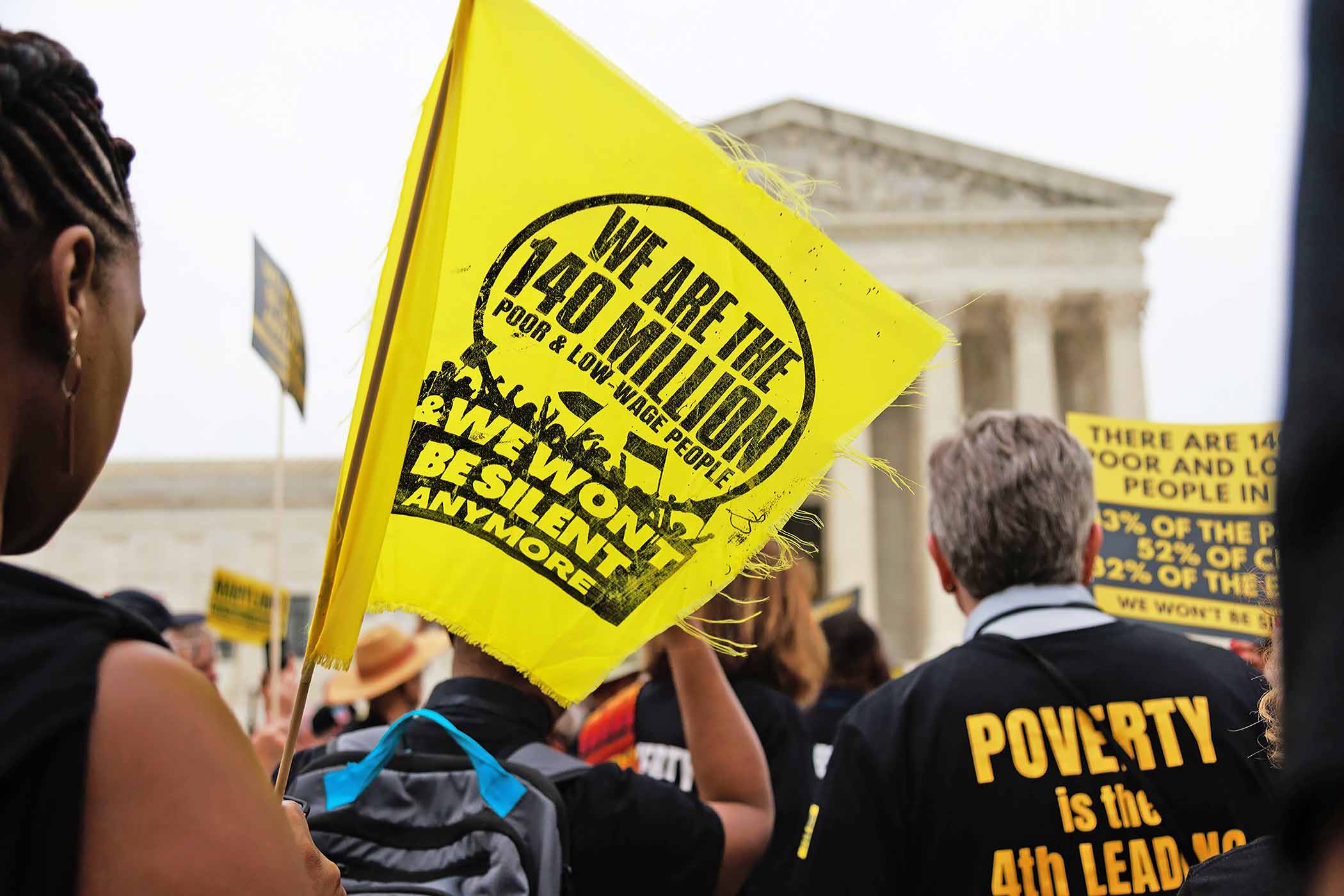
The PPC voter outreach campaign will target 15 million poor and low-wealth voters nationwide. A major opportunity to participate will happen on June 29, at the “Mass Poor People’s & Low-Wage Workers’ Assembly & Moral March on Washington, D.C., & to the Polls.”
Shifting approximately 3,400 votes would have given the Democrats a one-vote majority in the House.
In 2020, in a ‘proof of concept,’ the Poor People’s Campaign targeted specific low-wealth and low-wage voters in several states. This included Georgia, where the organization identified and mobilized 36,000 previously unengaged voters, who helped produce the margin of victory in the pivotal U.S. Senate races won by Rev. Raphael Warnock (D-GA) and Jon Ossoff (D-GA). Headed into the 2024 election, Barber explains that the Poor People’s Campaign’s 40 state chapters are targeting 15 million poor and low-wage infrequent voters, which will be highlighted at the June 29 event in D.C.
“For far too long, extremists have blamed poor people and low-wage people for their plight, while moderates too often have ignored poor people, appealing instead to the so-called middle class while the poor and low-wage people have become nearly half of this country,” Barber told reporters at a press conference in Washington earlier this year, announcing the voter drive. “Poor and low-wage people have the power to determine and decide the 2024 elections and elections beyond. In the 2016 election, there were 34 million poor and low-wealth people eligible to vote but didn’t. These voters made up more than a quarter of the electorate.”
Barber continued, “If we are serious about saving democracy, it can’t be some philosophical term. Saving democracy must be a Third Reconstruction, where people are paid a living wage, where people have health care, where public education is fully funded, and where voting rights are protected and expanded.”
In 2016, in key Rust Belt states such as Michigan, where unions were part of the historic Democratic base, Trump won. This was thanks to depressed African American voter turnout and the lack of engagement of the multi-racial cohort of economically struggling voters, which polls show overwhelmingly supported reproductive rights, a living wage, and universal healthcare. In 2016, Trump carried Michigan by just 10,000 votes — 980,000 low-wage potential voters did not turn out. If 1.1% of those voters had been engaged enough to go to the polls, the results might well have been different.
In the House of Representatives in 2022 — now held by Speaker Mike Johnson (R-LA.), an unapologetic insurrectionist — the GOP won control by less than 3,400 votes spread out over five tight House races. “Republicans retook the House majority in the midterms, but just a few thousand votes in five races could have swung the outcome in favor of Democrats,” reported The Hill. Indeed, consider these numbers: Rep. Lauren Boebert (R-CO) won by just 546 votes. In California’s 13th District, the Republican won by a margin of 564. In Michigan’s 10th, 1,600 votes did the trick. In Iowa’s 3rd, Rep. Cindy Axe (D) lost by 2,144 votes. Rep. Sean Patrick Maloney (D-NY) lost to Mike Lawler, the Republican, by only 1,820 votes. Shifting approximately 3,400 votes would have given the Democrats a one-vote majority in the House.
“We are committed to come together with Bishop Barber and Dr. Liz Theoharis and the Poor People’s Campaign and our partners in the faith and civil rights and social justice movements to mobilize working people and use our collective voice to demand an end to systemic economic injustice and the scourge of poverty,” Fred Redmond, the secretary-treasurer of the AFL-CIO, told reporters at a briefing about the Poor People’s Campaign’s voter mobilization effort. “We are committed to vanquishing oppression in all its forms and there is no greater form of oppression than when a country with immense wealth allows its people to suffer and die for lack of resources. Poverty is a failure of the system. It exists because we allow it to exist.” ❖
Bob Hennelly is an award-winning print and broadcast journalist who covers labor and politics for Salon, Work-Bites, City & State, and InsiderNJ. He hosts the Stuck Nation Radio Labor Hour on Pacifica’s WBAI, 99.5 FM, and is the New York City Hall reporter for WBGO, 88.3 FM, NPR’s jazz station, in Newark, New Jersey.