





Alain Guiraudie’s Misericordia is a well-chilled thriller in the Gallic style. Its closest cousins include Dominik Moll’s With a Friend Like Harry (2000), Cedric Kahn’s Red Lights (2004), and any number of the late Claude Chabrol’s autumnal work. It’s the kind of film that makes you lean in and ask, “What kind of movie is this?” — until the very last frame, and even then, it plays the story close to the vest. The French film magazine Cahiers du Cinéma named Misericordia their top film of 2024, and it will likely gain a few more champions as it rolls out its U.S. tour.
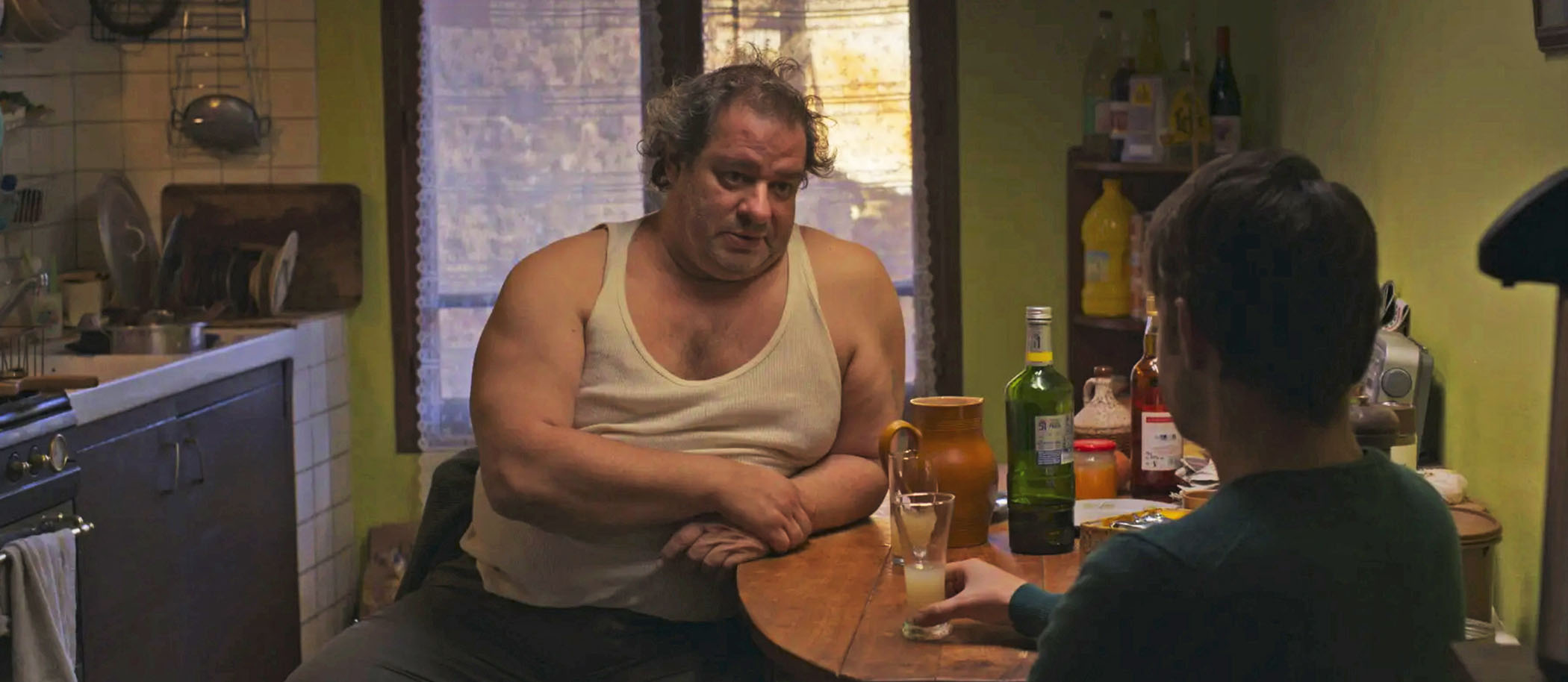
Jérémie (Félix Kysyl) is a drifter who returns to the quaint village of Saint-Martial, a fictional settlement in southern France, to attend the funeral of his former boss, the town baker. Invited to spend the night at the house of the baker’s hospitable widow (the great Catherine Frot), he decides to extend his stay indefinitely, much to the annoyance of the deceased man’s grown son (Jean-Baptiste Durand). Drifting through the woodsy countryside, Jérémie insinuates himself into the life of a lonely shut-in (David Ayala), as well as the abbot (Jacques Develay, in a wily performance) of the local parish.
What gives this thriller a decided edge — what makes it essentially French — is the suave, confident, sophisticated unraveling of events.
Guiraudie lets each scene unfold with masterly poise and patience, taking his sweet time in setting up this network of conflicting personalities. Once established, the premise could be characterized as suspensefully diffuse: What does the main character want? What’s his endgame? Jérémie, cannily played by Kysyl, is a bit of an enigma: sexually ambiguous and, as we learn early on, capable of malevolence. Guiraudie allows the tension to uncoil around him slowly, inexorably, until a crucial act of violence shifts the focus of the narrative. At this point the traditional cat-and-mouse mechanics take over, while the mysteries of character only deepen. If Stranger by the Lake (2013) is the director’s ultimate statement on the dark side of male desire, Misericordia (“Mercy”) is likewise an exploration of the self-destructive nature of attraction.The characters don’t seem to make choices so much as they are pulled along by them, enslaved by erotic impulses beyond their control.
This is well-trodden ground. What gives this thriller a decided edge — what makes it essentially French — is the suave, confident, sophisticated unraveling of events. Eschewing a musical score, except for the minimalist drone over the opening and closing credits, the soundtrack instead focuses on the accumulation of mundane sound effects: the squish of wet leaves in the forest, the gentle exhalations through the nostrils. There are fine, felicitous visual touches, such as the sinister appearance of morel mushrooms that sprout over a shallow grave. The characters — including the local cops — chat about murder while sipping glasses of pastis. Even with the occasional yet pointed eruptions of lust and violence, the temperature of the piece never rises above a simmer. And the emergence of a character peripheral to the foreground in the second half is a crafty move, worthy of that overworked adjective “Hitchcockian.”
Only the most impatient viewer would object to this kind of painstaking attention to detail, or complain at the delayed arrival of a denouement that lets a main character off the hook even as it ensnares him in another kind of trap. Misericordia is a master class in delayed gratification, and a showcase for a filmmaker totally in charge of his material. If the ending leaves a little something to be desired, if it vacates its premise with several dangling questions and loose threads, so much the more mysterious. So much the more French. ❖
Nathaniel Bell is a Los Angeles–based writer who has been writing for L.A. Weekly and the Village Voice since 2021.