




Just weeks before its scheduled opening at the United Nations Headquarters Visitors’ Lobby, Rules, Responsibilities, Restraints: Women’s Pursuit of Equity — artists Sawyer Rose and Fleur Spolidor’s Women’s History Month exhibition — was unceremoniously canceled. While no one ever wants to get that email, exacerbating the artists’ frustration was the fact that their exhibition had been chosen to coincide with this month’s 69th session of the Commission on the Status of Women, presenting works based on research, journalism, science, and data, intended to give form to the complex stories and circumstances of real women’s lives. Irony, it seems, is alive and well in Manhattan. So it’s a good thing that, with a little help from their friends, the show, renamed (UN)censored, headed to Brooklyn. But even a defiant restaging with vibrant receptions doesn’t give this story a happy ending.
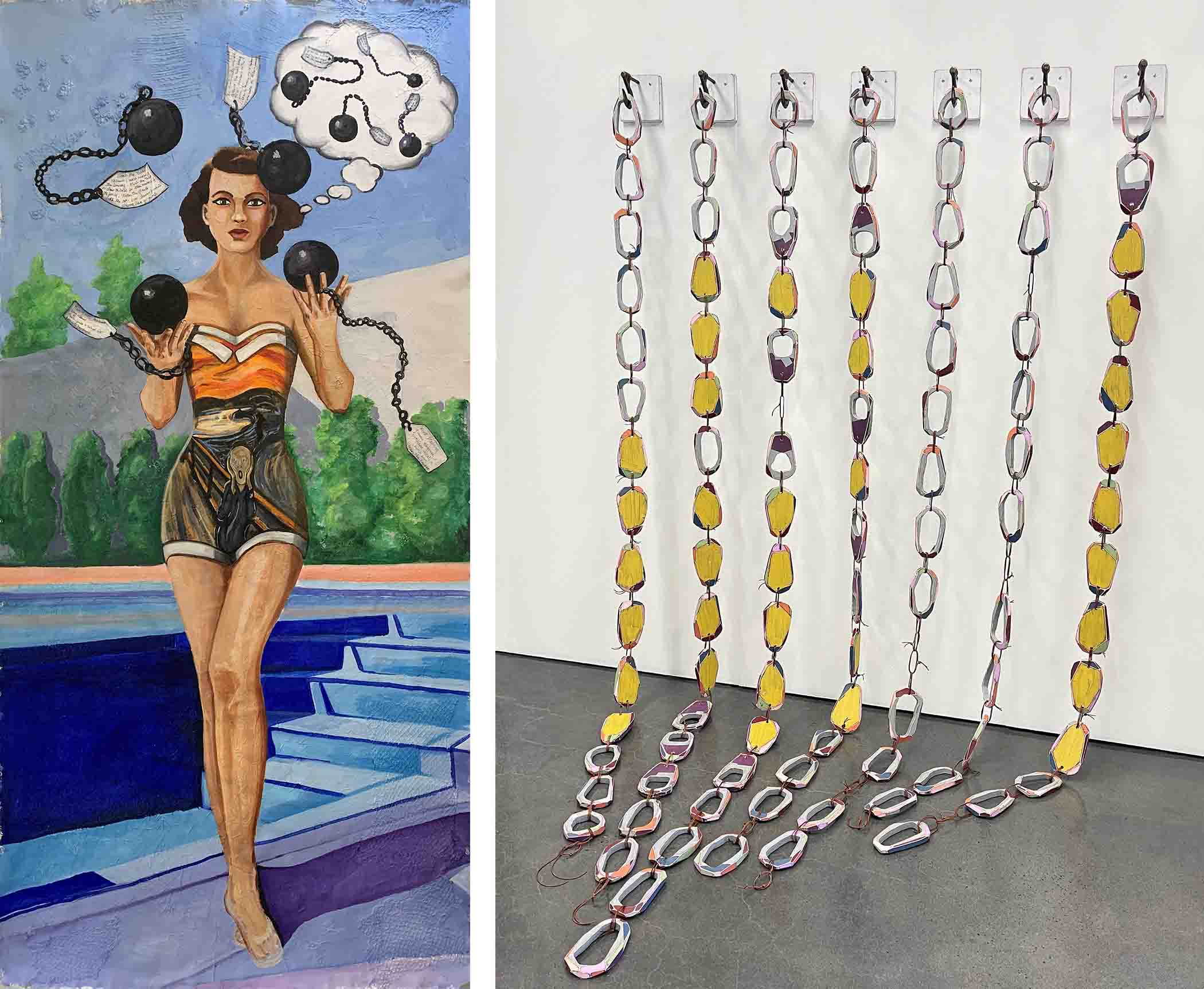
Painter Fleur Spolidor makes work at the multivalent intersection of women’s rights — comprising history, cultural representations, economic justice, and the burdens of climate chaos. Her “Swimsuits Series” uses its eponymous motif as a visual synecdoche for the astonishingly wide array of forces and systems that work against women, such as “health, gender inequality, body image, and restrictive social norms.” Spolidor’s paintings use vetted data drawn from eclectic official sources, including the World Economic Forum, UNICEF, and WHO, to then construct her surreal and affecting metaphorical scenarios expressing the fraught terrain of vulnerability and power that women walk each day.
In February 2023, Spolidor exhibited seven of these paintings in the European Union UN Delegation’s NYC offices, during the 67th Commission on the Status of Women (CSW67), where they remained prominently displayed for months afterward. She subsequently received grant funding to expand the series to 12 works — which she planned to show this month for the 69th CSW.
“Silencing these conversations won’t make women’s issues disappear, it will only make them worse.”
United Nations Headquarters (UNHQ) exhibitions require two collaborators, so Spolidor reached out to Bay Area sculptor Sawyer Rose, whose inventive series The Carrying Stones Project conceptualizes large-scale work based on data visualization to highlight the disproportionate labor burdens placed on women worldwide. Participants — each of whom’s story is individually told as part of the installation — are of diverse ages, races, and walks of life. They track their hourly activities, including paid work, caregiving, household tasks, and personal time, then Rose translates this data into gestural, emotional sculptures and empathetic photographic portraits. “I started the project because I saw how women’s labor inequity is an obvious, measurable injustice, yet progress has been painfully slow,” Rose shares with the Voice. “As an artist, I wanted to find a way to make people understand these inequities by turning boring numbers into something human and relatable.”
Spolidor adds, “Women face ongoing danger; their rights, security, and lives are perpetually at risk due to systemic inequalities, societal norms, and widespread violence. I want my work to underscore the pressing need for collective action and advocacy to safeguard and empower them in all areas of life.”
The two artists duly presented their plans for a collaborative exhibition, which was thoroughly vetted and approved with the EU Delegation as the administrative (not fiscal) sponsor, and then by the UN Exhibition Committee. After two years of planning, and with artworks already shipped from L.A. and upstate New York, the exhibition was abruptly canceled just two weeks before the opening. The EU Delegation, first by email and then by phone, gave the artists no specific reason for the cancellation — and certainly none that questioned the quality of the work, proposal, or preparations — other than the cautiously worded explanation that they, the delegation, “aim to have forward-looking, constructive, and positive messaging” at the UN, and that in the “challenging global context,” endorsement of the exhibition could risk “hampering” their work. The Delegation’s office did not reply to follow-up questions.

“Nothing in our show changed,” says Spolidor, who feels certain the decision amounts to obeying in advance the Trump administration’s anti-DEI directives. “The only thing that changed was who’s in charge politically — and suddenly women’s rights, equity, and data-backed truth became unacceptable. Silencing these conversations won’t make women’s issues disappear, it will only make them worse.”
Karen M. Gutfreund is an artist and curator with a focus on the power of art as activism. When she heard about the situation, she knew right away she had to help. “I was outraged and quite despondent too,” Gutfreund relates to the Voice, whose previous projects include exhibitions such as Agency: Feminist Art and Power; Deadlocked and Loaded: Disarming America; and Not Normal: Art in the Age of Trump. “My curatorial practice has been dedicated to feminist and activist art and promoting women in the arts and telling their stories,” she explains. “I knew I had to get involved and do everything in my power to not have their important work cast aside and silenced.”
With Gutfreund coming onboard as the curatorial producer of (UN)censored, and widespread community support, the artists secured a new venue — an 8,500-square-foot gallery space in Brooklyn, where they were able to install all of the artworks intended for the UNHQ. Well-attended receptions and viewing hours have helped blunt the sting of the rescinded invitation, but on balance, the whole experience has been more of a wake-up call — one of an alarming number of such incidents plaguing the culture sector nationally. Thus, rather than a happy outcome, it feels more like an explosive, emblematic beginning.
“Artistic freedom isn’t a luxury,” says Rose. “It’s a necessity. If artists can’t tell the truth about human experiences, we’re not just censoring art, we’re erasing reality. In a political climate where conversations about equity, justice, and human rights are being silenced, we need fearless art more than ever.” ❖
Shana Nys Dambrot is an art critic, author, and curator based in Los Angeles. In 2022, she was awarded a Rabkin Prize for Visual Arts Journalism.