






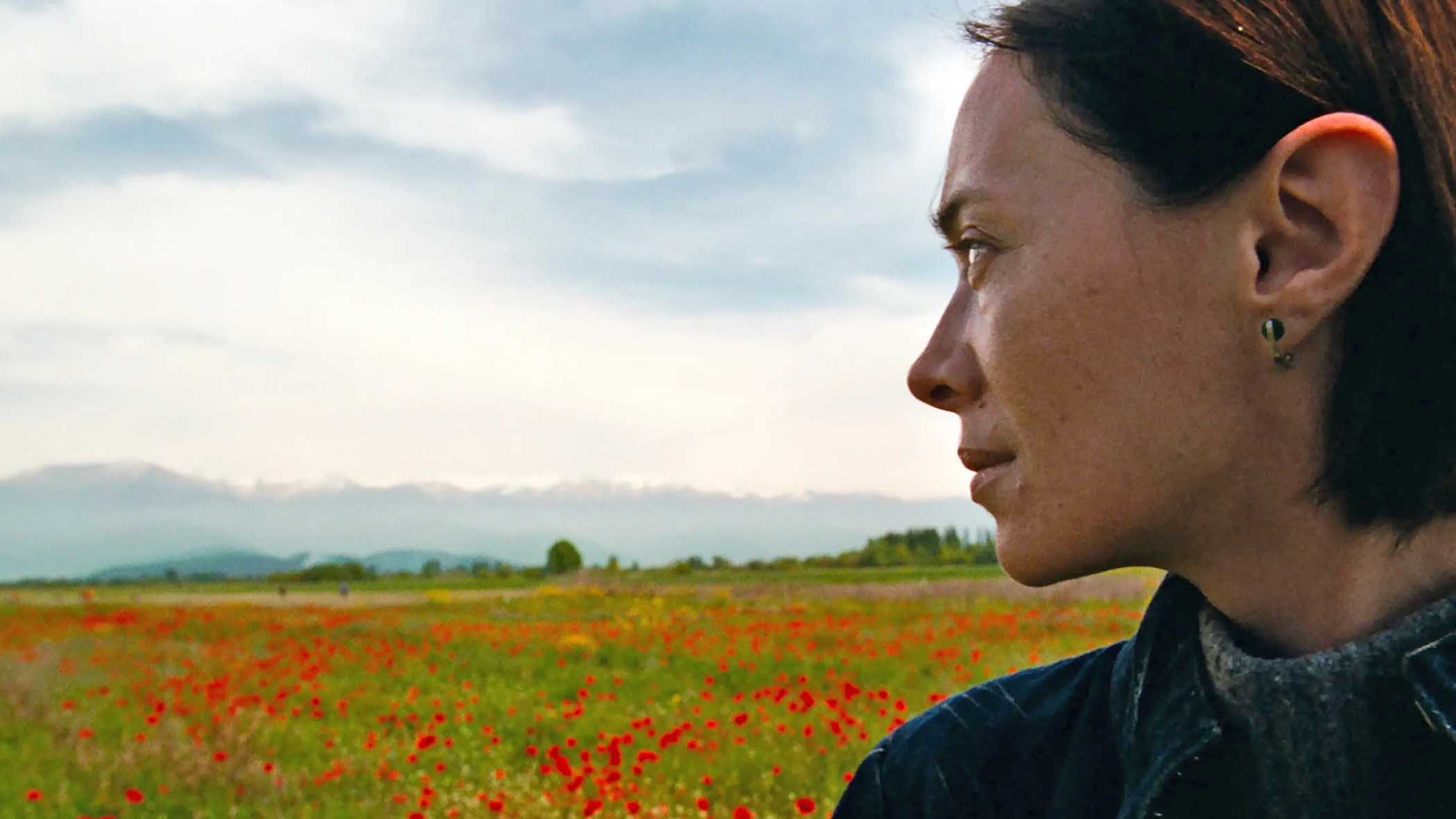
A mood piece of otherworldly control and breath-holding severity, the new Georgian movie April is the kind of art film you wish for all year long, if you’ve otherwise spent too many cinema-hours waiting for contemporary filmmakers to grow up and stop fucking around. Every scene, every frame, means business, unpacking a dazzling arsenal of one-shot compositional iron maidens, pregnant tensions, and splats of mysterious New Weird subjectivity. (Incidentally, I’ve always thought “art film” was a deplorably small-minded tag, born in the New Wave era, when audiences needed a boost to qualify exactly how Bergman and Antonioni movies differed from Hollywood’s. But now, given how the medium’s culture has mutated, I think it resonates.) Director Dea Kulumbegashvili — at 39, she was all of 5 when Georgia became an ex–Soviet nation — is both heiress to an austere and enigmatic legacy stretching back to Tarkovsky and a defiantly personal voice. If you’ve seen her first feature, Beginning (2020), you know that beneath the restrictive “slow cinema” surfaces, hemorrhages await. Our filmic expectations, and our sense of viewership privilege, are on the operating table.
When the filmmaker lands on an image, she holds on with white knuckles; a ferocious distant stormhead is practically its own scene.
April — the emergence of seasonal blooms in this Georgian rural backwater is prominent, if unhopeful — focuses most often, but not always, on a tense, fraught obstetrician, Nina (Ia Sukhitashvili), whom we first see from the ceiling as she delivers a baby in just the first of the film’s full-frontal obstetrical confrontations. “He isn’t crying,” she mutters, amid the 100%-real spurting gore and fluids, and he isn’t — did Kulumbegashvili somehow film a stillbirth? In the narrative, at least, the baby dies, and Nina is framed up for an inquest into why, led by David (Kakha Kintsurashvili), a sympathetic fellow doctor who, we eventually learn, was Nina’s lover eight years earlier. Kept to a brooding, pause-heavy temperature, the movie is less interested in plot than in contemplating Nina, who is nonetheless a mystery: a confident professional but also a loner who cruises the dark country roads for car sex, and who routinely risks her career by giving illegal abortions to villagers.
Still, what we end up with isn’t quite a character study — Kulumbegashvili’s film is more of a mosaic, using Nina sometimes as a witness to the human landscape (including a harrowing visit to a midnight beef market), and sometimes evoking Nina’s manifested alienation via glimpses of a naked golem-like female figure slogging through the darkness. (At least two-thirds of the film is shot at night.) When the filmmaker lands on an image, she holds on with white knuckles; a ferocious distant stormhead is practically its own scene. If you were guessing that we’d be made to endure an abortion in real time, you were right, but Kulumbegashvili shoots it, for 10 unwavering minutes, from an abstracted side-angle close up: naked hip on the kitchen table, hands holding the patient down, the doctor’s hands between the thighs, the belly moving suspiciously as though the uterus was being probed from the inside….
The use of off-screen (and intrauterine) space is diabolical, and veterans of the procedure will climb the walls. (We can be thankful that the autopsy of that dead newborn happens entirely, if horrifically, out of sight, and that an on-camera C-section is speedy as can be.) Kulumbegashvili doesn’t flinch, her sensibility coming across as alternately pugnacious and aloof. You can’t predict what’ll come next, as in the penultimate scene, which abruptly climaxes with a bird hitting a window. If the name of Mexican provocateur Carlos Reygadas showing up as a producer on Beginning made sense, romanticist Luca Guadagnino’s credit on April makes much less, but the upshot remains hypnotic — as with Reygadas, Tsai Ming-liang, Albert Serra, and much of the tribe commonly referred to as “slow,” it’s an aesthetic that mixes a hot cocktail out of unequal jiggers of inhuman restraint and scalding audacity. The films aren’t “slow,” they’re paying attention. You’re not waiting in a Kulumbegashvili film, you’re living on the cliff edge, and life there runs on its own clock. ❖
Michael Atkinson has been writing for the Village Voice since 1994. His latest book is the new edition of his BFI tract on David Lynch’s Blue Velvet.