




So, when is a movie not really a movie, and a documentary hardly a documentary, and a pandemic splooge of recorded online gameplay not gameplay at all but something even more indulgent and pointless? You’d be right in thinking, just from that squib, that the real juice flowing through the machinima farce Grand Theft Hamlet is conceptual — as fun as the “film” is, the real absurdities happen when you remind yourself what you’re actually watching and what you’re actually not. What is the act of watching someone else’s virtual gameplay, anyway? Moment to moment within this trifle, which is “shot” entirely within the idly misused online world of Grand Theft Auto, you toggle between bemused affection for the outsider-craftiness of what the “filmmakers” managed to do and wondering how close it comes to not “existing” at all.
Which is virtuality, right? We could keep in mind that, say, Red vs. Blue, which got high comedy out of dubbing voices onto the helmeted soldiers of Halo, is 22 years old, and over 350 episodes deep. But these Brits don’t care: During the late COVID lockdown, unemployed actors Sam Crane and Mark Oosterveen played too much GTA, or so they say; we only get to hear them, as their muscly, posing avatars run around in the game’s ruined L.A. map trying not to get shot by other players. The game, perhaps using mods, makes a half-hearted try at putting their voices into the uncanny valley mouths, meaning that the diegesis of the game is always paper-thin, and we know we’re just listening to two guys with consoles in their hands, somewhere in England. Crane and Oosterveen roll with it, not playing the game per se but wandering around a simulacra of the Hollywood Bowl and deciding to try to literally stage a performance of Hamlet virtually.
Crane and Oosterveen must often interrupt their acting to kill threatening passersby.
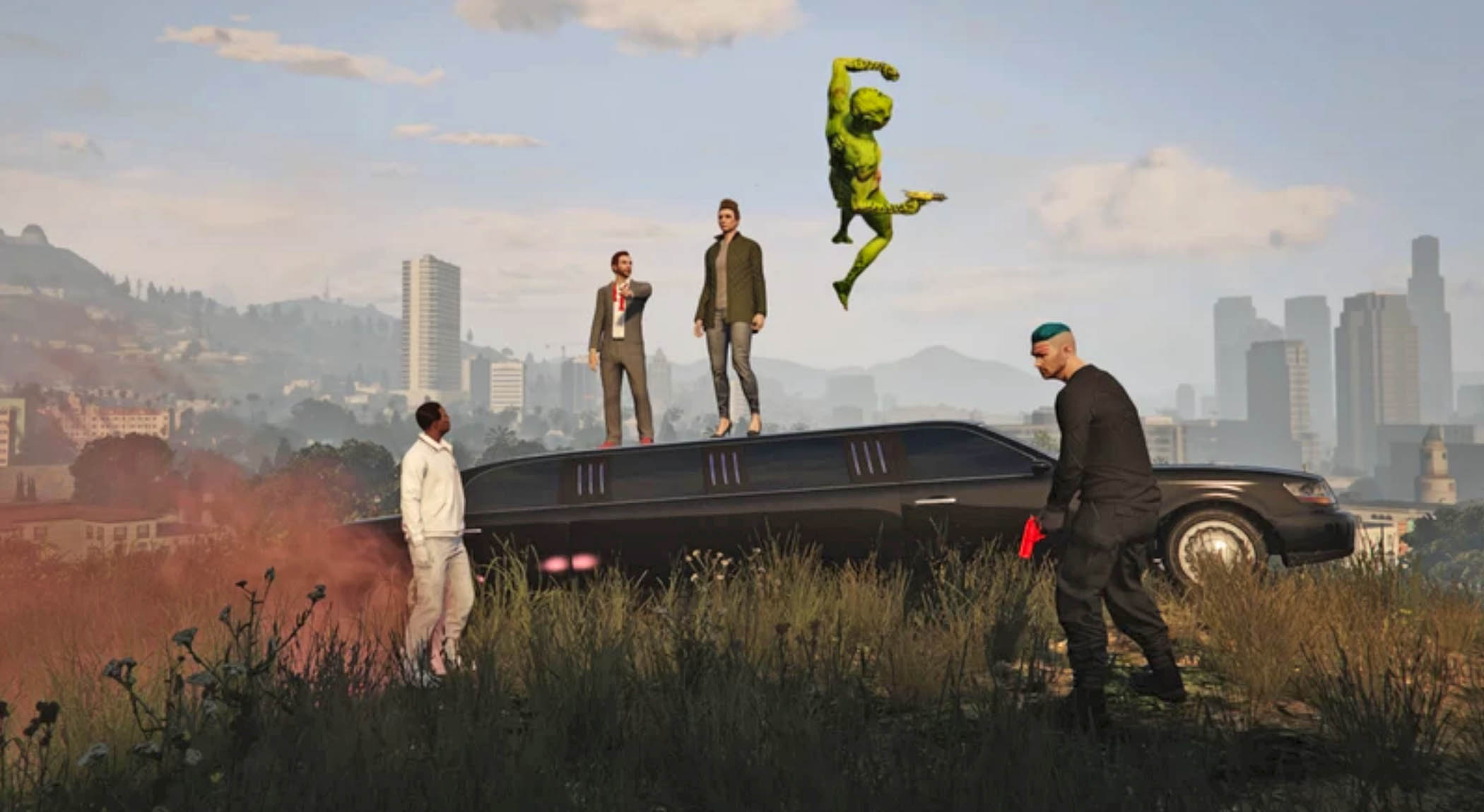
Which makes perfect GTA sense to them: In the play, everyone “pretends to be someone they’re not,” and almost everyone dies. But this dubious project requires them to recruit others: first, Sam’s partner, Pinny (popping in as a muscly butch in a T-shirt), which gives the project three recordable POVs. Then, total strangers, avatar-ed as aliens and gangbangers and masked avengers, running and jumping around and sometimes only nominally interested in Shakespeare. From there, we get edited swatches of the laborious audition process (including one Tunisian reptilian who in lieu of Hamlet recites the Q’uran), and the staging, which includes speeches performed on mountaintops and on a blimp. The “actors” commonly arrive in stolen police helicopters, and unaffiliated strangers show up to watch or shoot or sometimes watch, then shoot.
A rehearsal of the pivotal to-be-or-not speech in a dive bar quickly devolves into a brawl/shootout; Crane and Oosterveen must often interrupt their acting to kill threatening passersby. Eventually, the three “producers” herd the wild cats (real-life schedules complicate commitments, as people start going back to work) and “stage” Hamlet proper, in some fashion (we see highlights throughout, edited down from some 300 hours of “footage”), then win a dazzled post-pandemic Brit stage award. To celebrate, the avatars all go drinking in a disco.
The rich comedy of Grand Theft Hamlet drips mostly from the mix between the actors’ nonplussed dialogue over the absurd action and the game’s preposterous violence, uncanny glitchiness, and open-to-the-public messiness. (Notifications of off-screen deaths randomly blip in; at one late point, we get a banner: WASTED: Rosenkrantz destroyed you.) The efforts at dramatic earnestness aren’t as convincing or successful. Mark, being lonesome and familyless, has a bit of a stagy breakdown, and the actors’ earnest desire to make Shakespeare matter within this faux hellscape of smoking car wrecks and tattooed NPCs can burp up unintended irony.
I still don’t know what it is, though: nonfiction or not, cinematic or not, gaming or not, an amusing anomaly in the cultural matrix or a warmhearted yet chilling glimpse of a future entertainment dystopia. All of the above? ❖
Michael Atkinson has been writing for the Village Voice since 1994. His latest book is the new edition of his BFI tract on David Lynch’s Blue Velvet.