




Over more than 40 years of playing blues around the world — from a Hopi reservation in Arizona to Norway, Kenya, and his native Sweden — guitarist Robert Lighthouse had never heard Bob Dylan’s ballad “John Brown.” This nettled the 60-year-old, a disciple of American music who’d thought himself familiar with the whole of the legend’s vast catalog. Simple and plaintive, “John Brown” is a deceptive anti-war song, beginning as a patriotic fairy tale narrated by a young soldier’s proud mother. But a vivid description of her son’s return from battle — highly decorated and ghastly maimed, his face “all shot off” — leaves no doubt about what kind of song it really is.
In late March 2024, Lighthouse returned from his third tour of Ukraine, where he played Robert Johnson, Blind Willie Johnson, Isaiah “Doctor” Ross, and original songs for beleaguered locals and exhausted soldiers. Back in suburban Washington, D.C., where he has lived for close to 40 years, Lighthouse was surprised to learn that the song he’d written about the carnage in Ukraine closely resembled the one Dylan had recorded in 1962, at the Gaslight Cafe, on MacDougal Street. Lighthouse’s cris de coeur is called “If They Won’t Book You in Heaven,” and the lyrics, in part, go like this:
A young soldier with his foot blown off
Walking in the park with his girlfriend
And the sun was shining …
If they won’t book you in heaven, try your luck in hell …
Lighthouse had seen this hobbled soldier at a park in Kyiv in March 2023, with his friend Max Tavrichesky, a Ukrainian harmonica player who goes by “Shoe Man Max” onstage. Tavrichesky claimed that the blues had saved his life, but added, “To explain, I’d have to tell you my life story.” He arranged virtually all of Lighthouse’s tour dates — including those in Mykolaiv, Kharkiv, and Kherson, where bombs were falling during the shows.
“Without Max, none of this would have happened,” Lighthouse tells the Voice, adding that in the Kyiv park, “I saw the soldier with his girlfriend in the sunshine. He looked about 18, just a skinny kid with no right foot walking with his girlfriend. My God, for what?”
The photographer told Lighthouse of fat dogs near the frontlines, one carrying a human arm.
The song began to take shape later, back in Sweden, between the second and third tours. Lighthouse had arrived for his second tour in 2023, playing a gig in the basement of a theater that was destroyed by Russian bombs the next year. This took place in the ravaged city of Kherson, a metropolis of some 280,000 invaded by Russia in February 2022 and taken back by Ukraine that November.
At that show, Tavrichesky auctioned off bottles of vintage wine — some 100 years old, according to Tavrichesky — liberated from a wrecked winery the Russians had used for target practice when they occupied the city. The proceeds went to the Ukrainian army for items such as batteries, socks, and helmets. “Kherson is where I learned everything about war for the first time,” says Lighthouse. “It’s where I learned to open my jaw wide and cover my ears to give the [pressure] a place to go [other than your] skull.” A common joke, he says, is for folks who have been there awhile to ask a newcomer like himself if he’d brought a second pair of pants. Why? “Because,” he explains, “the first time a rocket goes off near you, you’re going to shit yourself.”
Down at the Dnipro River, the Russian army was on the east bank, while Ukrainian forces held the west. “You can’t process the reality that half a mile away people are being shelled and dying,” he says. “You laugh like a crazy person to process the horror.” In the midst of all this, Lighthouse recalls, “Coffee kiosks are everywhere. Fifty cents a cup.”
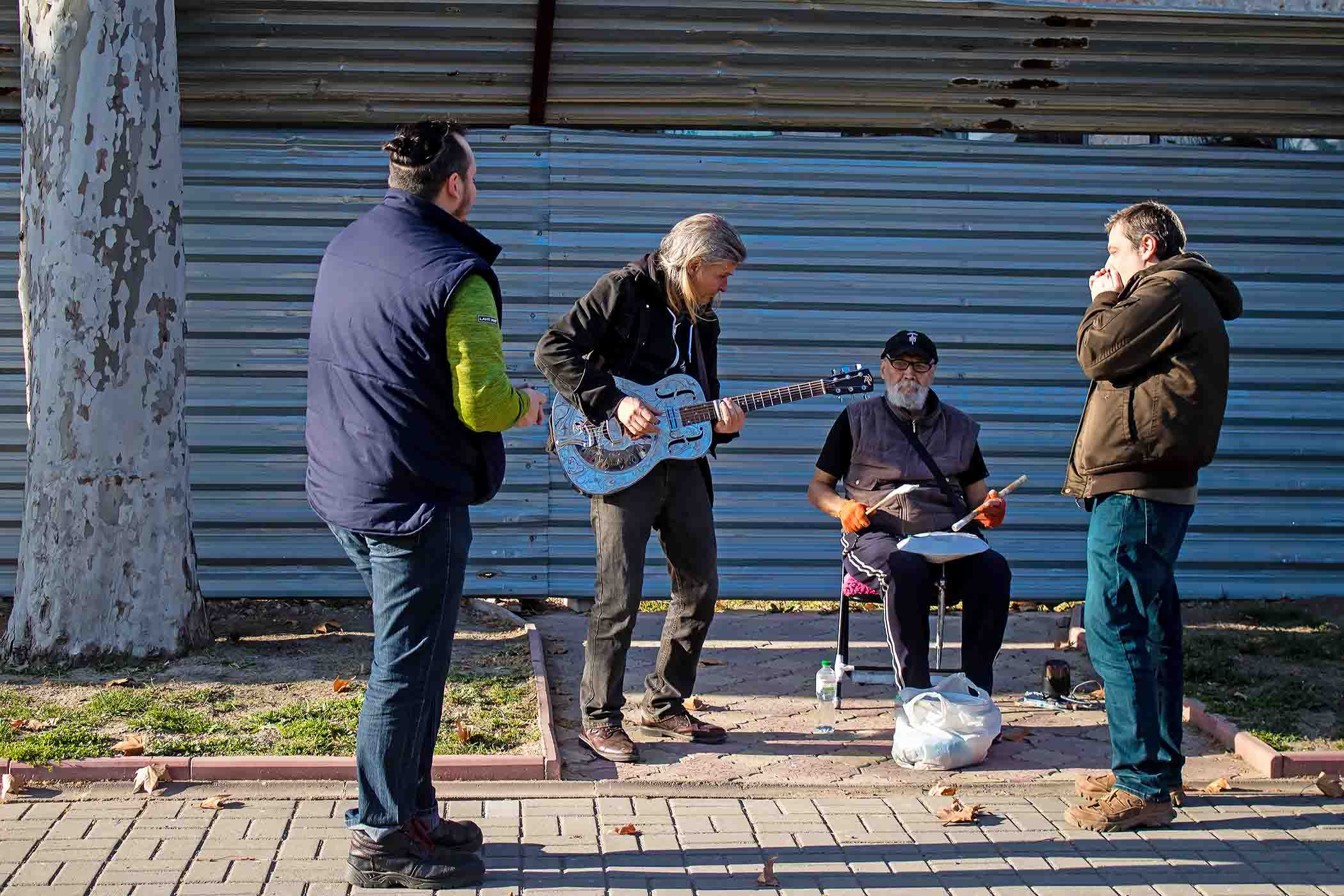
In Kherson, Lighthouse attracted a ragtag entourage that included a freelance combat photographer working the frontlines since the war began, a documentary filmmaker from France, and a trumpet player — who doubled as soundman — from the Kherson theater show. At one point, a couple of them gathered around a gray-bearded man playing jazz on an improvised snare drum, keeping time to a tape of John Coltrane on an otherwise deserted street. “I joined him on guitar,” recalls Lighthouse. “Max blew harp.” Out of nowhere, a man with a big beard and army fatigues appeared.
In Croatian, Lighthouse’s given last name, Palikoca, means “burning down the house.” He translated it for a career in show business.
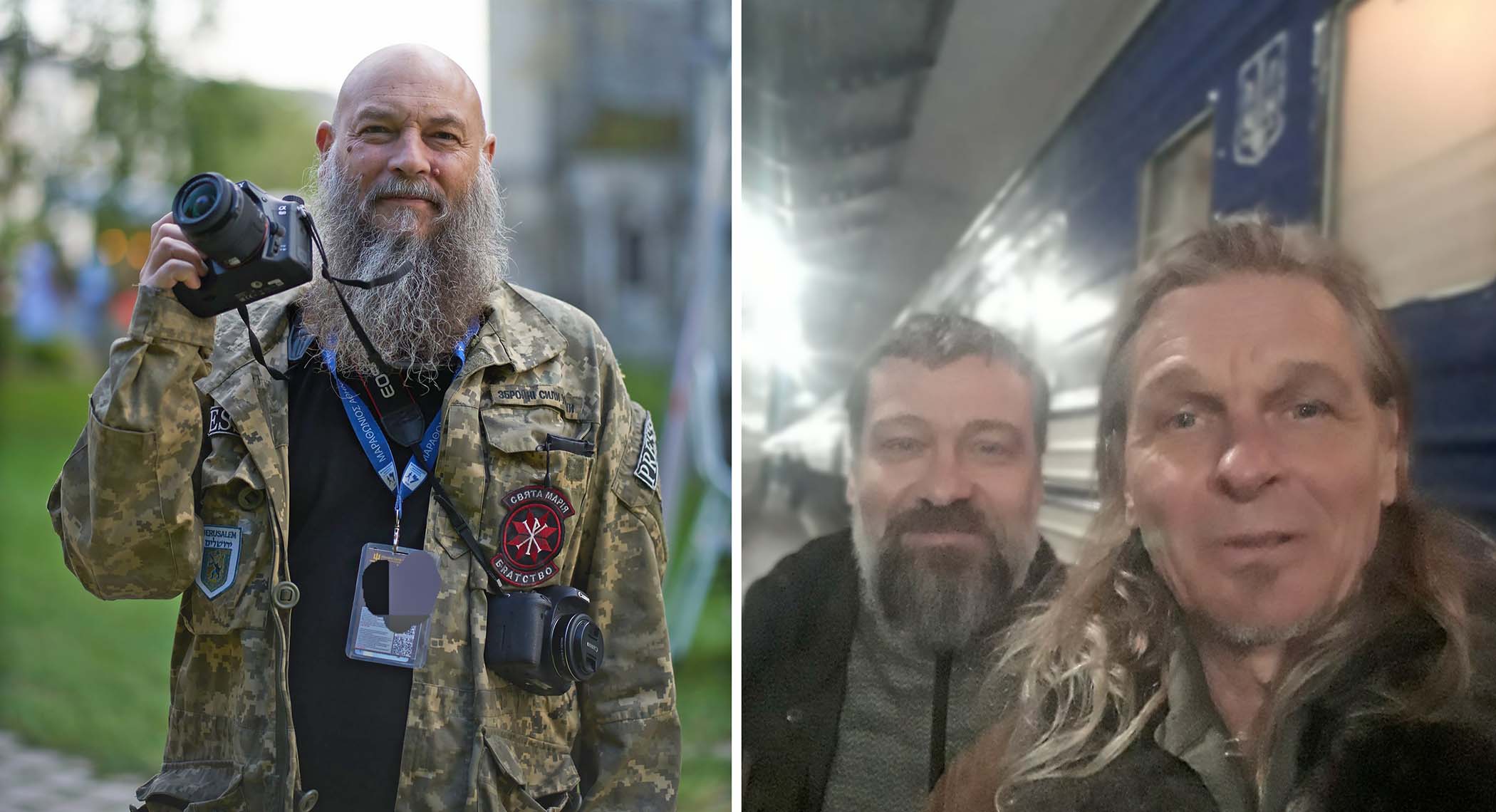
This was José Maria Hernandez, 55, a Spanish-born war photographer from France who happened upon the scene. “Kherson was under Russian bombs when I met Robert,” Hernandez says. “I was surprised to see a musician like him jamming in the street with alarm sirens sounding.”
While Hernandez snapped stills, Juliette Corne, of Paris, began filming. That footage, which also includes military families reuniting at a train depot with flowers and tears, accompanies the official video for “If They Won’t Book You in Heaven.” Lighthouse adds, “There’s also a video floating around somewhere of us playing ‘Going to the River,’ by Doctor Ross,” a mid-’50s blues song with the lyrics: “What you going to do when they send your man to war?” “We weren’t that far from the river where they were shooting,” he says. “It was absurdly appropriate.”
Lighthouse wrote “If They Won’t Book You” at a country house he uses in Tolita, Sweden. “I scribbled down ideas and picked up the guitar,” he says. “It came together in about an hour.” It was Hernandez who told Lighthouse of fat dogs near the frontlines, one carrying a human arm. The garrulous photographer was incorporated into the song.
He’s got lots of stories to tell
Boom, 500 bucks for just one shot
I guess they like those kinds of pictures up in heaven
Lighthouse first played this song in NYC on May 31 during a solo gig at Terra Blues, on Bleecker Street. He uses a mechanic’s socket on his pinky when playing slide on a resonator guitar and a glass slide on his Gibson “Southern Jumbo,” the kind made famous by Woody Guthrie when the Oklahoma legend scrawled “This Machine Kills Fascists” on its front. His voice is soft — you might say, kindly — and somewhat at odds with the fierce gravel of Blind Willie Johnson’s, as when Lighthouse covered the Texan’s gospel blues “God Moves on the Water,” about the sinking of the Titanic. A few songs later, Lighthouse’s harmonica filled the club with the roar of a freight train on a rendition of “My Little Woman,” by Doctor Ross. At the back of the room were two men in fatigues, Valéry Shyrokov and Mykolai Sierga, of Cultural Forces, a collective of performers drawn from Ukraine’s armed forces. Shyrokov is the group’s press representative; Sierga is a Ukrainian TV presenter, musician, and producer who leads the outfit. Just as Lighthouse had played American music for Ukrainians, a half-dozen soldier-musicians (several of them wounded) toured the States this summer to play their music in the U.S.
During Cultural Forces’ tour, Shyrokov had heard about Lighthouse on an NPR feature out of Wilmington, North Carolina, and stopped by the Village to say hello before a Manhattan engagement the following day. Other stops for the collective included Detroit, Pittsburgh, Cleveland, and Dallas, with the goal of keeping the two-and-a-half-year fight against Russia — overshadowed since the start of the Israeli-Hamas war last fall — from being forgotten.
“We’re here to remind America of our struggle,” Shyrokov tells the Voice, adding, “and we’re making a documentary of the tour,” which began on May 20 in Washington and ended in New York on June 28 with a performance at the Ukrainian Institute of America. The shows featured keyboards, violin, and the bandura, a centuries-old plucked instrument similar to a zither that can have as many as 65 strings.
Similar to the soldier in Lighthouse’s song, the group’s lead vocalist — opera singer Yurii Ivaskevych — lost a leg in the war. Violinist Olha Rukavishnikova wears a skull-and-crossbones patch on her injured left eye. “We feel a warmth when we see how Americans react to what we play, and we hope there won’t be any more delays [in shipments of U.S. weapons],” says Shyrokov. “This is the darkest moment in our modern history. Every day costs lives on the frontlines, and we can’t afford any more.”
If they won’t book you in heaven
Try your luck in hell …
• • •
Lighthouse was born Ivan Robert Palikoca just before Christmas 1963, to a Swedish mother and a father from Croatia. His given last name — later changed by the family to Palinic — means “burning down the house” in Croatian; he translated it to Lighthouse for a career in show business. “I was disenchanted with the industrial world,” he says of his decision to leave Sweden at age 18 with a backpack, his guitar, and a book about the prophecies of the Hopi tribe in Arizona, a gift from his girlfriend at the time. “I just took off, the best thing I ever did. I sent a postcard, ‘Hey Mom! I’m in New York.’”
Lighthouse arrived knowing nothing about America except what he’d read; he’d never even encountered a telephone answering machine. Skyscrapers like the Chrysler Building were pointed out to him by a stranger on the Greyhound on which he’d booked a ticket, which was headed to Flagstaff, Arizona, and from there to the Hopi Reservation two hours northeast. This was the beginning of a 40-year friendship with the tribe. At the same time, he set his mind to the intricacies of American music — blues, country, folk — never holding a regular job, just some freelance carpentry, house painting, and a short stint in an antique shop in Alexandria, Virginia. Early on, Lighthouse lived in a “band house” in Silver Spring, Maryland, with blues guitarist Pete Kanaras, formerly of the Nighthawks and now touring with the Chris O’Leary band. “Robert ranged from Doctor Ross to incredible Dylan covers to the Hopi thing,” says Kanaras. “He’s got his own rhythm and his own clock. When he’s feeling it, he’s in a rare place.”

The primary meaning of the word Hopi (short for Hopi’sinom), explains Lighthouse, is “one who is mannered, civilized, peaceable, polite, who adheres to the Hopi Way,” a philosophy at odds with that of Putin the Invader. More than once, Lighthouse recalls, in the midst of intense shelling while traveling throughout that besieged country, he muttered, “Motherfucking Russians.”
After his first tour, from his own observations and those of his Ukrainian friends, Lighthouse sensed hope and a belief that Putin somehow would not survive the conflict. After the second tour, he says, “It seemed like hope was out the window.” Now, in the midst of widespread blackouts, blistering heat, persistent Russian progress along frontlines earlier retaken by Ukrainian forces, and the July 8 bombing of Kyiv’s Okhmatdyt Children’s Hospital, whatever hope there was has been strained almost to breaking.
On July 14, Lighthouse reached out to Rustam Nezhura, a filmmaker in the central city of Zhovti Vody, who’d documented him in a recording studio there this past March. Said Nezhura, “The greatest fear of ordinary Ukrainians is that the collective West will abandon us.” ❖
Rafael Alvarez recently returned from a trip to Red Cloud, Nebraska, to research stories about Willa Cather. His most recent book is Don’t Count Me Out, the tale of a Baltimore junkie’s miraculous recovery, released by Cornell University Press in 2022. He is currently at work on a book about the Rosary.