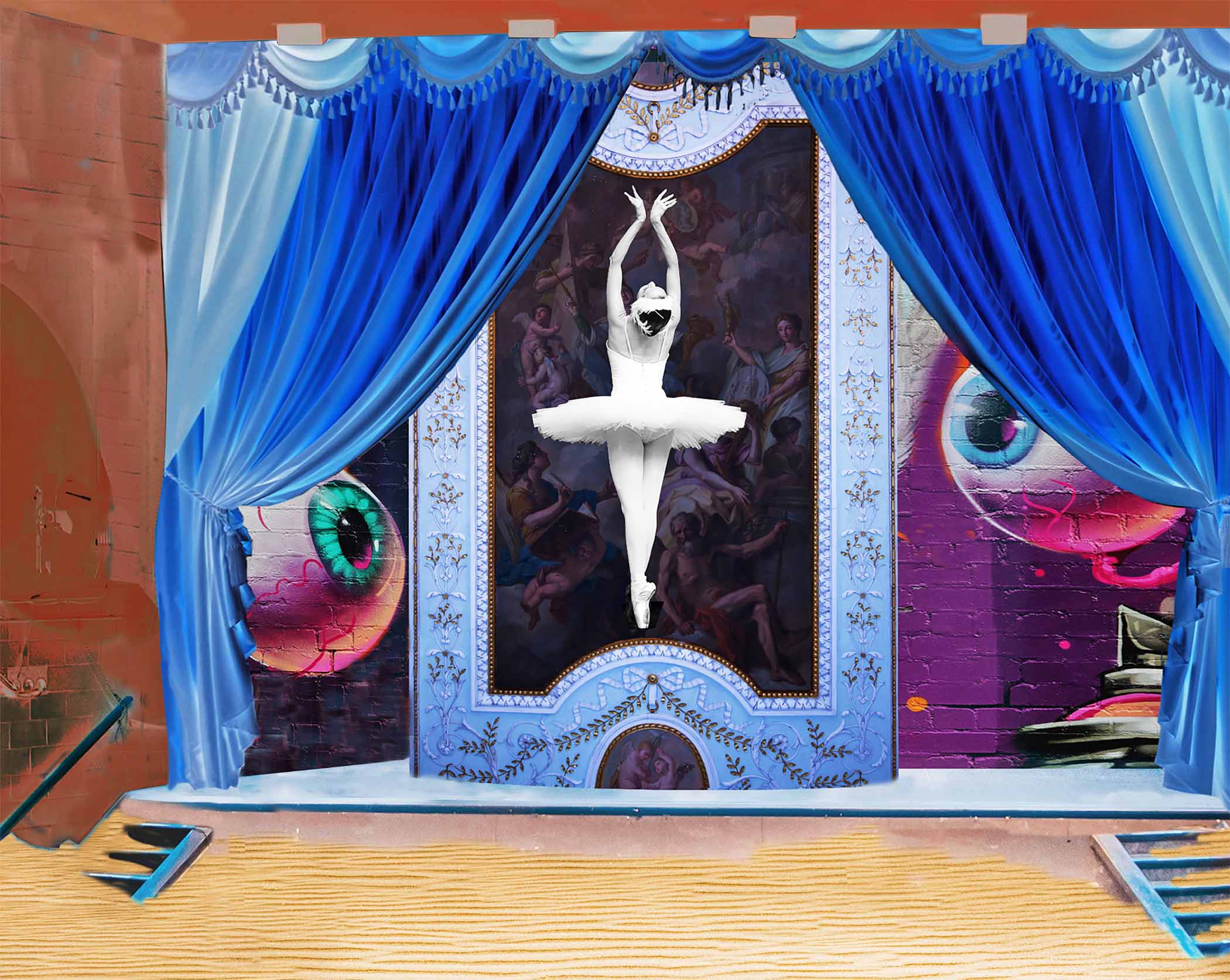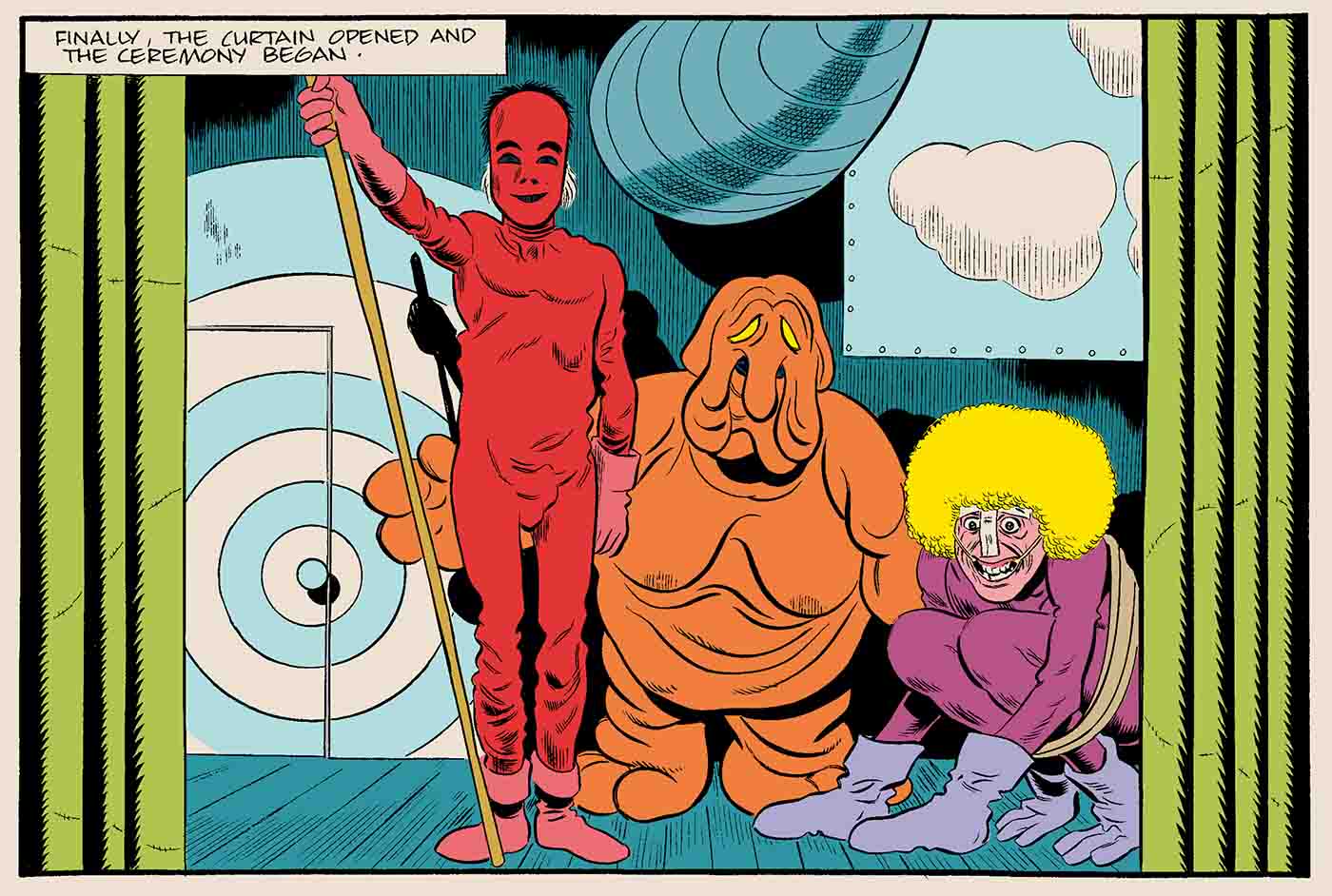






Void Corporation, Blake Butler’s new novel, isn’t new. He already published it under a different title, Alice Knott, in 2020. You’d be forgiven for being confused. Butler’s popular — and wrenching — 2023 memoir, Molly, was a breakthrough, for him and his indie publisher, Archway Editions. Now, with Void Corporation boasting the new title and some eye-catching cover art (a Seymour Rosofsky nightmare landscape has replaced George Ault’s coffee-table flowers), publisher and author hope to connect new fans with the older book. The problem is that on the surface, Molly and Void Corporation have very little in common: One is a tender, if harrowing, memoir, the other a very literary sort of sci-fi thriller; one might attract a fan of novelist Rachel Cusk, the other of Steve Erickson. Alice Knott was Butler’s fourth novel, and, like his earlier books, Scorch Atlas, There is No Year, and 300,000, it’s high-concept, genre-bending, and experimental. The heady mix of Butler’s interests — consciousness, memory, art, killing, and cults — makes for opaque windows into pulsing adventure. Think Eyes Wide Shut as directed by Terence Davies, or Red Dragon as written by Virginia Woolf. Butler has a Heidegger eye for a Dan Brown world — if that sounds like a strange combination, it is. But Void Corporation is not an experiment for the sake of experimentation; there is more behind Butler’s novel than a fancy for fusion. The reason for this high-wire act is not just stylistic, there’s a personal bent, too. The unrestricted access to Butler’s psyche in Molly opens up the earlier novel. Choices that felt random back in 2020 have resonance now. A new title feels appropriate to a transformed book.
Like The Da Vinci Code, Void Corporation begins with an inexplicable act deep in the catacombs of fine art. A video of de Kooning’s Woman III being slowly, deliberately burned for an audience has been recorded and released online. “The incineration begins along the canvas’s upper left-hand edge, instantaneously eating into and through the paint wherever it is made to touch; such that during the interface the image becomes obliterated … as the steadfast neon eye continues across its face without relent, quadrant by quadrant, stroke by stroke.” The video, which involves “masked figures,” “one full minute elapsed in silence,” and “the bright eye of a blue node of focused flame,” creates art-related psychosis in viewers en masse. Other homegrown destructions follow: “a screen displaying a looping presentation of Ann Hamilton’s video aleph (1992–93)” is thrown at “Richard Tuttle’s Purple Octagonal (1967)”; a mother of two smashes “through an installation of Duchamp’s The Bride Stripped Bare by Her Bachelors, Even (The Large Glass) (1915–23)”; and “at Centre Pompidou, in Paris, a screen displaying an early print of Kenneth Anger’s Lucifer Rising (1973) is head-butted by a fourteen-year-old.” Despite this cultural carnage, mankind is not especially gloomy at this twilight of the idols. “Breaking shit is cool,” remarks one impressed observer. “I don’t like art, but I like shit that’s been broken or might be broken later.” It’s good material, but this pandemic of cultural pessimism is just the B plot.
In the new foreword, Butler recalls that originally, Void Corporation was a “bottomless pit,” reading “like a dozen novels crammed into one, stacking subplot onto subplot.”
The real story is that Alice Knott, the art collector who owned the de Kooning, has become unstuck from reality. As she is interviewed about the theft, arrested (on suspicion of having done it herself), and, eventually, liberated by the thieving cadre she may or may not have been leading, her minute-to-minute experience is a three-layer cake of sensory data, distant memory, and the fleeting feedback of impressions that barely register. Void Corporation quickly reveals itself not as an art-inflected page burner but as a kaleidoscopic eye into a woman’s fractured psyche, “a fever screen of all the mislaid reflections of her life.” After all, an adventure can hardly register when you are “standing in a single, repeating day forever.”
At one point, years before, Alice had stopped recognizing her family. She began to see her father as an “Unfather” and her brother as an “Unbrother,” as the world around her became “a manifestation agreed upon by everyone around her,” a maze she could never get used to, full of unwanted surprises — “the house itself would not stop reassessing itself during her unconscious hours, appending and recompiling old partitions with prickly new ones,” “even familiar doors at times seemed not to lead to where they’d previously led, while others led to spaces that did not even seem part of their house.” To cope, Alice took solace in the “temporary corridors of medication” and later, in drinking: “Consumption made Alice’s hours seem to blur both going forward and in reverse, giving time a graceless and yet transfixing texture.” Occasionally, “one or both of her parents would sit her down and explain the whole configuration of their family once again as if from scratch, to an amnesiac.” Butler calls this day-by-day dehumanizing “the continuous smudging of her existence.” It sounds unpleasant.
In the opening pages of Molly, Butler recounts his last interactions with his wife, the poet Molly Brodak. She told him she loved him, sent him a PDF for a final manuscript of her poetry, and “said she’d finished reading the galley of [his] next novel … she liked the way it ended: with the book’s disturbed protagonist suspended in a grim panoptic cryptostasis, surrounded by ads.” Butler recalls being surprised that “she’d finished, given her low spirit and how she’d said she found the novel difficult to read because it hurt for her to have to see the pain behind my language, how much I’d been carrying around all this time.” Within minutes, she had ended her life. The novel she’d read was Alice Knott. Now, in the wake of Molly’s success, it makes sense that readers would want to seek the novel out as a sort of coda.
Void Corporation is a beautiful paper lamp covering up a burning core of pain.
The picture Butler paints of his marriage is multifaceted, and Molly is by no means a monument to misery. Butler and Brodak danced to “Nothing Else Matters,” by Metallica, at their wedding; they dressed up as hip-hop duo Insane Clown Posse for Halloween; they watched The Shining hundreds of times, weaving lines into their “own strange elaborations of rapport.” They had a deep connection, but things were not easy. Butler had already lost his father to Alzheimer’s, and in the early years of his marriage, his mother entered the early stages of dementia; her decline weighed heavily on the marriage. Butler also had issues with drinking (he memorably recalls “writing two books at the same time — Aannex and Aabbys, one during the day, sober, and the other at night, wasted”). Brodak’s problems were more internal. Soon after moving in together, she warned Butler, “If there were ever a gun in this house … I’d end up using it on myself.” Brodak was also, according to Butler, irritable and could be vicious. In the memoir, he writes, occasionally “the light behind her eyes would become glassy” and “Molly seemed to become someone else … the insults pouring out like black exhaust: You’re the most selfish person I’ve ever met. I wish you’d go away forever.” At one point, he states frankly: “It’s hard not to read the DSM-5’s description of the traits of borderline personality and not find Molly there in every line.”
Molly begins with the day of Brodak’s suicide, goes back to before Butler and Brodak met, and ends with some reflections on the afterlife (this final section is the closest, stylistically, to Void Corporation). It is brutal, breathless, and tender, and very hard to put down. Excerpted in Harper’s and The Paris Review, with big splashy reviews in the New Yorker and the London Review of Books, and already having gone through many printings, Molly was a major critical and commercial success. Alice Knott was, well, not. “Grueling” but “I respected it” was the verdict of The New York Times. Other big-name publications failed to review the book at all, and the publisher, Riverhead, declined to issue a paperback. (The hardcover is still available on Amazon, now offered at a significant markdown. Butler, who has discussed his experience with small and large presses on his substack, Dividual, says of large publishing houses: “Majors tend to think they know what sells.”)

In the new foreword, Butler recalls that originally, Void Corporation was a “bottomless pit,” reading “like a dozen novels crammed into one, stacking subplot onto subplot.” Over the years, he says, he wrote “at least three totally different novels,” starting in his childhood bedroom (as a 20-something caring for a father with dementia) and ending in the house he shared with Brodak. Void Corporation’s final form was inspired by a remark from Thomas Pynchon about the necessity of publishing The Crying of Lot 49 to build a readership for Gravity’s Rainbow. (The source of this remark is elusive. Butler, who refers to it in the preface, recalls that he found it from “reading somewhere.”) Following the example of Pynchon’s slimmest work, Butler kept the global conspiracy but tightened the lens. Unlike Oedipa Maas, the protagonist in The Crying of Lot 49, who provides a human entry into a vast postal conspiracy, Alice Knott’s mind maze is an active obstacle to the intrigue. She’s unable to concern herself sufficiently with the sweep of events, and instead brings readers into the stream of her consciousness. Even with the new title, Butler’s novel is still mainly about Alice.
The buried theme of Void Corporation is the dissonance created by living with people who are not exactly themselves — a topic on which Butler is expert. There isn’t any exact one-to-one, Alice isn’t Butler’s mother or his father or him, but what he went through with his parents’ long mental decline and with Molly clearly found its way into Void Corporation. Under the modernist A plot and the mass-market B plot, and cloaked in all of Butler’s long lilting sentences, is a personal revelation. Void Corporation is a beautiful paper lamp covering up a burning core of pain. In Alice Knott’s inability to form new memories or to cope with changes in people and places, Butler is drawing on his years with his parents. But when Butler writes about Alice’s unwillingness to recognize relatives who are outwardly identical but inwardly crooked (the unfather, the unbrother), he is, I suspect, drawing on Brodak’s Cluster-B rage. Drinking to cope applies to both.
All of this might make the reader’s reaction less like the bored but respectful NYT critic and more like Molly herself, horrified at how much Butler had been through on the eve of being about to go through a whole lot more. Void Corporation does not exist only as some sort of cryptic confession — it’s a dense novel full of big ideas about everything from monoculture to surveillance to painted giraffes — but at least one trap door out of the maze leads you back to Butler, his experience and emotions steaming away under the surface. In contrast, Molly was, to borrow a phrase from Void Corporation, “emotional spontaneous combustion,” an act of vulnerability and openness brought on by unprecedented (and presumably, unrepeatable) distress. Butler, who understandably has little left to say about his personal life, has returned to writing fiction. A new book, Uxa.Gov, was released this month. Butler has new readers now; maybe it’s time for his Gravity’s Rainbow. So what if he’s not as private as Pynchon. ❖
Gideon Leek is a writer who lives in Brooklyn.