




Anthony Howard
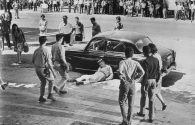
The standout in a sharp group show, Anthony Howard’s 34-minute, dust-pocked black-and-white film Oui We (2001) is a hilarious (when not excruciating) portrait of an artist desperate for an audience. Any audience. Pierre (Howard) parades a painting in front of MOMA, demanding that bystanders pass judgment, but his senseless, phlegm-caked, French-accented gibberish causes the public to either laugh or edge quickly away. Before long Pierre collapses like a fetus while his writhing limbs shred his painting. Later, conducting man-in-the-street interviews, his handheld mic crackling, he chases after a group of schoolkids in ties and skirts, who, à la Lord of the Flies, soon sense weakness. Screaming obscenities, they surround the sobbing hipster wannabe as he again curls up on the sidewalk. In other scenes, butt crack exposed above flapping trousers, Pierre clambers over scrap heaps and dirt piles, urinating and bellowing in solitary triumph. Whether humping a shapeless sculpture on the steps of the Met or crucified with duct tape in front of the Guggenheim, Pierre remains his audiences’s unrequited lover.
Elizabeth Dee, 545 West 20th Street, through June 24.
Paul Etienne Lincoln
Intended for one of Manhattan’s cavernous water tunnels, Lincoln’s Rube Goldberg–esque contraption of steam engines will power 86 1936 Buick car horns as they honk out variations of The Stars and Stripes Forever in a 60-hour performance. On view are records fitted with aluminum wedges for generating electricity, to be stored in old-fashioned Leyden jars; a hand-cranked turntable nested within a revolving sousaphone; and documentation of New York–themed songs from the 1920s onward. These exquisitely crafted anachronisms preserve snippets of an elusive past.
Christine Burgin, 243 W 18th, 212-462-2668. Through June 21.
Dawn Mellor
This Brit gives us Yanks what-for with large, vibrant paintings, in which leather-and-lace-clad Britneys, Angelinas, Winonas, and Madonnas cavort and kill in front of swastika-encrusted American flags (or in the case of Shitty Spanky Banner, the word “LOVE,” slathered over the stars ‘n’ stripes in fecal-brown clots). Fuck the Mothers, Kill the Others (2006) features Dorothy under the rainbow, using a riot shield to hold back a phalanx of Liza storm troopers sporting tarantula-like mascara. Closer to the artist’s home is Fuck the World, a 2006 portrait of Queen Elizabeth, her mouth stitched shut with the word “MUTE.” As Mellor’s compatriot (and spiritual predecessor) Johnny Rotten once crooned, “God save the Queen/She ain’t no human being!”
Team Gallery, 527 W 26th, 212-279-9219. Through June 24.
“Livres d’Artistes”
This gorgeous survey of printed collaborations between French writers and artists includes Manet’s lithographs for Stéphane Mallarmé’s translation of “The Raven,” De Chirico’s team-up with Apollinaire for a volume of surrealist Calligrams, and Guy Debord and Asger Jorn’s 1958 Situationist classic “The Naked City,” a “psychogeographic” map of Paris. Besides 120-plus books published between 1874 and 1999 there is also a poster for Alfred Jarry’s uproarious and scatological 1896 play Ubu Roi and a Green Box by Duchamp—it’s 93 sheets of diagrams and notations for the Large Glass scattered haphazardly inside a vitrine.
NYPL, Social Sciences and Humanities Library, 42nd & Fifth Ave, 212-869-8089. Through Aug 19.
Dennis Hollingsworth
Hollingsworth plays with paint like a kid making mud pies: Blobs of pigment, sometimes teased into spiky burrs, jut from the surface; palette-knife scrapings leave only marbleized stains on the canvas; thick layers are sliced, lifted, and folded back on themselves as if a brain surgeon had attacked a scalp. These visceral, garishly colored canvases straddle a netherworld between flesh and abstraction.
Nicole Klagsbrun, 526 W 26th, 212-243-3335. Through June 17.
Mark Schubert
Made from resolutely prosaic materials—foam rubber, lawn ornaments, car-top carriers, plywood—these sculptures nonetheless achieve startling presence. The extreme tension of a molded plastic lawn chair torqued and twisted into an ambiguous figure is intensified by the sharp, naked screws cobbling the structure together. Smart and intuitive—the childish red of a cheap plastic wheelbarrow makes one tottering heap sing from atop its rough masonite pedestal—these works have the slapdash solidity of great jazz improvisations.
Monya Rowe, 526 W 26th, 646-234-8645. Through June 10.
Marco Boggio Sella
Hung floor to ceiling as if at a teeming bazaar, these batiks, wall reliefs, and sculptures feature fanciful views of spacemen and planetary bodies. Sella, an Italian-born artist, showed West African artisans pictures of the 1969 American moon landing (which many had never heard of) then collaborated with them on the works. Their bold and abstracted visions provide a perfect counterpoint to a video of the remote villagers expressing wary acceptance (or in some cases, outright disbelief) that such a miracle ever happened.
John Connelly Presents, 625 W 27th, 212-337-9563. Through June 17.
Victor Moscoso
The new book Sex, Rock & Optical Illusions reveals how Moscoso broke all the rules of “good” design to create seminal rock posters in the ’60s: near illegible bubble lettering, painful color contrasts (learned from his Yale professor Joseph Albers), and dense graphics that slowly, if ever, impart their message. A classic poster for the Doors features a shapeless blob—is it a skull? mushroom? mushroom cloud?—that slowly resolves into a woman with butterfly wings. Other joys are the quick ink sketches and watercolor overlays Moscoso gave to printers as color guides; four decades later, they unveil the natural draftsman behind the psychedelic virtuoso.
fantagraphics.com
Sarah Sze
A mysterious pyramid of disaster greets strollers at the southeastern entrance to Central Park: A full-scale section of an apartment building juts diagonally out of the paving stones, asphalt sheets flapping from the triangular slice of roof. Windows piercing the brick walls reveal a jumbled interior spread out below ground: stacks of towels and toilet paper, empty specimen bottles, pencils strung with thread like miniature high-tension wires, a tiny foam-core staircase spiraling up amid springclamps and a bird’s nest. The blend of homey detail, shifting scale, and architectural detritus is a vision of homeland insecurity.
Doris C. Freedman Plaza, 60th & Fifth Ave. Through Oct 29.
E.V. Day
Two Bridezillas have booked the same slot at the most exclusive Location! Location! Location! ever, and each fabulous reception has been ruined by that other bitch! The remorseless tension of wedding day is manifested in a pair of disembodied bridal gowns facing off against each other, replete with satin heels, frilly undies, aqua garters, and jeweled tiaras: Tulle veils and silk trains are rent and twisted, with even the smallest shred freeze-framed in midair through a matrix of monofilament line, fishing tackle, and stainless-steel hardware dooming these two society-page wannabes to mortal combat all summer long.
Lever House, 390 Park Ave. Through Aug 26. ❖