


F. Scott Fitzgerald’s novel The Great Gatsby turns 100 in 2025, and we are still grappling with it. Routinely topping “Best of” lists, the novel is famous for its evergreen takedown of what we now call “the one percent”: “They were careless people … they smashed up things and creatures and then retreated back into their money or their vast carelessness, or whatever it was that kept them together, and let other people clean up the mess.…” But Gatsby is probably most celebrated as a fairytale of the American dream — at least, that’s what my undergraduate students, and AI, seem to think. The title character, Jay Gatsby, “believed in the green light, the orgastic future that year by year recedes before us.” Fitzgerald’s ambivalent story of our country’s promise has been echoed by writers from Jack Kerouac to Julia Alvarez and in cultural touchstones from Scarface (the 1930 novel and films from 1932 and 1983) to Mad Men to the 2013 hip-hop-styled movie version of Gatsby (the fifth to be made), with Jay-Z as executive producer.
Everyone remembers Gatsby’s pursuit of social and economic status and its tragic results; not everyone remembers that the novel’s narrative goes beyond tragedy into the realm of the sinister. Two 2024 stage adaptations neatly showcase this divided legacy. The Broadway musical The Great Gatsby is a slick spectacle that takes the green light — beaming throughout much of the show — as its guiding beacon, and revels in the 1920s fashion, booze, jazz, hotcha dancing, and bootlegging with which Gatsby is associated. Then there’s Elevator Repair Service’s Gatz, an unexpurgated staging that, relaying every syllable of Fitzgerald’s near-50,000 words, bares the novel’s disquieting overtones of nativist (whites born in the U.S.) thought — a 1920s form of white supremacy.
The real star of the Broadway production is the sumptuous 1920s spectacle, with its Art Deco sets, flapper costumes, and painstakingly designed props.
The book that is source material for these adaptations makes free use of nasty, physiognomical stereotypes of Jews, Blacks, and the people of “southeastern Europe.” The racist thinking of the ’20s is bruited about; some of the bruiting is by the brutish Tom, who explains, “We’re Nordics … It’s up to us, who are the dominant race, to watch out or these other races will have control of things.” Tom is an object of scorn for the story’s narrator, Nick Carraway, but the plot takes his paranoia seriously, and rhetorically identifies Gatsby as a menace to the racial order. Gatsby is, the novel suggests, the “Sheik” of the song “Sheik of Araby,” creeping into a white woman’s tent. (The song itself played off the Rudolph Valentino movie The Sheik.) Gatsby’s murder — he’s shot in his swimming pool — is paired with the more graphic death of Tom’s mistress, Myrtle Wilson, a tawdry reflection of Gatsby’s social climbing: She does what he does, except within the limitations of gender and middle-class vulgarity. Both threaten to disrupt the “Nordic” couple of Tom and Daisy, and Gatsby’s violent end is a lesson in knowing one’s place. The gangster movies that Hollywood started churning out a few years after the novel’s publication — Little Caesar, Public Enemy — made it clear: We can celebrate the rise of the new-money outsider, but eventually, enough is enough. Like all works that occupy a central place in a society’s consciousness, Gatsby serves as a fable. The moral of its story is that you can climb only so far before we kill you off.
In the novel, Nick’s ironic, self-conscious voice allows multiple dimensions of meaning, especially when it comes to Gatsby. When Gatsby asks what Nick thinks of him, Nick begins to answer with “the generalized evasions which that question deserves.” (I have often, when put on the spot, recalled those words.) Hearing Gatsby’s clichéd account of his past, Nick observes, “was like skimming hastily through a dozen magazines.” As Nick and Gatsby head to the Buchanans’ estate, riding a broiling commuter train, Nick voices his exasperation over Gatsby and Daisy’s romantic intrigue: “That anyone should care in this heat whose flushed lips he kissed, whose head made damp the pajama pocket over his heart!”
But moments into the Broadway version of Gatsby, when Nick (Noah J. Ricketts) starts singing about his great friend Gatsby, we are being told to forget the novel: This is a different story, a different Nick. Fitzgerald’s Nick would never engage in such an unselfconscious activity as singing a song, much less an unequivocal paean to Gatsby. (In the novel, Nick introduces his admiration for his friend while at the same time saying that Gatsby “represented everything for which I have an unaffected scorn.”) This Nick even gets engaged to socialite Jordan Baker (a commanding Samantha Pauly), which seemed to surprise them as much as it did me — it probably would have surprised Fitzgerald as well, since he took pains to create an unconsummated intimacy between two characters hinted at as being gay. Though the Broadway musical uses Nick to frame the story, the romance between Gatsby (Jeremy Jordan) and Daisy (Eva Noblezada) takes center stage, and earns the final bows. Noblezada, in particular, and her gorgeous alto voice, merit the appreciation. The real star, though, is the sumptuous 1920s spectacle, with its Art Deco sets, flapper costumes, and painstakingly designed props; when Gatsby’s car, described by Fitzgerald as “swollen here and there in its monstrous length with triumphant hatboxes and supper-boxes and toolboxes, and terraced with a labyrinth of windshields” rolls out onto the stage, it is an emblem of Gatsby’s celebration of the mythical excitements of the 1920s. A duo of tap dancers, one Black, one white, performs at one of Gatsby’s extravagant parties — to be historically accurate, they would have been in blackface, both of them. And the Broadway production integrates Gatsby’s underworld colleague Meyer Wolfsheim (Eric Anderson) into the main plot, changing him from a Jewish stereotype into a deracinated gangster. The novel’s more cringeworthy racist remarks, such as Tom’s outburst about “intermarriage between black and white,” are absent. At the play’s end, the melancholy final words from Nick, about the illusory, implacable pull of the past, give way to one final opulent party scene/chorus number. The audience is sent off celebrating.
Gatz does nothing to neuter the ugly nativism that infects the book.
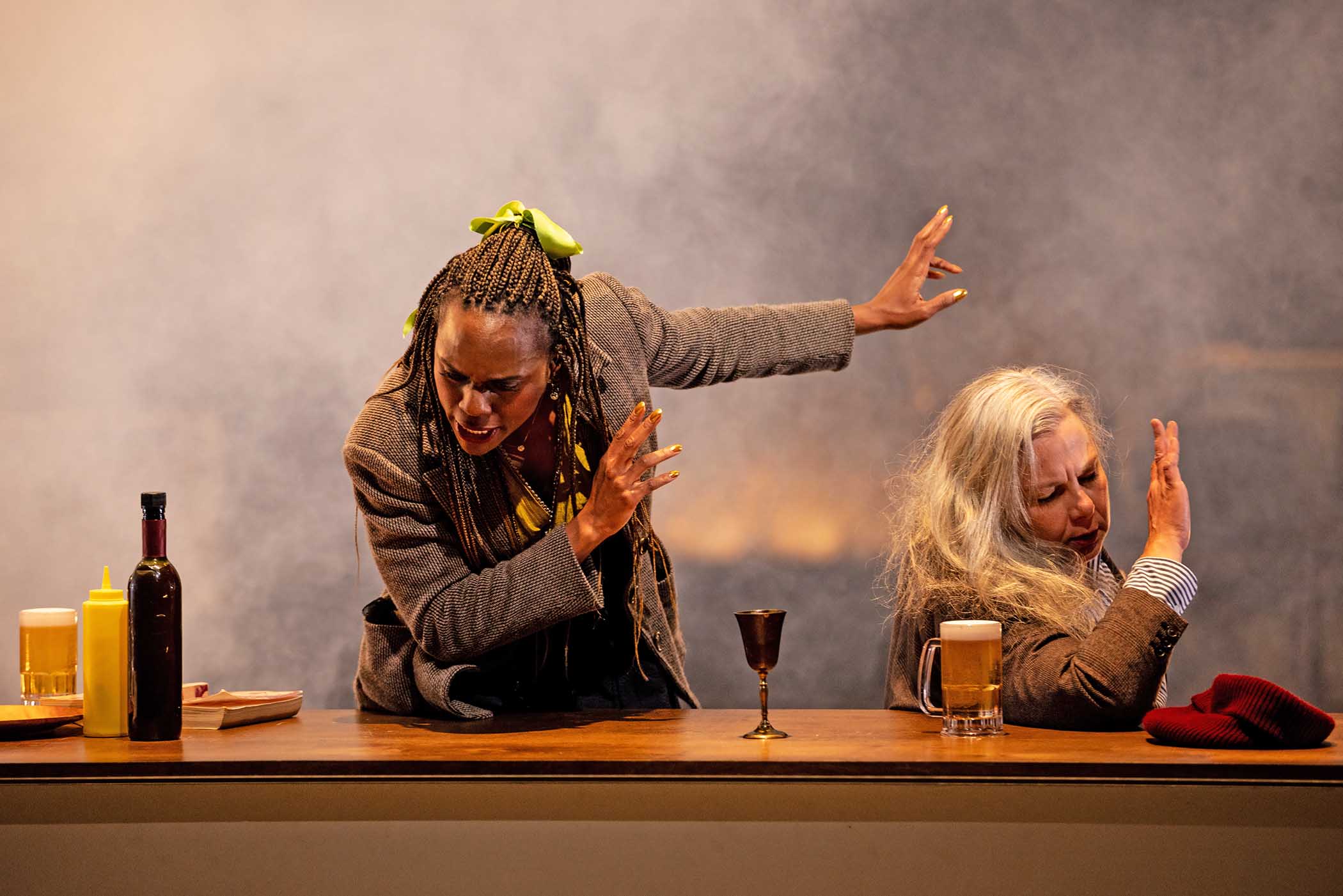
On the other hand, Elevator Repair Service’s Gatz (of which the latest iteration closed on December 1, 2024) is less an adaptation than a full rendering of Fitzgerald’s novel, structured like a workday: eight hours, curtain to curtain, with a couple short pauses plus a break for a meal. Attending means agreeing to make Gatsby’s life your own for a while. This compact between company and audience implicitly asserts that the novel has something to say to today’s world. Or not exactly today’s, as the set — a modern corporate office, with desks arranged back to back — could be from any moment during the past 30 years. Gatz’s premise is something like this: A man arrives at work, NYC to-go coffee cup in hand, to find that his PC won’t boot up. He tries various tricks, hitting first random keys and then all of them, turning the power on and off (we have all of us been there), and eventually phoning tech support. Waiting for assistance, he goes analog, unearthing from a Rolodex a copy of Gatsby, absurdly enough, complete with the iconic Scribner’s 1925 cover illustration: a ghostly female face, crying, superimposed over a night-sky-blue amusement park landscape. He opens it, begins to read aloud, and for the rest of the play his workmates take on the roles of the characters, and his office substitutes for the various settings in the novel. It’s Gatsby via The Wizard of Oz meeting The Office.
All of the ambivalence and ambiguity of Nick’s voice register in this brilliant performance by Scott Shepherd. Shepherd (who apparently has the novel memorized) recites most of the book: all of Nick’s lines, plus the narration, including every “she exclaimed” and “he interrupted,” etc. — interjected amidst the dialogue with flawless timing. Other performers are not as pitch-perfect, and that’s okay; this is Nick’s jam. Jim Fletcher, as Gatsby, eschews the studied grace of a character who prompts Nick to think about personality as “an unbroken series of successful gestures.” This Gatsby is just the gangly dude who sits across from you … and doubles as a legendary fictional character, sometimes even dressing the part. The doubling leads to delightful moments, as when that gangly dude arrives at the office wearing Gatsby’s pink suit. Just as the office furniture serves as 1920s accouterments, the cast has been chosen without regard to whether they match Fitzgerald’s descriptions, or readers’ mental pictures, a charm unto itself. That said, the company works wonderfully, pantomiming in time to Shepherd’s narration. Laurena Allen’s Myrtle shines particularly bright — brassy, and at times grubby: “I’m going to make a list of all the things I’ve got to get. A massage and a wave, and a collar for the dog, and one of those cute little ashtrays where you touch a spring.…”
The stamina of the Gatz audience is rewarded as ERS brings out the humor of a truly funny book. The first meeting of Gatsby and Daisy is a slapstick tour-de-force — Nick narrates while Gatsby, a bundle of nerves, tries to appear insouciant by slouching at an impossible angle. The lovers proceed to stutter-step around each other, as Nick third-wheels it. The audience tittered at the subtle humor, as when, amid the chaos of a drunken party, Nick says, “It was nine o’clock — almost immediately afterward I looked at my watch and found it was ten.” And viewers roared at some of the broader lines, such as when Gatsby is asked which part of the Midwest he is from and he answers, unironically, “San Francisco.” Even Tom gets a laugh, when he responds to the claim that Gatsby went to Oxford by snorting, “Oxford, New Mexico.” The words, and the play, gallop along, never dragging. Gatz, too, is a celebration for its audience, a celebration of experiencing in one sitting the novel’s ragged glory.
Gatz does nothing, of course, to neuter the ugly nativism that infects the book, inviting spectators to recognize the continuum between attitudes of the 1920s and those plaguing us today. That decade’s anti-pluralist, anti-immigrant movements led to racially motivated immigration limits (1921 and 1924), the persistence of Jim Crow, and the reemergence of the KKK (which had a particularly active chapter in Port Washington, site of Fitzgerald’s “East Egg,” where the Buchanans live). Fitzgerald smuggles these currents into his tale of upward mobility, placing references to racial hierarchy adjacent to Gatsby to show that, 100 years ago, social status was limited by ethnic pedigree, by one’s “breeding” (a word only used by Myrtle and Wolfsheim, characters who surely don’t have it, in the eyes of the others). Gatz’s frank enunciation of these cultural ills, echoing over the hours, suggests their staying power, allowing Gatsby to reverberate with contemporary headlines.
Ironically, the Broadway adaptation suggests the same: Its squeamish exclusion of the novel’s ugliness betrays a recognition of and discomfort with the racism afflicting our own time. These contrasting, compelling stagings reveal that when we celebrate the novel’s literary delights, as we endure its cultural horrors, we are rewarded with a prescient dissection of our past that illuminates our present. ❖
Jonathan Goldman is a professor in the Department of Humanities, New York Institute of Technology; author of Modernism Is the Literature of Celebrity; director of the website New York 1920s: 100 Years Ago Today, When We Became Modern; and president of the James Joyce Society.