Top

arts

Stories


2010's Best Comics and Graphic Novels

An assassin for Christmas, or maybe some witchcraft and depraved subordia?

Fantagraphics
Well, hello kitty! King of the Flies.

We’re sorry, but 2010 has been a dreary slog (Tea Party, anyone?), which is reflected in just about every graphic narrative that moved us this year. But we won’t let darkness visible obscure the intense artistry found in our picks of 2010’s best comics and other illustrated provocations.

Related Content

More About

Like this Story?

Sign up for the Offstage Voice Newsletter: (Up to multiple times a week) Information on theater and the performing arts.

Privacy Policy

For starters, we now know what 1930s anti-Nazi collagist John Heartfield would have done with the physiognomies of Hitler and Goebbels if only he’d had Photoshop. In Repuglicans (Boom Studios, 128 pp., $14.99), Pete Von Sholly brings every right-wing potentate from Newt to Sarah to undead life with bloated pustular flesh, frothing fangs, black-oil eyes, and other colorful grotesqueries. Steve Tatham’s pithy commentary confirms that the policies of these demagogues are every bit as monstrous as their portraits.

Even more horrifying, Danzig Baldaev’s Drawings From the Gulag (Fuel, 240 pp., $32.95) documents the phantasmagorical evil of the Soviet prison system. Female “enemies of the people” were thrown into cells to be gang-raped by thieves and murderers; children of imprisoned dissidents were given a “ticket to a happy childhood”—a euphemism for a bullet to the head. One prisoner lamented that “a human being survives by his ability to forget,” but Baldaev (1925–2005), who served as a camp guard and risked his own freedom to create these unflinching, painstakingly crosshatched scenes, knew that forgetting only allows such horrors to be repeated.

The Sinister Truth: MK Ultra (Pop Industries, 102 pp., $11.95) exposes our own government’s nefarious experiments with mind control and the CIA’s 638 different plots to kill Castro (and you thought it was only exploding cigars). Jason Ciaccia’s tale of LSD-crazed assassins would seem ridiculously hyperbolic if it weren’t derived from the CIA’s own files. With nods to Grosz, Bacon, and Steadman, Aaron Norhanian’s fervid ink drawings propel this witty hybrid of underground comix and the History channel right over the top.

Another aspect of America’s id gets probed in The Horror! The Horror!: Comic Books the Government Didn’t Want You to Read!(Abrams, 304 pp., $29.95). Jim Trombetta’s exuberant prose posits that postwar visions of atomic Armageddon, combined with rebellion against the era’s social constipation, inspired paroxysms of four-color mayhem. Bluenoses all around the country held comic books up as examples not only of why Johnny couldn’t read but also why he was out raping, robbing, and killing. Copious color reproductions highlight the lucid lunacy of Basil Wolverton, the proto-psychedelia of L.B. Cole, and other inspired craftsmen of the macabre.

By 1955, Congressional pressure had driven horror comics out of business, but in less than a decade Creepy andEerie magazines resurrected the genre like some reanimated corpse seeking revenge on its own murderer. Darkhorse’s striking reprints (currently at 13 hardcover volumes, $49.95 each) reveal such industry giants as Gene Colan, Russ Heath, Jerry Grandenetti, and Alex Toth using ink wash, crosshatching, and swathes of Zip-a-tone to lend their murderers and monsters convincing presence. These always entertaining, occasionally brilliant stories—see Steve Ditko’s kaleidoscopic time shifts in “Collector’s Edition” (Creepy Vol. 2)—gain force from the lithe black-and-white layouts.

Meanwhile, contemporary horror keeps coming at us like a zombie tsunami. Julia Gfrörer’s Flesh and Bone (Sparkplug, 40 pp., $6) features ardent line drawings of wan figures that might have escaped from an Elizabeth Peyton painting. This unearthly collision of witchcraft, gruesome love, and pathetic death dissipates into a truly poignant climax.

Equally absorbing, Charles Burns’s X’ed Out (Pantheon, 56 pp., $19.95) takes his obsession with the mating habits of teenagers to otherworldly planes. Burns allies luxuriant brushwork with an inspired palette that illuminates boho parties and mutant dystopias with equal conviction.

King of the Flies: 1. Hallorave (Fantagraphics, 64 pp., $18.99) manages to combine dystopia and partying in one particularly morose suburban nabe. Artist Pascal “Mezzo” Mesenburg’s crisp scenes of druggy costume soirées and bowling-alley liaisons deftly complement writer Michel Pirus’s slyly interlocking tales of depraved jollies in suburbia.

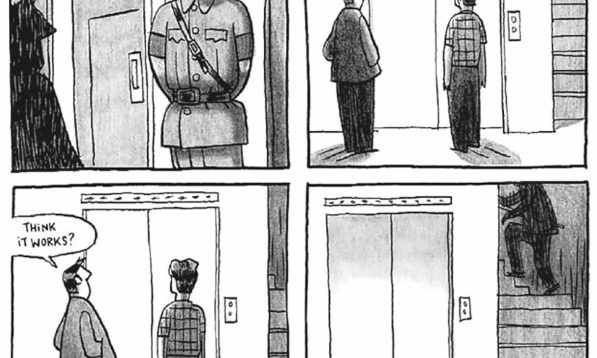
No one, however, can transform the workaday into existentially bleak page-turners like Chris Ware. His tales of myopic relationships and enervated dreams shimmer with eloquent graphics, precisely tuned dialogue, and perfect-pitch body language. In Lint, Acme Novelty Library Vol. 20 (Drawn & Quarterly, 72 pp., $23.95), we see parents’ faces slowly come into focus through their baby’s eyes, watch the young Jordan Lint grow into an adult-scaled world, then follow his punctured ambitions and bumptious middle-aged affairs to the moment when everything contracts back down to that first dot of consciousness. Astonishing.

Also dazzling, Dirty Baby (Prestel, 160 pp., $125.00) begins with Ed Ruscha’s paintings of blurrily silhouetted sailing ships and foreboding tract homes overlaid with white bars implying censored phrases. Each of these mysterious images is counterpointed by David Breskin’s witty poetry (derived from such Ruscha titles as “Be Cautious Else We Be Bangin' on You”). Rather than explicate the pictures, the poems seek to metaphorically fill the blank areas with fresh interpretations. Nels Cline’s clashing musical harmonies (included on four inset audio CDs) further stitch poetry and canvas together into a mordantly funny, amorphously beautiful genre Frankenstein.

But if you’re looking for the current gold standard in straight-up comic-book artistry, Darwyn Cooke is your man. The Outfit (IDW, 160 pp., $24.99), like last year’s The Hunter, sets one of Donald Westlake’s crime thrillers against Rat Pack–era backdrops, where antihero Parker wages a profitable war on syndicate bosses who want him dead. Westlake’s cynical characterizations—a thrill-seeking society girl pouts when a would-be hitman confesses before he can be tortured—merge with Cooke’s diverse layouts and visceral figures to keep the plot burning rubber from wire to wire.

1 | 2 | Next Page >>


Most Popular Stories

for free stuff, theater info & more!

Browse Voice Nation
  • Voice Places

    Voice Places

    Discover restaurants, nightlife, travel, shopping...

  • VOICE Daily Deals

    VOICE Daily Deals

    Get 50 to 90% off every day on restaurants, movies, massages...

  • Best Of

    Best Of...

    More than 10,000 of the BEST things to eat, drink, and experience

  • My Voice Nation

    My Voice Nation

    Join the Village Voice community and get exclusive deals and info

  • Happy Hour

    Happy Hour

    Your local Happy Hour guide at your fingertips

or

Log in or Sign up

Social Connect:

Use your favorite account to access My Voice Nation.


Use your My Voice Nation account to log in:


Forgot password?
or

Sign Up or Log in

Social Connect:

Sign up for My Voice Nation with your preferred network.


Sign up for a My Voice Nation account:


Privacy policy