Top

arts

Stories


Unnatural Acts: The School for Scandal

Plastic Theatre's play tells the not-so-gay story of how Harvard treated gay students in 1920

While we're celebrating New York's legalization of same-sex marriage, Unnatural Acts (Classic Stage Company) has arrived, with perfect timing, to be the ghost at the feast, a salutary reminder of the many for whom the gay-rights movement arrived too late. The lives hounded into misery, isolation, suicide, and other forms of premature death make up a grim and dauntingly long list, which no group exemplifies better than the Harvard men who, in 1920, used Perkins 28, the dorm room of undergrad Ernest Weeks Roberts, as a social center.

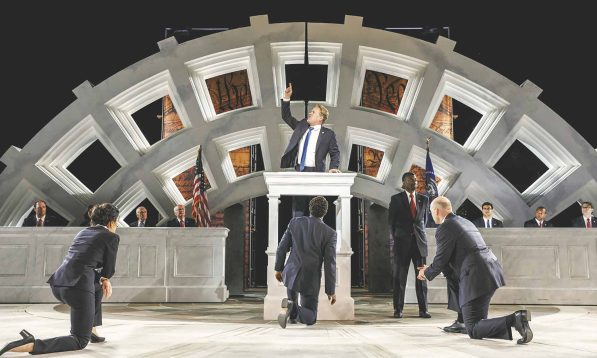
"Tainted" in Cambridge.
Joan Marcus
"Tainted" in Cambridge.

Details

Unnatural Acts
By Plastic Theatre
Classic Stage Company
136 East 13th Street
212-352-2101, classicstage.org

Related Content

More About

Like this Story?

Sign up for the Offstage Voice Newsletter: (Up to multiple times a week) Information on theater and the performing arts.

Privacy Policy

Roberts (Nick Westrate), a retired congressman's son, was a child of privilege, like many of those at the frequent parties in his suite. But others weren't. Much like the crowd you'd meet in any gay bar today, Roberts's guests included middle-class kids for whom a Harvard degree equaled a step up the socioeconomic ladder, artistic kids aspiring to professional careers, and working-class townies out for a good gay time. World War I, just ended, had left prewar moral values as wrecked as Europe; "dangerous" books still banned in Boston, like Havelock Ellis's Sexual Inversion, circulated clandestinely but freely. The '20s were only starting to roar.

Harvard's establishment, reared on pious Victorian principles, hardly knew how to cope. The messy events that Unnatural Acts covers began to emerge from Perkins 28, and got a lot messier, when Cyril Wilcox, a troubled undergrad from Fall River, Massachusetts, committed suicide at home by "accidentally" leaving the gas tap on in his room. Wilcox's older brother (Roderick Hill), a Harvard alum already showing signs of mental instability—he spent his last two decades in a state asylum—discovered letters that Roberts and another undergrad had written Cyril, full of gay gossip, naming names. After beating up one of the townies so named—who, under duress, supplied more names—the elder Wilcox took his evidence to Harvard's president, at whose orders the college's acting dean assembled a five-man "secret court" to investigate.

Its proceedings stayed secret until 2002, when a reporter from the Crimson, the student newspaper, stumbled on the court's records in an archive. Subsequent research has revealed much, sometimes despite Harvard's reluctance, about the lives of the college men "tainted" by the goings-on in Perkins 28, and in some cases destroyed as a consequence of the dean's investigation. The case has inspired a book, an indie film, and two plays: Stan Richardson'sVeritas, seen in the 2010 Fringe Festival, began as a collaboration with Unnatural Acts' creators, Plastic Theatre and its director, Tony Speciale.

Though the two works tell the same story and draw, essentially, the same moral from it, their stylistic differences clearly explain why Richardson split off from Speciale and his troupe. Veritas strove for an archly "literary" period diction, partly inspired by the tone of the Wilcox letters; Unnatural Acts, reserving its artifice for its stage pictures and directorial devices, tends to be more down-to-earth verbally. In Veritas, the parties Roberts hosted evoked the italicized orgies in Erich von Stroheim silent films; analogous scenes in Unnatural Acts look, more persuasively, like undergraduate queers getting cheerfully raunchy.

The increased sobriety of tone that clearly comes with Speciale's directorial sensibility transmits the substance of the story far better, but offers its own drawback: an earnestness of language that, unlike Richardson's beribboned phraseology, sometimes edges uncomfortably close to cliché. Where Richardson went for the fervid, painting the two students who got off most lightly as black-hearted betrayers, Unnatural Acts fixes them, lucidly, as victims desperately seeking their own ways out of the common dilemma. Its one grave mistake is to get preachy about that dilemma, with a gigantic final speech that lasts exactly twice as long as necessary, accompanied by ensemble choreography that crumbles in focus just as the speech gets repetitive.

But this excess, like the show's other flaws, looms small in the context of the big matters it gets right. The differences in outlook between 1920 and today are caught clearly, as is the unvarying, fear-driven bigotry that's made the gay journey from then to now such an anguished, embittering struggle. The show's acting, like its collectively authored script, varies in quality, but its overall skill and good sense make its tale of unjustly wrecked lives painfully tangible.

mfeingold@villagevoice.com


Most Popular Stories

for free stuff, theater info & more!

Browse Voice Nation
  • Voice Places

    Voice Places

    Discover restaurants, nightlife, travel, shopping...

  • VOICE Daily Deals

    VOICE Daily Deals

    Get 50 to 90% off every day on restaurants, movies, massages...

  • Best Of

    Best Of...

    More than 10,000 of the BEST things to eat, drink, and experience

  • My Voice Nation

    My Voice Nation

    Join the Village Voice community and get exclusive deals and info

  • Happy Hour

    Happy Hour

    Your local Happy Hour guide at your fingertips

or

Log in or Sign up

Social Connect:

Use your favorite account to access My Voice Nation.


Use your My Voice Nation account to log in:


Forgot password?
or

Sign Up or Log in

Social Connect:

Sign up for My Voice Nation with your preferred network.


Sign up for a My Voice Nation account:


Privacy policy