save older movies, let today's junk rot
(....or buy today's junk at walmart for 4 lousy movies on one disc for five bucks.)
Digital might be the future of the motion-picture medium, but for film preservation, its a mixed blessing. Archivists polled in a recent Cineaste make it clear that digital technology is part of the solutionand part of the problem.
Itself difficult to preserve, digital cinema subtly distorts (by improving) the celluloid image, even as it often dictates (through commercial considerations) those movies deemed worthy of preservation. Indeed, debunking the myth of increased access, movie historian and New York Times DVD critic Dave Kehr has pointed out that each new distribution platform (from 35mm to 16mm, VHS, DVD, Blu-ray, and online streaming) has narrowed the range of titles in active distribution and diminished the proportion of available films.
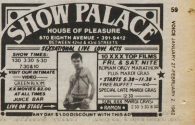
Bucking historical inevitability even as it serves history, the Museum of Modern Arts month-long annual festival of film preservation, To Save and Project, could be retitled To Save and Project . . . Film. The Movie Orgywhich opens TSAP this Fridayis a digitally preserved version of the four-hour found-footage extravaganza first orchestrated by Joe Dante and Jon Davison back in 1968. But this anarchic assemblage aside, the only digital presentations in the series are the two 3-D programs (necessary in that their original format is no longer viable) and the Academy of Motion Picture Arts and Sciences preserved print of the 1968 Saul Bass short Why Man Creates. The remaining 30-odd movies and programs are being presented on old-fashioned film stock, showing celluloid fans the actual stuff.
Forward into the past: Although most film festivals are consecrated to glamorous premieres and the newsworthy new, TSAP treasures the rediscovered and dusted-off. Like browsing a used bookstore in an unfamiliar cityanother endangered pleasureparsing TSAPs lineup, youre never sure what will turn up. This years attractions range from a restored color version of Georges Mélièss A Trip to the Moon (the Star Wars of 1902) and the first Soviet stereo-vision feature, Robinzon Kruso (1947), to new prints of Roger Cormans anti-segregationist screen-scorcher The Intruder (the most alarming B-movie of 1962), Louis Malles 1969 doc Calcutta (showing with Iranian poet Forough Farrokhzads lyrical portrait of a leper colony, The House Is Black), Alberto Lattuadas 1952 neorealist adaptation of Gogols The Overcoat, and Elaine Mays 1976 black comedy Mikey and Nicky (the best movie John Cassavetes never made), as well as the preserved work of the late downtown performance artist Stuart Sherman.
The mix makes its own context. Marcel Carnés 1938 proto-noir Le Quai des brumes rubs elbows with Seijun Suzukis delirious post-noir Zigeunerweisen; the surreal exotica of Mikhail Kalatozovs Soviet documentary Salt for Svanetia appears in dialectical opposition to the Hollywood orientalism of Don Weiss The Adventures of Hajji Baba; preserved documents of Elaine Summers epochal Judson Hall dance recitals follow prints of Jean Rouchs early ethnographic films. Some programs are themselves compilations. Cruel and Unusual Comedy From the Desmet Collection draws on Dutch archives to present an assemblage of savagely nutty preWorld War I European two-reelers, accompanied by Donald Sosin and his NYC Eclectic Electric Band.
The studio most dedicated to preserving (or recycling) its own history, Twentieth Century Fox, has five features in TSAP, including The Girl in the Red Velvet Swing (1955), starring a young Joan Collins; Bob Fosses autobiographicalAll That Jazz (1979); and, particularly timely in the wake of the current hit Drive, its model, Walter Hills The Driver (1978)all restored with an eye on the DVD market. More daringly impractical, Universal has excavated the far less commercial Afraid to Talk (1933), an urban corruption melodrama adapted from a play by leftists George Seldes and Albert Maltz, while Turner Classic Movies helped MOMA restore another pre-Code artifact, the carnival film Hoop-La (1933), directed by Frank Lloyd from a script co-written by pulp poet Joseph Moncure March.
Motion pictures dont just preserve vanished cityscapes, but also extinct and unique personalities. Hoop-Lashowing this Saturdayis loaded with hokum and casual outrage (the fat lady hoisted onto the circus train as midgets are jammed into the overhead luggage racks), elaborate brawls, and a primal father-son conflict, but its main attraction is 28-year-old Clara Bow, the It Girl of the 20s in her farewell screen appearance. (A movie about carnie barkers, Hoop-La is itself a build up to Bows near-naked hoochie-coochie dance.) Introduced rolling her eyes and shooting craps, Bow is a paradoxical presence, a fading star who seems the essence of hard-boiled resilience. A spunkier Jean Harlow, a svelter Mae West, she takes her place among the comic sex goddesses of the early talkies, resurrected along with the film that preserved her performance.
Film restoration is also the restoration of cultural memory. André Sauvages nearly forgotten city symphony Études sur Paris not only brings back the Paris of 1928 but also shows how that Paris saw itself. In this sense, The Movie Orgy is another double restoration. Originally a two-projector performance piece (at the Fillmore East and elsewhere), Dantes barrage of cheap creature-features, civil-defense-training films, 50s kiddie TV, and newsreels of Richard Nixon is not only an artifact of counterculture exuberance but was also, in its day, the visual equivalent of the faux doo-wop group Sha Na Na that, shown mainly to college audiences, reinforced the sense of a shared, cathode-ray collective unconscious in the first generation to grow up with TV. (For those born later, it might be less found footage than found surrealism.)
A vulgar, provocatively slapdash corollary to assemblages by avant-garde film artists Bruce Conner and Ken Jacobs, The Movie Orgys appearance at MOMA enlarges received histories of avant-garde film practice. So too Uruguayan artist Lidia García Milláns three-minute, jazz-scored poured-painted abstraction Color (1958), rediscovered by TSAPs edgy analogue, the NYU Orphan Film Project, and painter Agnes Martins lone completed and largely forgotten film, Gabriel, preserved by MOMA in cooperation with the Pace Gallery. First shown in 1977, Martins unfashionably romantic, even simpleminded, feature-length study of a child navigating the mountains and streams of a sublime Western landscapeas accompanied by intermittent bursts of Bachconfounded partisans of the artists stringent, minimalist canvases, who naturally expected something closer to that aestheticperhaps something akin to the structural cinema of Hollis Frampton or Michael Snow.
The Movie Orgy might be artless, but it is scarcely naïve; Gabriel is its opposite, with a highly sophisticated visual artist making earnestly amateur, if not primitive, use of 16mm film. Martins acceptance of the mediums intrinsic qualities and somewhat maddening emphasis on duration (if not her assertion that her subject is happiness, innocence, and beauty) brings her close to early Warhol. Indeed, with its shaky handheld camera, end flares, evident film grain, and occasional soft focus, Gabriel could not be anything other than 16mm. Good art or bad, its presence is essential to the TSAP worldview: Celluloid lives!
Join My Voice Nation for free stuff, film info & more!
Find everything you're looking for in your city
Find the best happy hour deals in your city
Get today's exclusive deals at savings of anywhere from 50-90%
Check out the hottest list of places and things to do around your city