




This past decade has been a cynical one for American institutions, if sporadically idealistic on a leftist, grassroots level. The return of socialism to mainstream discourse and the spread of unionization, coupled with the ripples of recent social justice movements, have forged pockets of collectivity and mutual care among what increasingly feels like an opposition without electoral representation. Needless to say, this resurgence is too little, but not too late — nor is it inherently minor compared to the shitshow of Trump’s second term. Small, organized groups might be a last bulwark for ideas, values, and, first and foremost, lives.
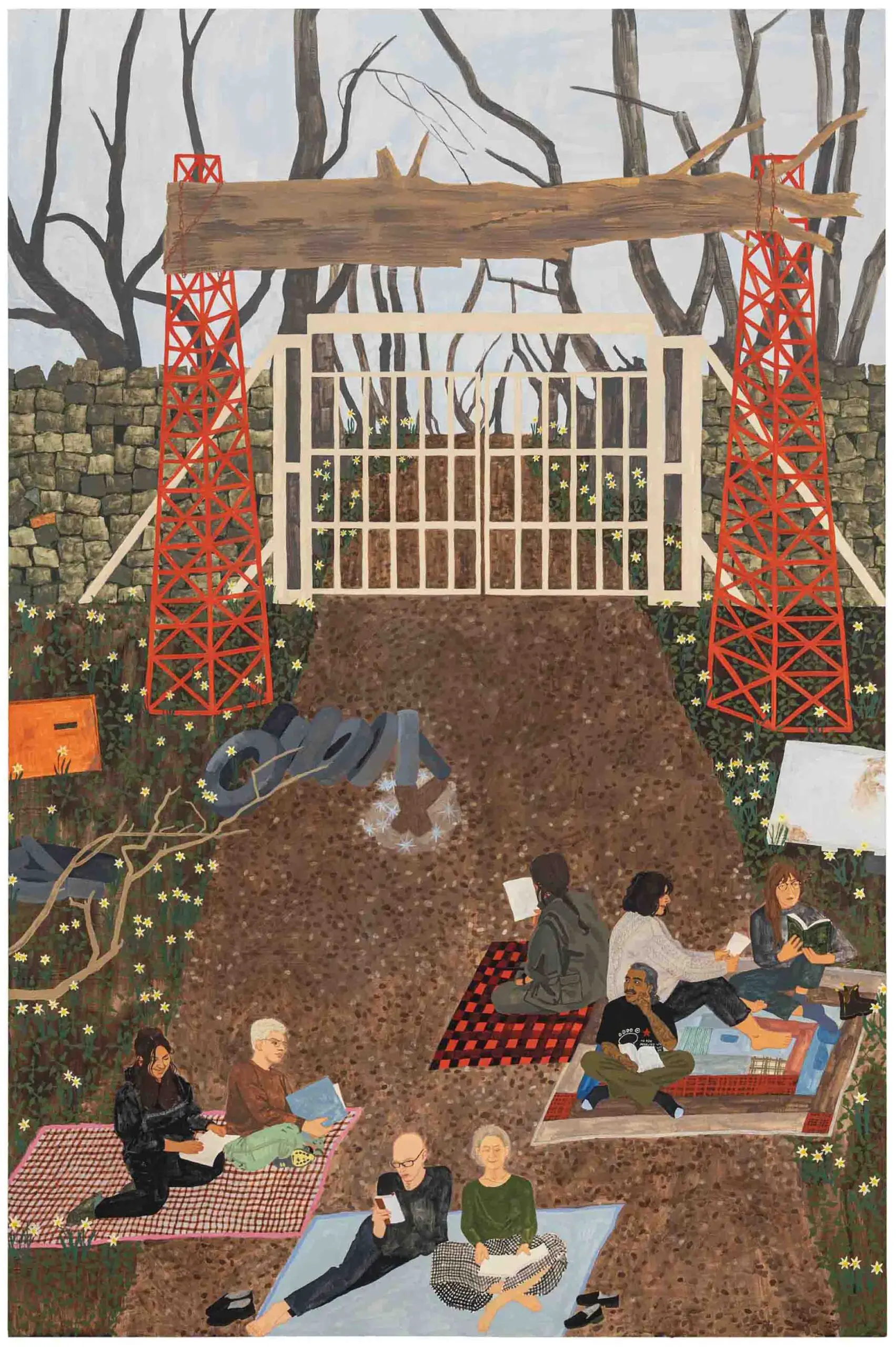
Dianna Settles addresses this civic predicament by portraying humanity in manageable morsels of solidarity and survival. The figures in her new show of paintings, Enemy of the Century, at the East Village’s March gallery, tend terrariums, muddle apricots and lemons into juice, forage for vegetables, trim branches from trees, and decorate ceramics. They appear to be inhabiting an autonomous enclave, fortified by fences and barbed wire, but most importantly they undertake these activities together: Her acrylics teem with seemingly incidental arrangements of people collaborating and cohabitating. Abstracted forces from the loneliness epidemic to industrial farming to the World Wide Web are nowhere to be found. Every task in her utopia is human-scaled and predicated on connection — with the land and with each other.
For five years, Settles resided at Crack in the Sidewalk Farmlet, a sustainable urban homestead in Atlanta, and she has often painted fellow residents and other friends. Her content echoes the Socialist Realist art that came out of the Soviet Union and kindred states, but her style is various and personal, and always a refusal of Stalin- or Mao-esque standardization. Sometimes she evokes outliers who made statements in those societies: The Huxian Peasant Painters, for example, whose rural pictures captivated China during the 1970s, are visible in her bright colors and busy, optimistic tableaus. The allusions in her art are sincere, though they twist the emotional reactions of viewers and pry open intellectual wormholes, as when she lifts the titles of her paintings from literature. These titles are lyrical (Being must everywhere be the basis of our thought and deed), and sometimes lengthy to the point of obnoxiousness (Art purifies, through catharsis, what should be seized directly – life. We will no longer make objects / our art is life / our medium revolution / & in a world based on repression our only message is liberation).
If Settles’s earnestness can feel like a flood that’s smashed the dam of good taste, her sentiments are generous, swelling with faith that her viewers have the same potential as her sitters. Recurring characters are often recognizable thanks to their tattoos, which are windows into their personalities and preoccupations — “techno-cumbia,” reads a music-referencing tat on the leg of a man in the 2024 beach scene What’s Left? This Season of heat and wind, this dinner tonight, and those large bands of trembling waves of various shades of green that split my heart with their incredible beauty. We’re witnessing the last days of civilization as we know it. Settles frequently renders these tattoos in dark blue, an ink color that had emblematic meaning in traditional cultures from Egypt to Māori New Zealand, which here suggests not just rekindled pre-modern customs but also limited resources. Personal freedoms and the abridged scope of self-sufficient agricultural communities are always pushing and pulling in her oeuvre.
Settles’s leftist syllabus leads her deeper into the unknown, into the quandaries of her own decision-making, like a real-life dawning of political consciousness.
Settles’s father is from Vietnam, and the country’s rich heritage of artmaking influences her practice and complicates her relationship with political history. Posters in the style of propaganda produced under the Viet Cong appear in her images, plastered on the walls of her subjects, a literalization of this art’s presumable sway over her milieu. But her lush pastoral sensibility and beatific slices of life also recall ex-pat exemplars such as Lê Phổ and Mai Trung Thứ, both of whom trained in an école that the French colonial government established in Hanoi, only to spend the bulk of their careers in Paris, protected from the restricted aesthetic possibilities of their changing nation. In Europe, they continued to mix their homeland’s classicism with Impressionism, Fauvism, and other imperial French innovations.
These are ingredients in an ideological and aesthetic brew, not proclamations of allegiance. The texts that her figures read similarly suggest an ever-developing harmony of ideas. Legible in the aforementioned beach painting is the spine of The Prison Memoirs of a Japanese Woman, young anarchist Kaneko Fumiko’s mid-1920s account of her life, written while incarcerated because she was charged with attempting to murder the emperor of Japan. Stacked just beneath it is Byrd Baylor’s illustrated 1975 children’s book The Desert Is Theirs. This juxtaposition fits the hodgepodge of free(-er) spirits in the painting: topless women make a shellfish dinner while a small child plays in the sand; in the background, two shirtless men spar by the surf. Settles doesn’t create Socialist Realism but instead a kind of anarchist futurism. She undermines hierarchy and establishes individuality while also taking a critical, hopeful look at the intricate mechanisms that allow people to coexist.
When Settles first began making waves outside of her longtime home of Atlanta, during the pandemic (she now lives in Lexington, Kentucky), her output seemed unconflicted, her characters cheerful in their devotion. But Enemy of the Century introduces a heavier sense of ennui, such as in the solemn, solitary Prelude to Devastation (2024) or the provocatively ambiguous An Old Rebirth (2025). In the latter painting, a woman removes handcuffs from an unseen figure, the frame tightly cropped to the woman’s body as though to foreground the familiar, rote, and perhaps desensitized reality of a professional revolutionary liberating an ally from their chains. We’ve done this before, the paintings in the show, all of which were made in 2024 and 2025, seem to say — Will it still be enough?
In its melange of symbolism, a highlight, Our work will be done when we can give these young ones a new world, a different world, I must be committed to the birth of that new world, which like every delivery will be painful and at the same time joyous (2025), feels uncharacteristically ironic. This painting is a self-portrait of Settles, visibly pregnant and seated naked on a small cot. Taken out of context, the title makes the depiction seem cultish and natalist, as if motherhood is an inescapable destiny. Her tattoos, which show women caring for children, demonstrate that such a lifeway has been literally written on her skin. Yet the lengthy name is in fact a quote from Dora Maria Téllez, at one time a Sandinista commander who fought for women’s rights in Nicaragua after the 1979 revolution and was imprisoned for opposing corruption in the Ortega regime, nearly half a century later. The volume that Settles reads is by the Italian philosopher Giorgio Agamben, whose corpus is concerned with the concept of biopolitics, or how governments control people by managing their bodies. Settles is exploring ways to contextualize pregnancy for herself, within her own ideological framework. Her leftist syllabus leads her deeper into the unknown, into the quandaries of ordinary decision-making, like a real-life dawning of political consciousness: There are innumerable critiques to explore, and no stable or simple solutions to the problems of the world or the self.
Settles’s technique reflects her work’s rigorous, open-hearted indeterminacy. Her picture planes often have flat surfaces, as though people, artworks, and language share equal significance. Her panels are finely detailed with colored pencils, their lines mimetic from a distance but wispy up close, as if we’re learning how to observe the world with shaky, new eyes — in the stripes of a shirt in Hundredth Repetition, After High Noon (2025), for instance, or the flowers in Blessed be thirst for teaching us the purity of water. Blessed be thirst for gathering us around the spring (2024). Settles lets us revel in the ecstasy of her fresh perspective and then leaves us, moved and energized, to form our own convictions. ❖
Dianna Settles: Enemy of the Century
March Gallery, 62-64 Avenue A
Through June 7
Daniel Felsenthal writes essays and criticism for a variety of publications, including the New Yorker, the Guardian, and the Atlantic, and is at work on a novel and an essay collection. He also helps fight for better pay and work conditions for writers with the Freelance Solidarity Project.