





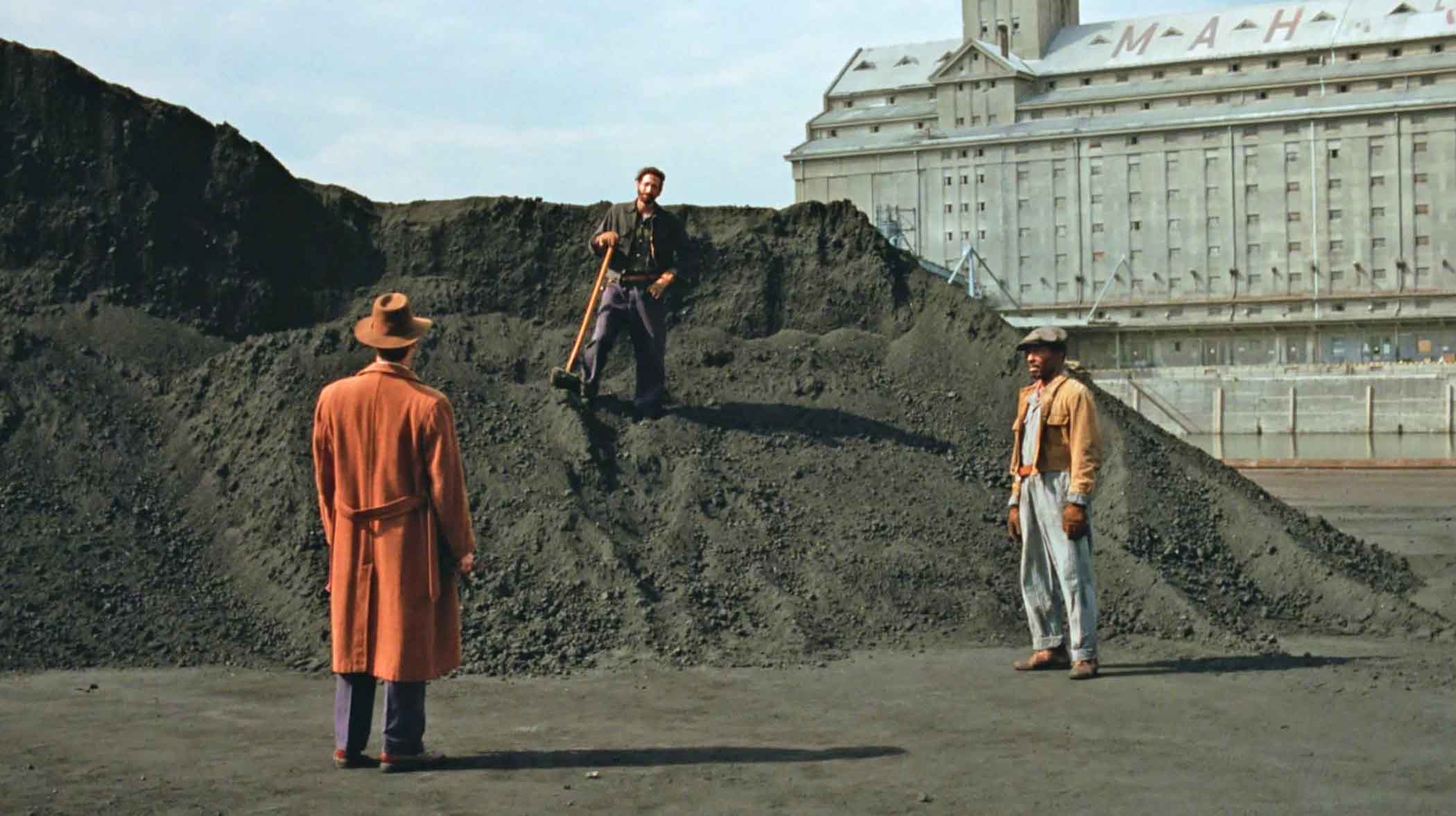
You could say that Brady Corbet’s sprawling, top-heavy, high-minded film The Brutalist is an ambitious, personal, all-American epic like they simply don’t make anymore — which may or may not sound like good news to you. While it’s not quite like other movies, as they’re made now or used to be in a fabled American past, the movie does go big with Gen Alpha retro-ness. Corbet delivers his postwar period piece in a conscientiously nostalgic package, shooting on VistaVision (the first American film to use the wide-screen format since Marlon Brando’s One-Eyed Jacks, in 1961), and adding an overture and an intermission (for a total of over 3.5 hours), all of it a self-conscious nod to the grandiosity of postwar Hollywood megamovies but also pretty grandiose in itself. The sheer size and torque of the thing is intimidating, and award-reaping, already winning a Best Director trophy at Venice and best film from the New York Film Critics Circle. You want to salute it, even while you wonder what all the tzimmes is about.
Longer than either Lawrence of Arabia or The Godfather Part II, Corbet’s film entwines two milieus — modernist architecture and the postwar refugee-in-America experience — and it seems driven by obsessiveness rather than any mere commercial concern, which can by itself be a seductive auteurist mode. But the film itself feels less obsessive than uncertain, and not even very epic, made rather stunningly on a reported budget of less than $10 million. (Length need not be expensive; Filipino auteur Lav Diaz routinely makes four- and five-hour films for less than you’d pay for a used car.) Film history is littered with rangy follies that test audiences’ patience, bladders, and capacity for leg cramps, and if anything, we’ve learned that extreme length demands either formal-conceptual daring or Eiffel Tower–level narrative engineering. What you realize somewhere in its third hour is that Corbet’s burly movie is trundling along with no great dose of either.
Still, there’s so much there there. Where did this reckless ox come from? I thought Corbet’s first two movies, Childhood of a Leader (2015) and Vox Lux (2018), were both, if not underrated (critics hearted them), then certainly underseen, underappreciated, and seethingly smart. Taking all three together, you can hardly slight the man for a deficit of ambition or inventiveness, and The Brutalist is at least impressive for the respect offered to its subject matter. We begin in a subjective blur, eventually revealed to be Ellis Island in 1947, as Laszlo Toth (Adrien Brody), an esteemed Jewish architect and Holocaust survivor, arrives in America penniless and is taken in by his cousin Attila (Alessandro Nivola), who runs a Philadelphia furniture store. (Corbet uses real vintage Pennsylvania promo films as frequent interpolations going forward, carving out the time and place.) Toth’s wife and niece, we learn, are stuck in Europe, thanks to immigration bureaucracy.
A diverting trip to an Italian marble quarry comes unexpectedly from the kitchen like a delicious appetizer we didn’t order.
Toth’s life in America begins its roller-coaster undulations with a plum commission, to build a cutting-edge custom library for an out-of-town millionaire (Guy Pearce), who, when he returns shy of its completion, throws an irate fit and kicks Toth out without payment. Soon, years pass, and Toth is living in a shelter — Corbet piles arbitrary incident and work montages as though he’s writing a fat ’70s Arthur Hailey novel — and smoking scag while working as a bridge builder. (This worries his buddy, played by Isaach de Bankolé, but Corbet shrugs it off.)
You think you’re seeing the set-up to a classic rise-and-fall-and-rise immigrant song, but Corbet has other plans: Pearce’s smooth-talking Brahmin shows up out of the blue with a renewed love for his library and a lavish awe for Toth’s reputation, eventually offering him an immense commission for an arts center on a hill in Doylestown. Still doing dope but now a rich man’s uneasy lapdog, Toth wrangles with the town’s provincial locals (wary of this brilliant Jew, they want a chapel incorporated into the project) and builds his model, amid floods of lofty rhetoric that wouldn’t sound out of place in The Fountainhead and discussions about retrieving his wife via the Displaced Persons Act. Intimations of tension between Jew and gentile, artiste and patron, modernism and tradition are hinted at, though often subsumed by bureaucratic negotiations so free of progression and meaning they might make a real architect break out in hives. Then, with the story gears just beginning to turn, the intermission.
Brody’s characteristic intensity can’t win the war by itself.
Dare to expect the unsettled issues of Toth’s marriage, his apparent drug addiction, his money problems, and his reawakening career to all be thrashed out in the film’s second half, but Corbet lets much of it vanish off-screen. (Being a junkie, often high in public, is not the dramatic bother you’d think it would be; years go by without reference to it.) His wife, Erzsébet (Felicity Jones), does finally arrive, in a wheelchair (years of famine plagued her with osteoporosis), and work on the Doylestown project surges forward, then is canceled, and then, years later, starts up again. (A diverting trip to an Italian marble quarry comes unexpectedly from the kitchen like a delicious appetizer we didn’t order.) Unsurprisingly, Toth is confounded by small thinking, tight budgets, and anti-Semitism. Pearce and his wealthy circle are, as we saw coming, simply repellant, condescending bigots. The building itself hardly inspires our emotional involvement. Montages accumulate. (How else do you show architectural design stages and construction?) Toth and Erzsébet seem to hate each other at times, but when the pain in her legs gets bad, he cooks her some dope.
The textures of The Brutalist are sometimes arresting, and Corbet’s way of disappearing things we thought were crucial and having the characters behave in startling ways can leave you, in the passing hours, feeling like you’ve been pickpocketed. Maybe that was the intention — like Paul Thomas Anderson, but in a very different register, Corbet enjoys eyeballing an ordinary narrative toggle and then doing the opposite. (The crowning Wtf moment might be an out-of-nowhere sexual assault that can only be read as a getting-fucked-by-capitalism metaphor.) The potential downside to this sensibility is that the story doesn’t aggregate so much as pile up as a series of strange happenings.
Brody’s characteristic intensity can’t win the war by itself. Some critics have noted the King Vidor inflection points, from both the Golden Age auteur’s studio-butchered An American Romance (1944), an immigrant-rising saga, and of course The Fountainhead (1949), as maniacally architecture-focused as any movie made anywhere. The focus on Jewish immigrants and on the poisonous amorality of the American upper crust in Corbet’s film, however meanderingly they’re mustered, certainly might’ve been intended as a corrective to the wild Anglo-Übermensch-ness of Vidor’s infamous Ayn Rand adaptation. Maybe I’d be more fascinated by that indexing if Corbet had attempted something like the ur-modernist style Vidor used in the latter film.
But even the principles and looming physicality of Brutalist architecture — raw materials, undecorative practicality — are minor factors in Corbet’s concept of Toth’s drama. Eventually, The Brutalist seemed to me to be a film without a plan, losing track of its own ideas, as though it were a biopic and therefore beholden only to a set of more or less random historical events. It has, in fact, been a long time since the reviews of a film have baffled me so thoroughly; the rush of effusion for the film, throwing around “epic” and “shattering” hyperboles like confetti at a homecoming, describes a movie I didn’t see, one in which the distended, dehydrated-mule-in-the-desert story thumps with propulsion and intent, and in which the often arch dialogue rings with eloquence and power. There may be no telling which movie you’ll see, once you’ve signed up. ❖
Michael Atkinson has been writing for the Village Voice since 1994. His latest book is the new edition of his BFI tract on David Lynch’s Blue Velvet.


