





Out the window beyond Raven Halfmoon’s “Sun Twins” (2023), the blackened nubbins of long-decomposed dock pilings form an uneven grid poking up from the ash-hued eddies of the Hudson River. It’s the press preview of the Whitney Biennial, in our annus horribilis of 2026, and the spitting rain and iron pall outside match the mood within. Halfmoon’s imposing sculpture of two hulking figures emanates a sense of deep time through the contrast of a millennia-old stoneware technique of the people of the Caddo Nation with a drippy, New York School-ish glaze, the gold-copper-rust palette aimed at conjuring the rise and fall of the sun.
Nearby, dance choreographer Jonathan González’s three 2026 photos of the Whitney’s exterior terraces, shot from a low angle that precludes seeing anyone in the spaces, have titles that include the terms “magic hour” and “golden time,” which the wall label informs us refer to the “warm, diffuse light around sunset and the time of day that draws the largest number of television viewers.” Enlarged from grainy Super 8 film, these stills feature skies like bloody smog, and the depopulated planes surrounded by vertiginously angled railings might be the prows of ghost ships in some post-apocalypse streaming series.

Because, indeed, we are in bleak times — while I was typing notes into my phone at the preview, autocorrect helpfully transmuted a typo into “Blake times,” which, lord knows, captures the escalating tides of misinformation and air-borne pollutants from our own age’s “dark Satanic mills” — and it is the Whitney’s thankless every-other-year job to capture the zeitgeist of even the ugliest epochs on just two capacious floors. Organized by Marcela Guerrero and Drew Sawyer, with assistance from other Whitney curators, this 82nd edition of the Biennial feels a bit like doomscrolling current events, only to be interrupted by some droll meme or flash of seductive color. And does it matter that Samia Halaby’s engaging “kinetic paintings” were created on a Commodore Amiga 1000 computer 40 years ago? Perhaps not, because some might remember that around that time, President Ronald Reagan joshed into an open microphone, “My fellow Americans, I’m pleased to tell you today that I’ve signed legislation that will outlaw Russia forever. We begin bombing in five minutes.” This off-the-record quip in August of that ominous year of 1984 had his staff chortling, at least until the recording was leaked to the public. Even still, that era’s “Teflon” POTUS rode out intimations of nuclear Armageddon just over the horizon to win re-election that November.
The ’80s saw the flowering of WYSIWYG computer graphics, and Halaby (born in Palestine in 1936 and now based in NYC) was an early adopter of updating painting by moving pixels with a mouse. In such animated videos as “Lines 3” (1986), “Land” (1988), and “Flower” (1988), she deploys vibrantly hued, juddering geometries along with video-game-style chirps and beeps to capture a transformational moment that, chockablock with compositional heft and chromatic verve, rises up today like joyous bones from the tar pit of miasmic “reality” proffered in our own century’s CGI-palooza.
There is the always-reliable Pat Oleszko to give one hope — or at least, a belief in absurdist perseverance.
For sheer wit, you could do worse than David L. Johnson’s “Rule” (2024–ongoing), which twists the old “Property is theft!” adage by, as the label informs us, “ongoing removal of codes-of-conduct signs from privately owned public spaces (POPS). POPS emerged in New York in 1961, following a zoning resolution that permitted private developers to construct taller buildings in exchange for creating nearby park-like spaces for public use. The private owners who control these spaces often set rules that are much more restrictive than those governing city parks and other public places. Under city planning regulations, POPS rules must be visibly posted to be enforceable.” A viewer from NYC won’t be surprised, therefore, to see a scratched and scuffed “NOTICE” that was once displayed at Zuccotti Park — ground zero for the Occupy Wall Street protests of 2011 — that warns visitors, “FOR THE SAFETY AND ENJOYMENT OF EVERYONE … CAMPING AND/OR THE ERECTION OF TENTS OR OTHER STRUCTURES … LYING DOWN ON THE GROUND, OR LYING DOWN ON THE PUBLIC SITTING AREAS OR WALKWAYS WHICH UNREASONABLY INTERFERES WITH THE USE OF THE PUBLIC SITTING AREAS OR WALKWAYS BY OTHERS,” plus biking, rollerblading, and skateboarding, etc., are all prohibited. One wonders if the steel plaque has since been replaced, as POPS rules have to be seen to be obeyed. These liberated signs are by turns shiny, cracked, dented, and/or bent, and the (often caps-locked) exhortations traverse that realm where public gathering and human freedom abut legal strictures. And while most of us can get behind “NO DEFECATING” in a public space, we’re not sure what “passive recreation” — another phrase that pops up on many of the plates — might be if one can’t nod off on a bench, since most of the notices prohibit sleeping. Johnson (b. 1993) highlights the signs of our times, reminders that most of us exist, literally, within the shadows cast by the dwellings of those whom zoning exceptions allow to live ever closer to the sun.

Aziz Hazara was born in Afghanistan in 1992, now lives in Germany, and is included in this quintessential American survey because, as he states in the catalog, “I started thinking around the idea of plausible deniability as a strategy in most warfare and conflict zones — how states produce it, and how ambiguity plays into the representation of an event.” Hazara’s eerie photos are captured from the circuit boards of night vision goggles, which became a cheap commodity during America’s “longest war,” as the Afghan conflict has become known. That 20-year projection of United States power across Afghanistan’s desert environs reads here as luminous green blurs shot through with streaks of color, like the waning lights of an outlasted empire.
Michelle Lopez (b. 1970) has long worked as a sculptor, a familiarity with 3-D volume that lends a frenetic gravitas to her partially AI-generated video animation “Pandemonium” (2017–25). Viewers look up at a large circular screen as, in one instance, bricks and debris swirl like an angry hive of wasps caught in a Wizard of Oz-type tornado, or, in another, newspapers and other printed detritus spin in a stately vortex, twirling with balletic grace and recalling Antonioni’s film Zabriske Point, where consumer detritus such as a Wonder Bread loaf, a Reddi Whip can, and a blasted TV set seemingly dance amid the slow-motion explosion of a luxury desert home. As in that 1970 movie, Lopez has viscerally captured the angst of recent years while intimating that the ride ahead will be no less turbulent (although she does leaven in some lovely scenes of what looks to be massed handheld lights at a concert, which flicker like a firefly mirror ball).
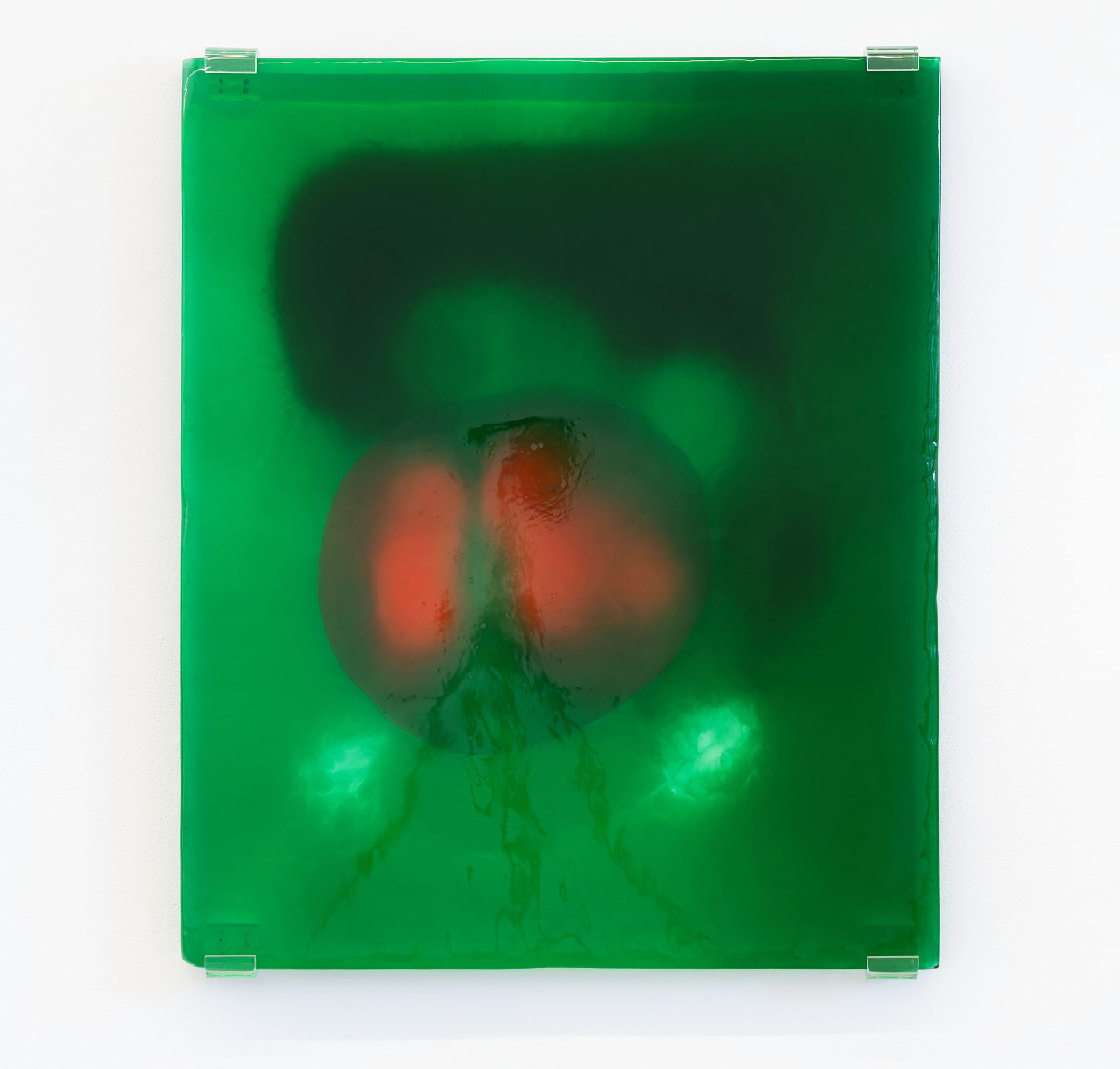
Nour Mobarak (born in Cairo, Egypt, in 1985, and now living in Washington state) uses her own body as the basis for her compellingly beautiful resin pieces. In “Reproductive Logistics 4” (2026), the artist mixed dehydrated blood, breast milk, semen, and other organic materials with liquid pigments into a resin cast of her pregnant body. Sumptuous reds and blues flow around and through the bulbous, glassy torso, which blurrily reflects and inverts the viewer and the entire surrounding gallery space, a reminder that we’re all part of the environment the child will soon be tumbling into. In an interview, Mobarak remarks that she sometimes employs “mycelium — the root structure of the mushroom” in her pieces, noting that she’s drawn to it because it “creates by breaking down the substrate that it’s eating. I’m enlivened by it as a material, because it creates by decomposing.” And certainly there is a grotesque quality to her “Recto Verso” pieces, in which swathes of emerald, magenta, cobalt, and other fierce hues spread like efflorescence stains or lichen through the clear resin. In this group of works, each piece features paired blobs floating in the luscious grounds, a vibrant blend of forcefulness and exuberance. In the catalog, Mobarak states, “I was reading about Palestine and the United States and feeling like any art I could make was almost futile. I was so disgusted and disturbed that all I could think to do was to just sit in some brown, wet clay and moon the audience.” Similar frustration in the late ’60s helped birth Philip Guston’s forever-fresh cartoon paintings: “I was feeling split, schizophrenic. The war, what was happening in America, the brutality of the world. What kind of a man am I, sitting at home, reading magazines, going into a frustrated fury about everything — and then going into my studio to adjust a red to a blue.” Or consider Jack Whitten, fulminating over the abuse of Black Americans as he was growing up and then maturing as an artist of luminously evocative abstraction in the latter part of the last century: “How can anyone justify staying in the studio when your people are dying? … What is the artist supposed to do?” Mobarak, like such predecessors, has answered that question by creating art that grabs the viewer through captivating forms — comparable to Guston’s hooded goons and Whitten’s by turns elegant and ferocious oscillations — to engender a matrix of visual intensity that can open viewers to both the beauty and the rage.
Comprising works by 56 artists, duos, and collectives, there is much to see and contemplate at this Biennial, mired as it is — as all of us are — in Year Two of the Rerun President’s bifurcated reign. As folks in Gaza have long known, and citizens of Ukraine are being continually reminded, and Iranians — whether gunned down by their own repressive rulers or blasted by U.S. and Israeli bombs — have discovered all over again, civilization is a facade that can tilt off balance for years, decades, or even centuries before crashing to rubble with bewildering swiftness. It’s like this bit of dialogue from Papa’s The Sun Also Rises:
“How did you go bankrupt?” Bill asked.
“Two ways,” Mike said. “Gradually and then suddenly.”
Watchwords for a country led in this third millennium by a serial bankrupt.
But lest I put you off from making your biannual trek to the shores of the Hudson (after decades of trudging to that brutalist mecca on the Upper East Side), there is the always-reliable Pat Oleszko to give one hope — or at least, a belief in absurdist perseverance. “I think of myself as basically a sculptor, but my sculpture also sweats,” the artist, who was born in Detroit in 1947 and is well-known for wearing extravagant costumes to create living sculptures, remarks in the catalog. In the black and white video “Footsi,” from 1979, tiny shoes at the ends of two fingers extending from a black dress-like half-glove on one hand traipse across the artist’s own naked body, gallivant along a thick branch (harassed by grasping, tiny white gloves on the fingers of another hand), dance in front of a portable radio, kick a Sunkist can into a hole (which harbors digits adorned with gag-store vampire teeth that almost pull down the intrepid protagonist), and in general cavort through the cityscape. The scale is then flipped in Oleszko’s gargantuan, room-filling “Blowhard.” With its bulging cheeks, goggling eyes, jester’s cap, and puffing lips blowing into a horn disgorging tongue-like flames, this inflatable sculpture, commissioned in 1995 for the World Trade Center Plaza, seems a missed warning from the go-go ’90s, when we countenanced blowhard clowns because they were at least entertaining. When it debuted, three decades ago, the piece was nearly blown away by high winds.

That WTC is no longer with us, and, as this dogged show conveys, neither have we the dubious comfort we once took in laughing at blowhards making fools of themselves. ❖
Whitney Biennial
Whitney Museum, 99 Gansevoort Street
March 8 – August 23


