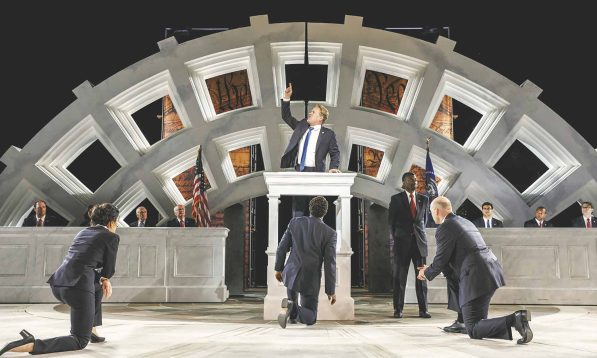
How wise or moral, though, was Andy Warhol, the antihero (Andy-hero?) of Anne Bogart's Culture of Desire? We learn Bogart's answer fast: Her Andy (a woman, Kelly Maurer) is shot, whereupon a Vreelandish muse (a man in drag) appears, reciting the opening of The Divine Comedy. Dante-Andy follows this astringent Virgil into shopping hell, a metal rack of identical cardboard cartons which, taken down, reveal bits of an ingenious backdrop (set by Neil Patel) that can be lit (by the incisive Mimi Jordan Sherin) to suggest inferno, purgatory, or paradise as needed.
Bogart's Andy has a rough time in hell, and things don't improve much when he reaches celebrity paradise. In fact, his whole experience is seen as purgatory--the agony of a queer, sensitive mama's boy in blue-collar Pittsburgh. Bogart's Andy is in a perpetual state of either swoon or desperation; his bland pronouncements about the joy of consumerized life are made to sound alternately like moans of despair or snide satiric gibes. The little interruptions during which the cast marches through in various stages of shopaholic frenzy muddle matters, seeming to finger Warhol as the cause of the consumer society that Bogart alternately abhors and relishes.
Culture of Desire
By Anne Bogart and the SITI Company
New Yor
Vague as sociology, this is way off the mark as biography. Even I, who only met Warhol a few times and largely loathe the effect of his work, can say that he wasn't the whimpering basket case Bogart depicts. On the contrary, his complacent assurance, even about his own insecurities, was the infuriating part. To ascribe his love of consumerism to his personal unhappiness is also to underrate his artistic intelligence: His ideas are pernicious because they're partly true.
Unlike Bogart, Warhol succeeded in merging his love and his distaste for mass-manufactured objects. The soup can was beautiful because it was beautiful; that it was also hideously banal just added ironic luster to the beauty. Far from being disappointed in human love, he was probably happier gazing at his love objects than interacting with them. He neither empathized with the freaks nor sang the blues; he had attained a state of consumerist satori. What was, was.
This condition, static by nature, seems to infuriate Bogart, who as a theater artist inevitably sees life as action first and last. She doesn't link Warhol's passivity to the analogous stillnesses of Robert Wilson, hero of her much friendlier Bob last spring, and she doesn't find reinforcement for it in the nature or history of American consumerism, though both blankness and acquisitiveness were noted by observers long before Warhol. His genius lay in knowing how to transform his vision of marketing into a system of marketable objects. His parallels aren't with artists but with the likes of Henry Ford, Howard Johnson, and Ray Kroc. Visually charming as much of Bogart's piece is--especially a ballet of people in supermarket carts--it doesn't come near either Warhol or the big questions his work raises. The uneven ensemble is only intermittent help, though Maurer's Andy is as touching as it is un-Andy-ish.
Find everything you're looking for in your city
Find the best happy hour deals in your city
Get today's exclusive deals at savings of anywhere from 50-90%
Check out the hottest list of places and things to do around your city