Top

arts

Stories


Sellout, Sucker, Seducer

There's nothing like a dose of dish to medicate the anthrax blues, and Target Margin Theater serves up a highly effective prescription with delightful side effects in its production of Beaumarchais's The Crazy Day, or The Marriage of Figaro. The play, as everyone knows, is just about perfect—infinitely adaptable and virtually indestructible (Odön von Horváth's Figaro Gets a Divorce notwithstanding). Figaro remains the happiest coupling in the dramatic canon of farce's pretty pirouettes and sharper jabs at social class. Its formal loveliness alone might have earned the play its theatrical laurels and many imitators.

Details

The Marriage of Figaro
By Beaumarchais
The Ohio Theater
66 Wooster Street
212-358-3657

Related Content

More About

Like this Story?

Sign up for the Offstage Voice Newsletter: (Up to multiple times a week) Information on theater and the performing arts.

Privacy Policy

But its celebrated premiere didn't hurt, either. Louis "Sunset" XVI feared that Figaro's subversive fun might give somebody bright ideas about where the aristocracy could shove its droit du seigneur, along with its other droits. "For this play not to be a danger, the Bastille would have to be torn down first!" Sunset shrieked. Louis XVI denied the play a public hearing for three years before caving in to Marie Antoinette, who loved it. When Beaumarchais finally did have his crazy day, on April 27, 1784, everyone who was anyone camped out in the actors' dressing rooms, picnicked in the auditorium, or crammed into the aisles to see what Louis's fuss was all about.

Even if its original audience didn't "get it" in the world-historical sense, Figaro was a smash. Target Margin's candy perfume restaging deserves good audiences and a long run, too, so go see it. You could use a laugh, for godsakes. More than that, you need some perspective. Somewhere between a nostalgia cocktail and a shot of vertigo, seeing the French Revolution in previews reveals at least two things: History ain't over till it's over; and our current—I'll say it—revolution is just as much about class as theirs was (even if theirs was a lot more amusing in its theatrical versions). By a happy accident reminiscent of one of the play's plot turns or its prescient premiere, Figaro is the ticket of the moment, zeitgeist-wise. I took one look at Target Margin's iridescent, reflective electric-blue set and thought, "That reminds me of life before the revolution." I meant this one.

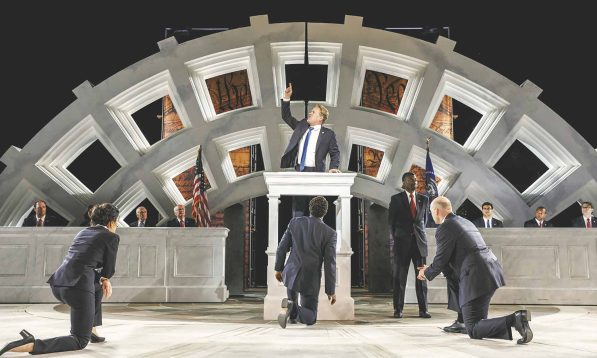
With a fake-wood-paneled tribute to the '70s, then, Target Margin takes a gymnastic leap at Figaro's fun and sticks it expertly. David Herskovits, the company's artistic director, has a knack for haute artificiality, and he has a lot of fun here with wig stock, hot pink hose, beards, and bustiers. His actors negotiate Emily T. Phillips's deconstructible Pac-Man maze of a set through an intricate series of skips, dives, and turns. Paul Vincent Black's Count is a beribboned autocratic nincompoop who stumbles over the twists in the plot 15 steps behind everyone else. His Head-of-Householdness constantly whirls about to find someone, or no one, sneaking up from behind, convinced (correctly) that everyone is out to get him. When he pouts to Figaro, "You used to tell me everything," or bellows at a meddlesome servant, "Always this fucking page!" (translation by Target Margin) you almost feel sorry for the silly sonofabitch: Everybody else gets to have all the fun.

Meanwhile Figaro, as played by Robert Alexander Owens, is not so much the Count's crafty opposite as his serpentine double. The two sport matching band-aids (the Count's plastered above-brow, Figaro's below) and share the need to suck on something sweet (an umbrella drink and licorice rope, respectively). They circle each other warily and wantonly, as much for each other's benefit as for "Suzie-Suzanne," who, as played by Rinne Groff, is smarter than both of them put together and runs the plot from start to finish with the efficiency of an Equity stage manager. This Figaro's a sellout, a striver, a sucker, and a seducer all at once, and the production's success owes much to Owens's versatility. He is particularly mesmerizing in Figaro's famous Act 4 monologue, whining his way through its bratty beginning, then rising to its still dizzying satirical heights before finally crawling back down to rejoin the plotters and the plot.

Yet long after the actors take their bows and you wander out into the particulate air, Figaro's remark that "only small minds are afraid of trivial writings" continues to echo. The Roundabout is scared of staging Sondheim's Assassins; the Times apologizes, considering "the gravity of the news," for distributing its subversive mag, Men's Fashions of the Times; and even the most naive among us no longer believe we're getting the whole story from the government, the media, or anyone else. In revolutionary times like these, it's comforting to know that somewhere in New York a guy who claims "Anonymous" as his patron saint, puts the Good for Nothing Journal on his résumé, and calls himself the Barber of Seville is still speaking truth to power.


Most Popular Stories

for free stuff, theater info & more!

Browse Voice Nation
  • Voice Places

    Voice Places

    Discover restaurants, nightlife, travel, shopping...

  • VOICE Daily Deals

    VOICE Daily Deals

    Get 50 to 90% off every day on restaurants, movies, massages...

  • Best Of

    Best Of...

    More than 10,000 of the BEST things to eat, drink, and experience

  • My Voice Nation

    My Voice Nation

    Join the Village Voice community and get exclusive deals and info

  • Happy Hour

    Happy Hour

    Your local Happy Hour guide at your fingertips

or

Log in or Sign up

Social Connect:

Use your favorite account to access My Voice Nation.


Use your My Voice Nation account to log in:


Forgot password?
or

Sign Up or Log in

Social Connect:

Sign up for My Voice Nation with your preferred network.


Sign up for a My Voice Nation account:


Privacy policy