Top

arts

Stories


Broadway's Political Past

Caine plays optical-illusion games; Of Thee I Sing remains bouncy and sharp

Plays that confront political topics openly have always been rarer on Broadway than anywhere else in the world's theater. In mainstream American entertainment, politics has tended to consist of either a quietly encoded message or an easily absorbed moderate-liberal platitude. So it was intriguing that the Broadway season came to a close with revivals of two old pieces that deal with political matters more or less openly: the 1931 musical satire Of Thee I Sing, and Herman Wouk's 1950 courtroom drama The Caine Mutiny Court-Martial. The former, produced as a staged concert in City Center's Encores! series, was received with cheers but ran only its scheduled single weekend; the latter, a commercial venture, got glum reviews and closed quickly.

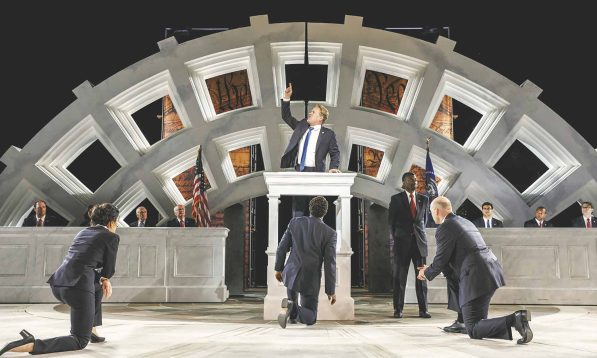
Man in chair: Ivanek and Schwimmer
photo: Scott Landis
Man in chair: Ivanek and Schwimmer

Details

The Caine Mutiny Court-Martial
By Herman Wouk
Schoenfeld Theatre
(Closed)

Of Thee I Sing
By George S. Kaufman, Morrie Ryskind, and George & Ira Gershwin
City Center Encores!
(Closed)

Related Content

More About

Like this Story?

Sign up for the Offstage Voice Newsletter: (Up to multiple times a week) Information on theater and the performing arts.

Privacy Policy

The critical call in both cases was the right one for a change. Of Thee I Sing, staged with bouncy good humor by John Rando and featuring some spiffy choreography by Randy Skinner, was a lot of fun, dressed up with solid musical execution and several first-rate performances. The Caine Mutinyfelt wordy and vague. Jerry Zaks's direction was surprisingly awkward, with only a few bright spots in the generally lackluster acting. Luster was lacked most of all by TV star David Schwimmer, whom the producers had presumably been counting on to sell tickets, as the tough-minded defense attorney. Julia Roberts would have done better.

Wouk's play is one of those optical-illusion games that litter the 1950s Broadway repertoire. From one angle, it's an anti-authoritarian study of good guys getting together to bring down a tyrant, the crazy, cowardly Captain Queeg (a credible but oddly muted performance by Željko Ivanek). Looked at the other way, it's a critique of smug liberal condescension, manipulating the innocent to bring down one of those hard-driving thuggish guys who get the job done. Toyed with throughout, the latter view doesn't get fully articulated till the epilogue, where it seems to contradict everything that's gone before. Heavily trimmed with fake-fur Freudianism, the play's ostensible discussion of power and its potential abuse is really no more than a choice of coffee or tea. Like authoritarians or hate them, the script will play up to your desires. Zaks didn't help matters by seemingly encouraging his actors to indicate their characters' goodness or badness; amid the underscoring, two brief comic turns, by Paul David Story and Tom Nelis, handily stole the show.

Comedy was uppermost in Of Thee I Sing, too, but here its precedence was intentional. Unlike Wouk's market-based catering to both sides, the cynicism of book writers George S. Kaufman and Morrie Ryskind is clean, overt, and all-encompassing. Nothing very deep gets said, but since the show's chief target is the way our power brokers manipulate the sentimental public, depth isn't the point. Fueled by the Gershwins' bubbly, witty score, the acid story of how pea-brained John P. Wintergreen wins the presidency on a platform of Love, gets himself into an international mess, and has to be rescued by his even more vacuous vice president, Throttlebottom, made for several big laughs and a fairly continuous diet of smiles throughout, especially whenever Jefferson Mays, making his musical-theater debut as Throttlebottom, held the stage with a ninny act that evoked memories of the genre's master comedians. Jenny Power was vocally and visually seductive as the official fiancée Wintergreen rejects, while Jeffrey Denman and Mara Davi offered some breathtaking footwork as tap-dancing White House aides. In a sense, what keeps Of Thee I Singsharp is its lack of political substance: Today, as in 1931, its notion that American politics is wholly a matter of appearances has an appalling timeliness.


Most Popular Stories

for free stuff, theater info & more!

Browse Voice Nation
  • Voice Places

    Voice Places

    Discover restaurants, nightlife, travel, shopping...

  • VOICE Daily Deals

    VOICE Daily Deals

    Get 50 to 90% off every day on restaurants, movies, massages...

  • Best Of

    Best Of...

    More than 10,000 of the BEST things to eat, drink, and experience

  • My Voice Nation

    My Voice Nation

    Join the Village Voice community and get exclusive deals and info

  • Happy Hour

    Happy Hour

    Your local Happy Hour guide at your fingertips

or

Log in or Sign up

Social Connect:

Use your favorite account to access My Voice Nation.


Use your My Voice Nation account to log in:


Forgot password?
or

Sign Up or Log in

Social Connect:

Sign up for My Voice Nation with your preferred network.


Sign up for a My Voice Nation account:


Privacy policy