Elia Suleimans third feature, The Time That Remains, is bookended by scenes of a panicked Israeli taxi driver lost somewhere in his own countryand that of the Arab passenger who sits, silent and shrouded in shadow, in the backseat. It will surprise no one who has seen Suleimans previous absurdist musings on Israels tortured relationship with its Arab minorities, Chronicle of a Disappearance (1997) and Divine Intervention (2002), that Suleiman himself plays the passenger, a mournfully droll observer cut from the cloth of Jacques Tati or Buster Keaton. Or that between the bookends is a funny, achingly sad, and discreetly bitter bricolage of embellished autobiography that evolves into a counter-history of the State of Israel, from 1948 onward. In its oblique, intensely personal way, The Time That Remains inserts an acidic voice into the fierce debates currently being waged in the country about who qualifies as Israeli.
IFC Films
Unlikely Zionists
IFC FIlms
The filmmaker
Details
Related Content
More About
Speaking by phone from Paris, where he now lives after a long stint in New York, the 50-year-old Arab filmmaker, who has taught film in Switzerland and at Bir Zeit University in the West Bank, says that the moviean epic by his standards, with a crew of 60 and a budget of just under $4.5 million of mostly French moneywas primarily shot in and around his family home in the Galilee town of Nazareth, where he spent his middle-class boyhood. I redid the whole neighborhood, says Suleiman, and indeed, in his hands, Nazareth, as he says, looks invitingly like Palermo.
The Time That Remains is based on diaries and letters written by Suleimans parents, an activist and a teacher to whom the film is dedicated, as well as memories (his own and others) of life under Israeli rule, filtered through the directors irreverent imagination. Though Nazareth lies not in occupied territory but in Israel proper, Suleiman identifies as a Palestinian, and this magpie collector of the telling incident or image (he always carries a notebook) can offer a real-life source for nearly every scene hes re-created. A friend of his really did leave his house to drop garbage into a trash can across the street, only to find his every move tracked by the gun sight of a tank. A scene in Ramallah, in which a feisty young Arab mother is told by an Israeli patrolman to go home and yells back, No, you go home, has its roots in a story told to Suleiman by a Jewish former soldier who rescued a Lebanese boy on a bike from a similar threat. That soldieran Italian Jewleft the army, says Suleiman. He became an interpreter for the Taviani brothers.
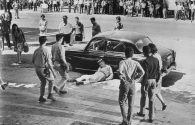
Much of The Time That Remains turns on the creeping immobility that afflicts Suleimans father, Fuad (played deadpan by Saleh Bakri, the stunning young Arab actor who sang Chet Baker to a charmed Jewish airport employee in the Israeli movie The Bands Visit), after Israel declared statehood in 1948. Suleimans own schizoid identity as an Israeli Arab is foreshadowed in a bitterly funny scene in a Nazareth elementary school whose pupils roar out a gung-ho Zionist song for a beaming Jewish visitor. My older brother played accordion in this band, he says. Me, I was a refusenik. When my turn came, I said, Theres no fuckin way. I was a little shithead, already with the political principles.
If Suleiman is a lifelong rebel, hes an exquisitely conflicted one. Its hard for me to be a member of anything, he says. Ambivalence toward Israel, the West, and even his fellow Arabs is the meat and drink of all his films, which are strewn with seemingly random alienation gagsfragments of incongruous Western pop culture or excoriating riffs on Arab identification with the Jewish masters they resent.
Divided loyalty is the central dilemma of the Israeli Arab, which is why Suleiman is physically present but politically and culturally disenfranchised in The Time That Remains (which is subtitled Chronicle of a Present Absentee) and in life. Every film he has made seeks to reinstate the dispossessed into Israeli historyexactly, he points out, as some revisionist Jewish-Israeli historians have been doing in recent years. Late in The Time That Remains, Suleiman appears to literally vault over the security wall that divides Israel from the territories.
Yet Suleiman considers himself primarily an aesthete, not a political filmmaker. He agrees that his films always have a political dimension, but when I suggest that the Israeli obsession with security on which he pours such scorn is not unfounded, theres a long pause. If youre asking me to discuss the portrayal in the film, thats one thing, he says. This is not at all the way I approach the cinematic.
The Time That Remains certainly adds up to a political movie, and an angry one at that. Yet for all his mixed feelings, Suleiman has close Jewish-Israeli friends and casts Israeli actors in his films. His first film was made with Israeli money, though he describes the funding process as a nightmarish battle that he won only with the help of a Tel Aviv attorney. I was the first one to fight through the system on the basis that we pay taxes in the same way as Jewish Israelis, he says, but we dont get the culture in the same way. He adds with some pride, The Time That Remains played to very positive notices in Israel, except for one Knesset member who wanted a special session to declare me an enemy of the State.
For all his rancor, Suleimans delight in the mordant irony never deserts him. Wow! he says when I tell him that I was born on a kibbutz near Nazareth in 1948, the year in which his movie begins and Israel was born. You should put that in the article.