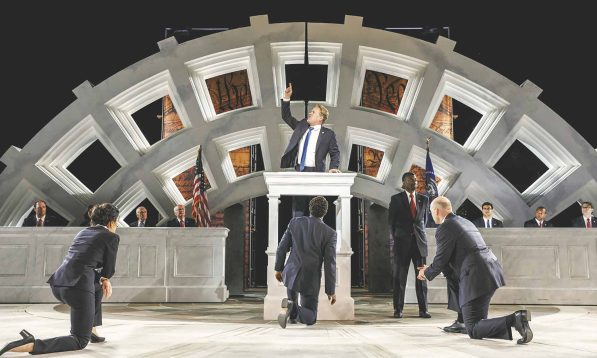
Attention, downtown theater troupes: If you propose to employ a methodology that I find totally unreasonable, I recommend following the plan adopted by Elevator Repair Service in its latest offering, Gatz (Public Theater). First, choose material that consistently holds my attention: ERS has chosen F. Scott Fitzgeralds 1925 novel, The Great Gatsby, every sentence of which is spoken onstage in Gatz, and every sentence of which is a pleasure to hear. (Gertrude Stein said that Fitzgerald was the only writer of his generation who wrote naturally in sentences.)
Second, be sure to make the untenable metaphor in which you encase your material sufficiently audience-friendly for me to find it at least partly viable. ERSs idea, neither an adaptation of Gatsby nor, as some have said, a dramatization of the act of reading it, sometimes suggests a running visual commentary. The troupe transmits Fitzgeralds text through the image of an ordinary office guy (Scott Shepherd), who, when his desktop computer goes down, inexplicably takes up a paperback of Gatsby and starts reading aloud, instead of turning to non-computerized tasks. As he moves further into the books first-person storytelling, his co-workers stop interrupting him with papers to shuffle and instead start spouting the dialogue of the various characters encountered by Fitzgeralds narrator, Nick Carraway.
They never precisely become these characters, any more than the drab office they inhabit (set by Louisa Thompson) becomes Gatsbys cavernous Long Island mansion. To some extent, they maintain office activities, office decorum, and flat-toned office voices even while finding themselves sucked deeper and deeper into Fitzgeralds sordidly glamorous, emotionally messy, morally troubling tale of lavish lives and disastrous loves in Jazz Age America, now so quaintly antique. If they stuck strictly to office behavior, the performance would be a simple put-down, predicated on a tidy cuts-both-ways irony: See how drab and monotonous our drudging workaday lives are; see how campily self-destructive Fitzgeralds people are, with their cartoon-rich lifestyles, their corny romantic notions, and their equally corny anything-goes cynicism. They lose; we lose; lifes so sad.
But thats not exactly the point, because the line between text and action, between Fitzgeralds dryly precise phrases and the casual clutter with which ERS surrounds them, turns out to be an extremely wobbly one. Journalists have imagined seeing various scenarios in Gatz: The readers co-workers pick up interest in the story from hearing him read, or his own growing interest leads him to imagine them as the characters. But nothing that literal occurs onstage, any more than it would in a real office, where any employee who started to read aloud while everyone else was trying to work would certainly get sacked by noon.
Functioning neither as a metaphoric counter-image nor as a literal framework for the action of Fitzgeralds novel, ERSs odd office seems to serve as a dreamlike meeting ground: In this familiar but hazily defined space, the more intense passions of the novels figures can bleed through, erratically, into the humdrum world that todays readers inhabit. We all know this office, though none of us has ever been in one that functioned, or rather dysfunctioned, quite like it. Almost before the employees have slid under the novels spell, Mark Bartons lighting has started using desk lamps and fluorescents to map Fitzgeralds shifting moods. And from the outset, sound designer Ben Williams (who also speaks a few minor roles) has been sitting at a desk downstage right, busying himself with a notebook computer, glaringly unlike the narrators outdated desktop, that mixes business-day ambient sound with effects evoking the era of roadsters and bootleggers.
The result neither comments on Fitzgerald nor dramatizes the experience of reading him. Instead it offers us the option, as it were, of observing how some imaginary office folk might dream they were embodying his book, or of dreaming it along with them by just listening to the words. This gives an exact opposite for the simple act of reading, with its unmediated effect on the readers imagination. At the same time, the staging rebukes the collective experience of theatergoing: Gatzs climaxes are those of prose in a book, not of a stage work; its physical action, rarely literal, is all mediation, comment, distractionan outside world at war with an audiobook. Visually and sensually, the shows peak comes when Tom Buchanan takes Nick to a drunken party at the apartment he keeps for his trysts with Myrtle; the summit of the novels first half, Gatsbys epic party, at which he and Daisy finally reunite, seems dragged-out and muted by comparison.
That doesnt constitute a criticism: ERS wasnt attempting a straightforward adaptation, which would involve finding dramatic equivalents for the narratives high points. Instead, they want us to take the book as book, and simultaneously to accept a theatrical (not necessarily dramatic) experience that theyve mingled with it. Some perception, and much occasional pleasure, comes from the mingling, but little real illumination, and even less deep connection to the novels emotional events.
Find everything you're looking for in your city
Find the best happy hour deals in your city
Get today's exclusive deals at savings of anywhere from 50-90%
Check out the hottest list of places and things to do around your city